
Disclaimer : All efforts have been made to make this image accurate. However Compare Infobase Limited,its directors and employees do not own any responsibility for the correctness or authenticity of the same.
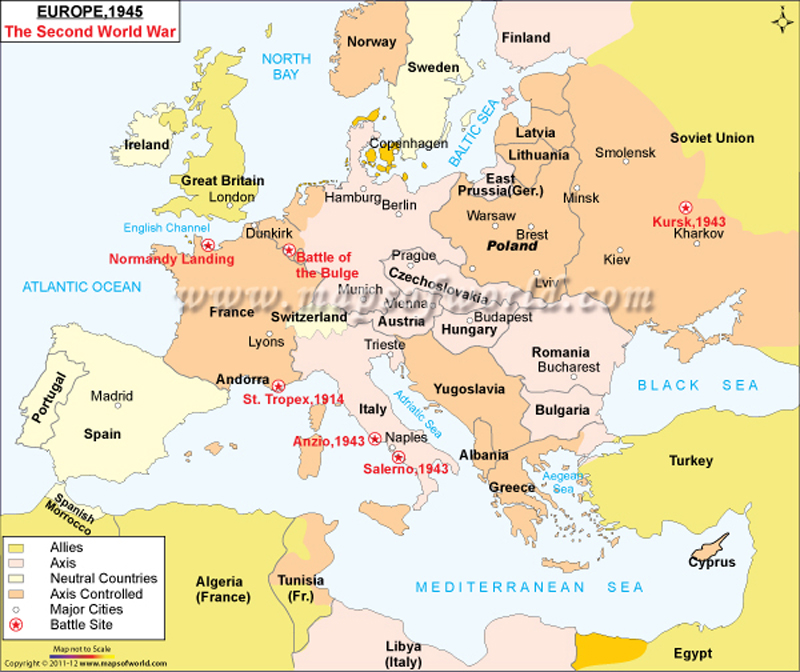
World war II map of Europe at Mapsofworld.com is based on highly researched data. It's about one of the most devastating wars fought globally by several super powers of the time in the last century. Also known as the Second World War, World War II was fought mainly in Europe during the period 1939-1945 between the Allies comprising of Great Britain, France, the Soviet Union, and the United States of America on one side and the three Axis Powers of Germany (Europe) , Japan (Asia) and Italy (Europe) on the other. With over 50,000,000 deaths it was the most devastating conflict in human history and in fact also involved other parts of the world, especially those in Africa, Asia and the Pacific. The World war II Europe Map shows the locations of Europe countries where some of the most crucial battles were fought in the European theater of the War.
German Invasion of Poland : The German invasion of Poland on September 1, 1939 signaled the beginning of the Second World War. It was however, not an isolated event but the culmination of almost three years of increasing international tensions brought about by events such as the Spanish Civil War, the so-called Anschluss or union of Nazi Germany with Austria, and the occupation of Czech Sudetenland by Hitler's forces. Following the German attack on Polish territory, Britain and France declared war on Germany (Europe) two days later. Earlier, in August, Germany and the Soviet Union signed the non-aggression pact popularly called the Ribbentrop Pact and the Soviet Union accompanied the German invasion into Poland (Europe) by attacking the country from the east. By the end of the year Poland was occupied and divided between the two invading nations. The most catastrophic war of our times has therefore already begun. Invasion of France and the Blitzkrieg : After occupying Poland the Russians pushed towards Finland while the Germans attacked Denmark and Norway. The stage was now set for the German invasion of France through the Low Countries comprising of Belgium and the Netherlands on 10 May. The German attack combined fast movements of armored tanks supported by sudden and surprise air raids by the Luftwaffe, which came to be popularly referred as the Blitzkrieg or ‘lightning warfare'. The German strategy was not only a novel military innovation but also proved quite effective against the much larger Allied forces. By the end of May 1940 Belgium and Holland were already occupied and Paris fell two weeks later in the French war . See the map of Europe during World War 2 given above to get an idea about the occupied territories at the time of the wwII war . The Evacuation from Dunkirk : After the fall of France, the Germans advanced towards the defences of the British Expeditionary Forces in French territory and therefore it became imperative to evacuate the troops by the sea. After the Germans crossed the defensive line around Calais, the only port left to carry out any possible evacuation was Dunkirk. Before the Germans could close on into Dunkirk, Hitler, quite surprisingly, ordered a halt in the German advance towards Dunkirk. This sudden turn of event provided a vital opportunity to the Allies to evacuate their troops through the English Channel port. The British made use of every possible vessel of any make and utility to evacuate as many troops as possible. The evacuation from Dunkirk started on may 26,1940 and the next day when the Luftwaffe bombed and damaged the inner harbor, most of the troops had to be ferried out to the open sea in small vessels to board larger ships waiting there. When the evacuation was finally by June 4, 1940, around 200,000 British and 140,000 French and Belgian troops had been saved. This was to become a crucial factor for the Allies in the later stages of the history war . The Battle of Britain : After the armistice with Germany was signed in France and a puppet regime under Marshall Petain installed at Vichy, Hitler set his eyes on Britain and ordered the Luftwaffe to launch a major air offensive on British air and sea defenses and bomb British cities. This was believed to be the key to destroying the superiority of British air defenses and facilitating the proposed amphibious invasion of Britain code-named ‘operation sea-lion'. What followed was a series of ferocious aerial combats between the German Luftwaffe and the British Royal Air Force (RAF), which came to be collectively known as the Battle of Britain, the first battle to be fought completely in the air. The aerial Battle of Britain lasted from July to September 1940 and at the end the RAF, mainly with the help of its radars, extracted a narrow victory. Although the German air raids and bombing of British cities were to continue throughout the veterans' war , their range and intensity diminished subsequently and Germany was forced to indefinitely postpone any plans of invading the British Isles. Invasion of the Soviet Union : Hitler's invasion of the Soviet Union was code-named ‘Operation Barbarossa' and comprised of around 150 divisions totaling 3,000,000 men, 3,000 tanks, 7,000 artillery guns, and 2,5000 aircraft. Operation Barbarossa, which was launched on June 22, 1941, was therefore the most massive and powerful invasion force ever in the history of military war . The Germans took the Red Army by surprise and moved fast and deep into Soviet territory, and by mid-July they had advanced 400 miles and were only 200miles away from the Soviet capital. The German advance somewhat slackened owing to indecisiveness as to which direction they ought to push forth thereafter and in the interim the Russian winter set in. The Germans realized, like Napoleon had realized in his soldiers' war a century and a half earlier, that they were ill-equipped to survive the harsh weather conditions and soon enough the Russian forces who were adept in fighting in such conditions launched quick and decisive counter-attacks. The Eastern Front of the war was therefore mired in inertia and attention was now diverted to the Pacific theatre with the Japanese attack on the American naval base of Pearl Harbor in Hawaii. The Battle of Stalingrad : After their losses at the North African Front and the reversals at the Pacific Front, the Axis forces had to face further counter-attacks, this time from the Soviets in the Eastern Front. The massive Soviet counteroffensive was launched on November 19, 1942, and in the ensuing battle the Russians engaged the Germany war forces to the north and south of Stalingrad while encircling those inside the city. Finally, on January 31, 1943,after what came to be considered as one of the greatest battles of World War II, the German forces totaling around 90,000 men surrendered to the Russians in Stalingrad. The battle of Stalingrad was therefore a turning point in the war in Europe and marked the beginning of the German defeat that was to follow in the ensuing time. The Normandy Landings : After long debates and much vacillations the Allies finally launched their invasion of France which was believed to be crucial in winning back the territorial losses to the Germans and in sealing Hitler's fate in Europe. Codenamed ‘Operation Overlord', some 130,000 Allied forces landed on five beaches in Normandy codenamed Utah, Omaha, Gold, Juno, and Sword. The Allied landings in Normandy were supported by cover fire from 12,000 Allied aircraft that also bombed German defences. The Normandy landings caught the Germans by surprise and they failed to launch any decisive counterattack. The Allies slowly advanced into France and in two weeks time Paris was liberated, thereby lending a major blow to Hitler's loosening morale and prestige. The Normandy Landings were a crucial success for the Allies and were instrumental in securing the Allied victory against Hitler's Germany in the following months. The Battle of the Bulge : Also called the Battle of the Ardennes, the Battle of the Bulge was Hitler's last offensive on the Western Front and his one last-ditch effort to halt the tide of Allied victories following the Normandy Landings. The ensuing German offensive in the Ardennes in December 1944 killed around 19,000 American troops and delayed the Allied advance to an extent. But lack of resources and the stiff Allied resistance forced the Germans to withdraw by early January 1945. On April 21, 1945 the Soviets entered Berlin and on April 30, 1945, Hitler committed suicide. Germany surrendered on May 7, 1945 and the Second World War came to an end in Europe. Mapsofworld.com offers countries' maps and all information related to Europe travel and tourism. These sections can be useful for you if you plan to visit the original sites of World War II in Europe. Browse through the site and enhance your knowledge about world. | |||||
|