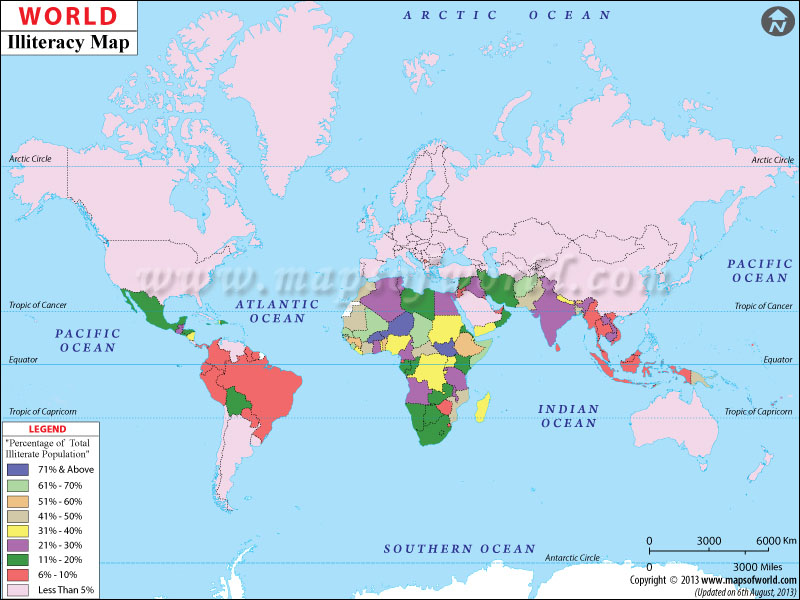
World illiteracy map presents us a not-so-nice picture of the world. Illiteracy is one of the major hindrances that come in the way of economic growth. Literate manpower helps a country in developing.
Illiteracy poverty relation has been highlighted by many a study around the world. The World illiteracy map shows a world map where different colors have been used to show different regions with different illiteracy rates. Different colors show the illiteracy rates in the population of all countries. A legend has been provided along with the map to make the interpretation easier. On the Illiteracy Map, blue color indicates that over 60% of the population is illiterate.
World literacy statistics show that Africa has the largest number of countries with 60% of illiterate people. Purple color shows those countries, where 40-60% of the population is illiterate. Orange color shows those countries, where 20-40% of the population is illiterate.
Light Green color shows those areas where 5-20% of the population is illiterate. Most of North America, Europe and Australia fall into the category of less than 5% adult illiteracy. Third world literacy figures show that in the developing countries, most of the population is illiterate. Highest illiteracy rates are observed in developing countries such as South Asian, Arab and Sub-Saharan countries. In developed countries the illiteracy rate is low. For instance, illiteracy in America cannot be compared with the functional illiteracy rates of the third world. US illiteracy is a meager 2.8 million in a country of more than 300 million people. Several factors, the development of a region, economic status as well as urbanization affect the region's literacy rate, illiteracy statistics reveal.
World literacy rates as a whole presents a bleak picture. World statistics show that the education world in the developing countries is caught up in a vicious circle: in order to provide education for its populace, the governments of these countries need to allocate funds. But funds are available only if there is economic development in the country. Many international organizations like the UNESCO and non-governmental organizations on world literacy missions make arduous effort to eliminate this social handicap.
| Countries | Illiteracy Rate |
|---|
| Burkina Faso | 78.20% |
| South Sudan | 73.00% |
| Niger | 71.30% |
| Mali | 68.90% |
| Afghanistan | 66.00% |
| Chad | 65.50% |
| Sierra Leone | 64.90% |
| Somalia | 62.20% |
| Senegal | 60.70% |
| Guinea | 59.00% |
| Benin | 57.60% |
| Ethiopia | 57.30% |
| Bhutan | 53.00% |
| Wallis and Futuna | 50.00% |
| Gambia, The | 50.00% |
| Guinea-Bissau | 45.80% |
| Central African Republic | 44.00% |
| Mozambique | 43.90% |
| Morocco | 43.90% |
| Ivory Coast | 43.80% |
| Bangladesh | 43.20% |
| Pakistan | 43.00% |
| Papua New Guinea | 42.70% |
| Mauritania | 42.00% |
| Timor-Leste | 41.40% |
| Nepal | 39.70% |
| Liberia | 39.20% |
| Togo | 39.10% |
| Haiti | 39.00% |
| Sudan | 38.90% |
| Nigeria | 38.70% |
| Yemen | 36.10% |
| Madagascar | 35.50% |
| Uganda | 33.20% |
| Congo, Democratic Republic of the | 33.20% |
| Burundi | 32.80% |
| Nicaragua | 32.50% |
| Djibouti | 32.10% |
| Angola | 29.90% |
| Rwanda | 28.90% |
| Ghana | 28.50% |
| Egypt | 28.00% |
| Laos | 27.00% |
| Algeria | 27.00% |
| Cambodia | 26.40% |
| Vanuatu | 26.00% |
| India | 25.95% |
| Malawi | 25.20% |
| Comoros | 25.10% |
| Guatemala | 23.97% |
| Belize | 23.10% |
| Cameroon | 22.40% |
| Tunisia | 22.00% |
| Tanzania | 21.80% |
| Iraq | 21.80% |
| Honduras | 20.00% |
| Eritrea | 20.00% |
| Zambia | 19.40% |
| Gibraltar | 19.00% |
| El Salvador | 18.90% |
| Eswatini(Swaziland) | 18.40% |
| Congo, Republic of the | 16.20% |
| Cape Verde | 15.70% |
| Botswana | 15.50% |
| Sao Tome and Principe | 15.10% |
| Syria | 15.00% |
| Iran[8] | 15.00% |
| World | 15.00% |
| Antigua and Barbuda | 14.20% |
| Mexico | 13.90% |
| South Africa | 13.60% |
| Bolivia | 13.30% |
| Oman | 13.00% |
| Dominican Republic | 13.00% |
| Kenya | 12.60% |
| Jamaica | 12.10% |
| Gabon | 11.60% |
| Namibia | 11.20% |
| Micronesia, Federated States of | 11.00% |
| Libya | 10.80% |
| Suriname | 10.40% |
| Lesotho | 10.40% |
| Mauritius | 10.20% |
| Burma | 10.10% |
| United Arab Emirates | 10.00% |
| Lebanon | 10.00% |
| Saint Lucia | 9.90% |
| Colombia | 9.60% |
| Brazil | 9.60% |
| Zimbabwe | 9.30% |
| Ecuador | 9.00% |
| Sri Lanka | 8.80% |
| Macau | 8.70% |
| Panama | 8.10% |
| Kosovo, Republic of | 8.10% |
| Seychelles | 8.10% |
| Guyana | 8.10% |
| Palau | 8.00% |
| Malaysia | 7.90% |
| Singapore | 7.50% |
| Thailand | 7.40% |
| Jordan | 7.40% |
| Brunei | 7.30% |
| Malta | 7.20% |
| Indonesia | 7.19% |
| Peru | 7.10% |
| Hong Kong | 6.50% |
| Marshall Islands | 6.30% |
| Fiji | 6.30% |
|
| Countries | Illiteracy Rate |
|---|
| Maldives | 6.20% |
| Equatorial Guinea | 6.10% |
| Vietnam | 6.00% |
| Paraguay | 6.00% |
| Kuwait | 6.00% |
| Dominica | 6.00% |
| Puerto Rico | 5.90% |
| China | 5.80% |
| Bahrain | 5.40% |
| Costa Rica | 5.10% |
| Niue | 5.00% |
| Cook Islands | 5.00% |
| Anguilla | 5.00% |
| West Bank | 5.00% |
| Venezuela | 4.90% |
| Turkey[19] | 4.80% |
| Portugal | 4.80% |
| Philippines | 4.60% |
| Bahamas, The | 4.40% |
| Chile | 4.30% |
| Saudi Arabia | 4.00% |
| San Marino | 4.00% |
| Saint Vincent and the Grenadines | 4.00% |
| Grenada | 4.00% |
| Greece | 4.00% |
| Gaza Strip | 4.00% |
| New Caledonia | 3.80% |
| Qatar | 3.70% |
| Saint Helena, Ascension, and Tristan da Cunha | 3.00% |
| Northern Mariana Islands | 3.00% |
| Montserrat | 3.00% |
| American Samoa | 3.00% |
| Israel | 2.90% |
| Argentina | 2.80% |
| Macedonia, Republic of | 2.70% |
| Aruba | 2.70% |
| Mongolia | 2.60% |
| Cyprus | 2.40% |
| Spain | 2.30% |
| Romania | 2.30% |
| Saint Kitts and Nevis | 2.20% |
| British Virgin Islands | 2.20% |
| Serbia | 2.10% |
| Korea, South | 2.10% |
| Bosnia and Herzegovina | 2.10% |
| Uruguay | 2.00% |
| Turks and Caicos Islands | 2.00% |
| French Polynesia | 2.00% |
| Cayman Islands | 2.00% |
| Bermuda | 2.00% |
| Austria | 2.00% |
| Taiwan | 1.80% |
| Montenegro | 1.60% |
| Italy | 1.60% |
| Bulgaria | 1.60% |
| Moldova | 1.50% |
| Trinidad and Tobago | 1.40% |
| Kyrgyzstan | 1.30% |
| Albania | 1.30% |
| Tonga | 1.10% |
| Turkmenistan | 1.10% |
| Croatia | 1.10% |
| United States | 1.00% |
| United Kingdom | 1.00% |
| Switzerland | 1.00% |
| Sweden | 1.00% |
| Saint Pierre and Miquelon | 1.00% |
| New Zealand | 1.00% |
| Netherlands | 1.00% |
| Monaco | 1.00% |
| Korea, North | 1.00% |
| Japan | 1.00% |
| Ireland, Republic of | 1.00% |
| Iceland | 1.00% |
| Hungary | 1.00% |
| Guam | 1.00% |
| Germany | 1.00% |
| France | 1.00% |
| Finland | 1.00% |
| Denmark | 1.00% |
| Czech Republic | 1.00% |
| Canada | 1.00% |
| Belgium | 1.00% |
| Australia | 1.00% |
| Uzbekistan | 0.70% |
| Poland | 0.50% |
| Kazakhstan | 0.50% |
| Slovakia | 0.40% |
| Russia | 0.40% |
| Belarus | 0.40% |
| Armenia | 0.40% |
| Ukraine | 0.30% |
| Tajikistan | 0.30% |
| Slovenia | 0.30% |
| Samoa | 0.30% |
| Lithuania | 0.30% |
| Georgia | 0.30% |
| Barbados | 0.30% |
| Latvia | 0.20% |
| Estonia | 0.20% |
| Cuba | 0.20% |
| Azerbaijan | 0.20% |
| Vatican City | 0.00% |
| Norway | 0.00% |
| Luxembourg | 0.00% |
| Liechtenstein | 0.00% |
| Greenland | 0.00% |
| Andorra | 0.00% |
|