

 Buy Printed Map
 Buy Digital Map
 Customize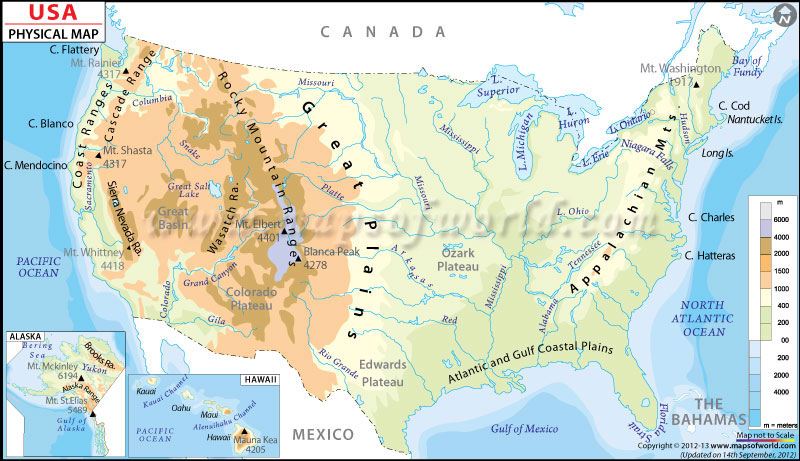
| Description : The physical map of the USA shows elevations, mountain ranges, plateaus, rivers, plains and other topographic features of the United States. | Disclaimer |
×
Disclaimer : All efforts have been made to make this image accurate. However MapSherpa, Inc, its directors and employees do not own any responsibility for the correctness or authenticity of the same.
Major Physical Features of the United States
The United States is a large country with a wide range of physical features, from tall mountains to deep valleys, rivers, lakes, and plains. Some of the unique features of US geography include the Grand Canyon, the Florida Everglades, and Death Valley in California's Mojave Desert.
Listed below are some of the important physical features of the United States.
Mountain Ranges :
Plains and Plateaus :
Rivers :
The United States is a large country with a wide range of physical features, from tall mountains to deep valleys, rivers, lakes, and plains. Some of the unique features of US geography include the Grand Canyon, the Florida Everglades, and Death Valley in California's Mojave Desert.
Listed below are some of the important physical features of the United States.
Mountain Ranges :
- Rocky Mountains - Separating the western third of the country, the Rocky Mountains traverse the continent, forming the Continental Divide, where waters to the west all drain to the Pacific Ocean and waters to the east drain into the Atlantic.
- Cascades and Coast Ranges - The Cascade and Coast Ranges run along the Pacific Coast, from parts of western Canada through Washington, Oregon, and California.
- Sierra Nevada - Located in California and Nevada, the Sierra Nevada Mountains are named for their snowy peaks, which run 400 miles from north to south along the border between these two states.
- Appalachian Mountains - Along the eastern United States, the Appalachian Range runs northeast from Alabama up through coastal states like North Carolina, Virginia, and Maryland.
- Adirondack Mountains - Sometimes grouped with the Appalachian Range, the Adirondack Mountains are situated in northeastern New York and are a prominent feature of this region.
Plains and Plateaus :
- Great Plains - The Great Plains span the central corridor of the country, made up of flatland covered with prairies and grasslands.
- Coastal Plains - Two major groups of coastal plains are found in the south and southeastern United States, known as the Gulf and Atlantic Coastal Plains for their proximity to these bodies of water.
- Columbia Plateau - Located in the northwestern United States, the Columbia Plateau is a high, raised stretch of land between the Cascades and the Rocky Mountains.
- Colorado Plateau - Covering the Four Corners region of the Untied States, where Utah, Colorado, New Mexico, and Arizona meet at a single point, the Colorado Plateau is a high desert covering 337,000 square kilometers.
Rivers :
- Mississippi - Part of the longest river system in the United States, the Mississippi runs from Minnesota down to New Orleans, Louisiana, where it drains into the Gulf of Mexico. Along the way, the Mississippi drains part of 31 different states.
- Missouri - The Missouri River merges with the Mississippi River near St. Louis, Missouri, after traveling eastward through Montana, and draining ten states.
- Colorado - The Colorado River runs through the southwest, beginning in the Rocky Mountains, through the Grand Canyon, and finally flowing down into Mexico.
- Rio Grande - One of the longest rivers on the continent, the Rio Grande flows from Colorado down to Texas, forming part of the US-Mexico border.
- Great Lakes - The Great Lakes are located in northeastern United States, along the border between the US and Canada. The collection of five lakes holds the record for the largest group of freshwater lakes in the world. The names of the Great Lakes are Lake Superior, Lake Michigan, Lake Huron, Lake Erie, and Lake Ontario.
- Great Salt Lake - Utah's Great Salt Lake, with an area of 1,700 square miles, is the largest salt lake in the western hemisphere.
Physical Map of the United States |
|---|
| Map of America |
|---|