|
|
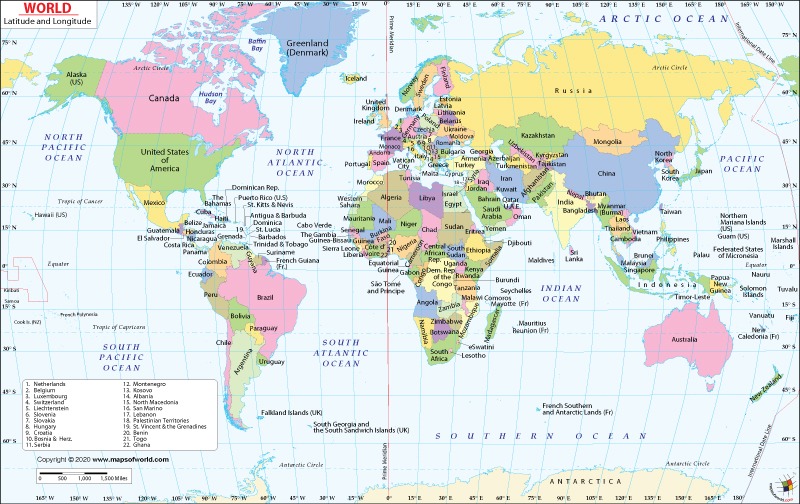
Latitude and Longitude are two numbers or coordinates used to plot any location on this Earth. One can know about the exact position of a place through latitude and longitude. Latitude and longitude also determine the time zone of the certain place, which is calculated on the basis of its latitude and longitude. The world map with Latitude and longitude brings the useful information on the coordinates of some of the important places on the world, so that one can learn about their exact positions as well as their time zones.
The coordinates are the angles, which are measured in degrees - "minutes of arc" and "seconds of arc".
1 Degree = 60 minutes of arc
1 Minute = 60 seconds of arc
Latitude
The latitude of a place basically tells you how far north or south the place is, relative to the equator. Typically latitude is expressed as degrees north or south. The equator, dividing the earth into a Northern Hemisphere and a Southern Hemisphere, has zero latitude. The North Pole has the latitude of 90 degrees north, whereas if you are close to South Pole, the latitude of the place would be nearly 90 degrees south. According to the definition, "latitude is approximately the angle between straight up at the surface and the sun at an equinox".On a world map with latitude and longitude, the imaginary lines of latitude appear horizontally from east to west. Though these may have varying curvature, however these lines are actually circular in nature with different radii.
Though equator is the most important of all the latitudes, you will also find four others in the world map with latitude and longitude, which play a pivotal role in the geometrical relationship between the Sun and the Earth.
Arctic Circle: 66° 33' 39" N
Tropic of Cancer: 23° 26' 21" N
Tropic of Capricorn: 23° 26' 21" S
Antarctic Circle: 66° 33' 39" S
All of the above lines lie in the Earth's axial tilt with respect to the sun (23° 26' 21.41"), and hence carry great importance.
The Sun remains at the zenith only at latitudes between the Tropics. Midnight sun is possible only in the north of Arctic Circle or south of Antarctic Circle.
It can also be noted here that Arctic Circle and Tropic of Cancer are colatitudes, which means the summation of their angles is 90°. Similarly, Antarctic Circle and Tropic of Capricorn are also colatitudes.
Following is a useful chart that would help one to calculate the latitude:
| Latitude | N-S radius of curvature | Surface distance per 1° change in latitude | E-W radius of curvature | Surface distance per 1° change in longitude |
| 0° | 6335.44 km | 110.574 km | 6378.14 km | 111.320 km |
| 15° | 6339.70 km | 110.649 km | 6379.57 km | 107.551 km |
| 30° | 6351.38 km | 110.852 km | 6383.48 km | 96.486 km |
| 45° | 6367.38 km | 111.132 km | 6388.84 km | 78.847 km |
| 60° | 6383.45 km | 111.412 km | 6394.21 km | 55.800 km |
| 75° | 6395.26 km | 111.618 km | 6398.15 km | 28.902 km |
| 90° | 6399.59 km | 111.694 km | 6399.59 km | 0.000 km |
Effects of Latitude
Latitude plays a major role on the weather of a place. It affects prevailing winds, polar auroras and other physical characteristics of places.Types of Latitude
There can be various types of latitude, which can be listed as below:- Common Latitude
- Reduced Latitude
- Authalic Latitude
- Rectifying Latitude
- Conformal Latitude
- Geocentric Latitude
- Astronomical Latitude
- Palaeolatitude
Longitude
Longitude is the geographic coordinate used to express how far east or west you are, relative to the Greenwich meridian or Prime Meridian. Greenwich has a longitude of 0°. The places located to the east of Greenwich may have longitude angles up to 180 degrees east. Similarly, the places located to the west of Greenwich would have longitudes up to 180 degrees west. Longitudes form an integral part of the cartographic findings. They are also used in global navigation for measuring east-west direction.According to its definition, "Longitude is the angular distance of a place measured as an angle whose vertex is at the center of the earth". It expressed in degrees, minutes and seconds.
Effect on Time
The Earth rotates around its axis by around 15 degrees per hour. As a result, when some parts of the world see the sun right at the mid-sky, there might be midnight in some other parts of the world at the same time. Therefore, when the longitudes changes as you move from one place to another, the relative position of sun keeps changing. It calls for creation of different time zones.
Longitudes can be from 0° to 180° east on one side and 180° west on the other. Every degree of change of longitude calls for 4 minutes of time adjustment. If you move towards east, you need to add the time with the existing one. Similarly, you need to subtract it from the existing time if you move towards west. The countries which are large in size may have more than one time zone.
Daylight Saving Time: There is another concept of "daylight saving time", where clock is altered one hour forward to take advantage of the earlier sunrises in many places in the world, usually between April and October.
The Date Line
As Longitudes determine only the hour of the day and not the time, in some point of time it becomes necessary to adjust the day, when on crosses the 180th meridian. For this, the concept of International Date Line has been formulated. The date advances one day when crossing the line from east to west, and goes back one day when the movement is on the opposite direction.
Effect on Climate
Latitudes play a pivotal role in determining the climate of a region. As the axis of the Earth is tilted 23° 26' 21.41" to the perpendicular, specific latitude receives varied amount of sunlight with the change of seasons. During April through September, the Northern Hemisphere receives more sunlight as it is tilted towards the Sun. On the other hand, the Southern Hemisphere is tilted toward the Sun from October and March.
Due to changes in latitudes, one can find three different climate zones in general:
- Arctic
- Temperate
- Tropic