China Map
 Buy Printed Map
 Buy Digital Map
 Wall Maps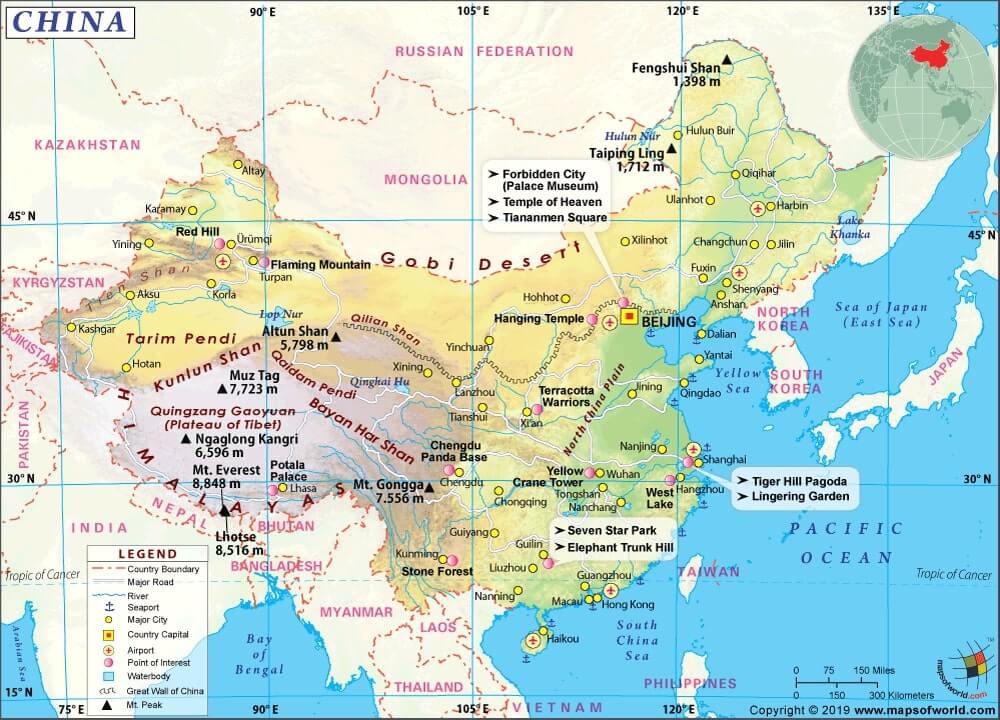
- Neighboring Countries - Mongolia, Nepal, India, South Korea, Pakistan
- Continent And Regions - Asia Map
- Other China Maps - Where is China, China Blank Map, China Road Map, China Rail Map, China River Map, China Cities Map, China Political Map, China Physical Map, China Flag
Explore this China map to learn everything you want to know about this country. Learn about China’s location on the world map, official symbol, seal, flag, geography, climate, postal/area/zip codes, time zones, etc. Check out China’s history, significant states, provinces/districts, & cities, most popular travel destinations and attractions, the capital city’s location, facts and trivia, Top FAQs (Frequently Asked Questions), and many more.
About China
China is a country located in East Asia, and it is the largest country in Asia. The country covers approximately one-fourteenth of the land area of Earth. China is the most populated and the fourth largest country in the world and is surpassed in an area only by Russia and Canada. China, officially known as The People’s Republic of China, is one of the potential superpowers of the world at present. China has a total area of 3,705,410 square miles, out of which land area is 3.60 million miles, and the rest is water. China shares borders with 14 countries. The country has 47 UNESCO World Heritage sites worldwide, after Italy. As represented in the map of China, the country’s capital is Beijing, and the largest city is Shanghai. China is the world’s second-largest economy by nominal GDP and the most extensive in terms of GDP per 2018 estimates. Mainland China is a member of various organizations, including the G-20, United Nations, WTO, APEC, BRICS, and BCIM. China is the largest export of goods and one of the fastest-growing economies. Check key facts about China to learn more. Its official language is Mandarin.
China Flag
The design of the China flag is red with five golden stars in the Canton, one star is large, and the other four stars are in an arc around. The red color of the flag represents the communist revolution, as red is the traditional color of communism. The stars in the flag symbolize the Chinese people, united under the country’s central leadership. The large star depicts the Communist Party, and the four small stars are the social classes of China.
China Location
China Location Map shows the exact location of China on the world map. This map shows the boundaries of this country, neighboring countries, and oceans. China is located in Asia and is bounded by Russia, Kazakhstan, and Mongolia in the north; South Korea, North Korea, Philippines, Japan, and Taiwan in the east; Vietnam, Nepal, Laos, Bhutan, and Myanmar in the south and India, Pakistan, Kyrgyzstan and Afghanistan in the west. The country also has the longest combined land border, measuring up to 13,743 miles (22,117 km). The land frontier of China is about 12,400 miles (20,000 km) in length, and its coastline extends for some 8,700 miles (14,000 km).
China’s Latitude and Longitude extents are 35.00 N Latitude and 105.00′ E Longitude in Asia. One can check this Latitude and Longitude Map of China for more information.
China Capital
The capital city of the People’s Republic of China is Beijing. The City is located in Northern China, surrounded mainly by Hebei Province except for Tianjin to the southeast. Beijing is the global City and the world’s most populous national capital city, with over 21 million residents within an administrative area of 16, 410.5 km2 (6336 sq. mi). The City is one of the leading centers of culture, politics, finance, business, education, science and technology, and transportation. The City is the “billionaire capital of the world,” and it is home to the headquarters of most of China’s largest state-owned companies.
Time Zones in China
Despite its vast size and large latitude extent, China has only a one-time zone, CST-China Standard Time (UTC+8) and Beijing Time, and it does not utilize daylight saving time. Check China Time Zone Map to learn more.
China Geography
The physical map of China reveals all the details about the topographic features of China. China’s vast geography is endowed with diverse landforms, including hills, mountains, high plateaus, deserts, plains, and deltas. The country’s landscape varies significantly across its territories, from deserts in the arid north to the Subtropical forests in the south. The Himalayas lie to the South and West of China, and the country is home to some of the highest mountain peaks in the world. The world’s highest point that Mount Everest, at 29,029 feet, is situated in Tingri County p, Shigatse (xigaze) in China. The country is said to have more than 22,000 rivers, including significant rivers like the Yellow River(Huanghe), Yangtze River (Changjiang), Heilongjiang River, Changjiang River, and more. The topography of the country is divided into the following physical macro-region:
- Eastern China (Northeast Plain, North Plain, and South hills)
- Xinjiang-Mongolia
- Highlands
China Climate
The climate of China is highly diverse owing to tremendous differences in latitude, longitude, and altitude. The climate in China ranges from subarctic in the far north to tropical in the far south and alpine in the higher elevations of the Tibetan Plateau. Winter is cold in the mountains and the plateaus in the north, while it is mild in the south. Summer in China is hot everywhere except in the highlands and high mountains. The highest temperature in China was recorded at Erbao Township at 50.5.C (122.9.F) on 10 July 2017, and the lowest temperature in China was recorded at Genhe, Inner Mongolia, at -58.C (-72.4.F) on 31 December 2009.
China History
China is home to one of the oldest civilizations in the world, emerging at the basin of the Yellow River in the North China Plain in 6000 BC. The country is one of the few existing countries that flourished economically and culturally in the earliest stages of world civilization. The classification of historical periods of China can be done in several ways. One way is to take into account the broad historical periods:
- The period of Ancient Dynasties
- The Imperial Era
- The Emergence of Modern China
- The period of Republican China
- The period of the people’s Republic of China
Another way would be to divide the historical periods according to the stages that the society has gone through, starting from the periods of the primitive community, slave society, feudal society, semi-feudal and semi-colonial society, and socialist society that existed in the lands of the current Peoples Republic of China.
China Provinces
The country has 34 administrative divisions consisting of 23 provinces, five autonomous regions, four municipalities, and two unique administrative regions (Hong Kong and Macau). The country has 23 provinces, 22 of which are controlled by the People’s Republic of China (PRC), and the PRC claims the 23rd Taiwan province, but it is not controlled and administered by the PRC and is thus a de facto independent country. Below are the maps of all provinces of China:
- Qinghai Map
- Sichuan Map
- Gansu Map
- Heilongjiang Map
- Yunnan Map
- Hunan Map
- Shaanxi Map
- Hebei Map
- Jilin Map
- Hubei Map
- Guangdong Map
- Guizhou Map
- Jiangxi Map
- Henan Map
- Shanxi Map
- Shandong Map
- Lion IGN
- Fujian Map
- Jiangsu Map
- Zhejiang Map
- Taiwan Map
- Hainan Map
China Major Cities
Many significant cities in China attract thousands of visitors every year. Cities map of China reveals valuable details. Below are the maps of major cities in China:
China Airports
China will have about 248 airports in 2021, with a few dozen more under construction. The figure includes airports governed by the CAAC (Civil Aviation Administration of China) and excludes Hong Kong, Macau, and Taiwan airports. Check China Airports Map to know more. The most popular and busiest airports in China are:
- Beijing Capital International Airport
- Shanghai Pudong International Airport
- Shanghai Hongqiao International Airport
- Chengdu Shuangliu International Airport
- Hong Kong International Airport
- Xian Xianyang International Airport
China Postal Codes
China uses postal codes to deliver letters and goods within mainland China. The country operates a six-digit all-numerical system with four tiers. The first tier is composed of the first two digits, showing the province or equivalent municipality or autonomous region; the second tier is composed of the third digit indicating the postal zone within the province, municipality, or autonomous region. The fourth digit in the postal code served as the third tier, which offers the postal office within prefectures or equivalent cities. The last two digits are the fourth tier indicating the specific mailing area for delivery.
China Travel
China has a vast territory and long history, so it offers much to see and explore. The country ranked second in the world in 2014 for travel and tourism contribution to GDP. Tourist resources in the country are divided into three main groups: natural sites, historical and cultural sites, and folk customs. Some of the most famous tourist attractions in China are:
- The Great Wall of China in Beijing
- Li River in Guilin and Yangshuo
- Potala Palace in Tibet
- Tiananmen Square
- Eastern Qing Tombs
- Mogao Caves in Dunhuang
- Historic Centre of Macau
Top FAQs on China
Faq #1: What year is it in China?
Ans: The year 2022 is the year of the tiger in China.
Faq #2: What is the capital of China?
Ans: Beijing is the Capital of China.
Faq #3: Is Hong Kong part of China?
Ans: Hong Kong is a Special Administrative Region controlled by the People’s Republic of China and enjoys limited autonomy.
Faq #4: Is Taiwan part of China?
Ans: Taiwan has been governed independently of mainland China, Officially the People’s Republic of China (PRC), since 1949. Taiwan, known as the Republic of China (ROC), is officially an island separated from China by the Taiwan Strait.
Faq #5: Where is China located?
And: China is located in Southeast Asia, covering an area of 9.6 million square kilometers, making it the third largest country in the world.
FAQ#6: How old is China?
Ans: China is among the oldest nation in the world, and it has been known to exist for over 3500 years.
Faq #7: Is China Communist?
Ans: The Chinese Communist Party (CCP) is the founding and sole ruling party of the People’s Republic of China (PRC), officially the Communist Party of China (CPC).
FAQ #8: Does China have nuclear weapons?
Ans: China has the world’s third largest arsenal of nuclear weapons, with an estimated 350, preceded by Russia and the US.
Faq #9:Is China in Nato?
Ans: China is not a part of NATO.
FAQ #10: How long is the Great Wall of China?
Ans: The great wall of China spans about 21,196.18 km (13,10.70 mi) in total. The figure is based on the latest state survey results.
