Japan Map
 Buy Printed Map
 Buy Digital Map
 Wall Maps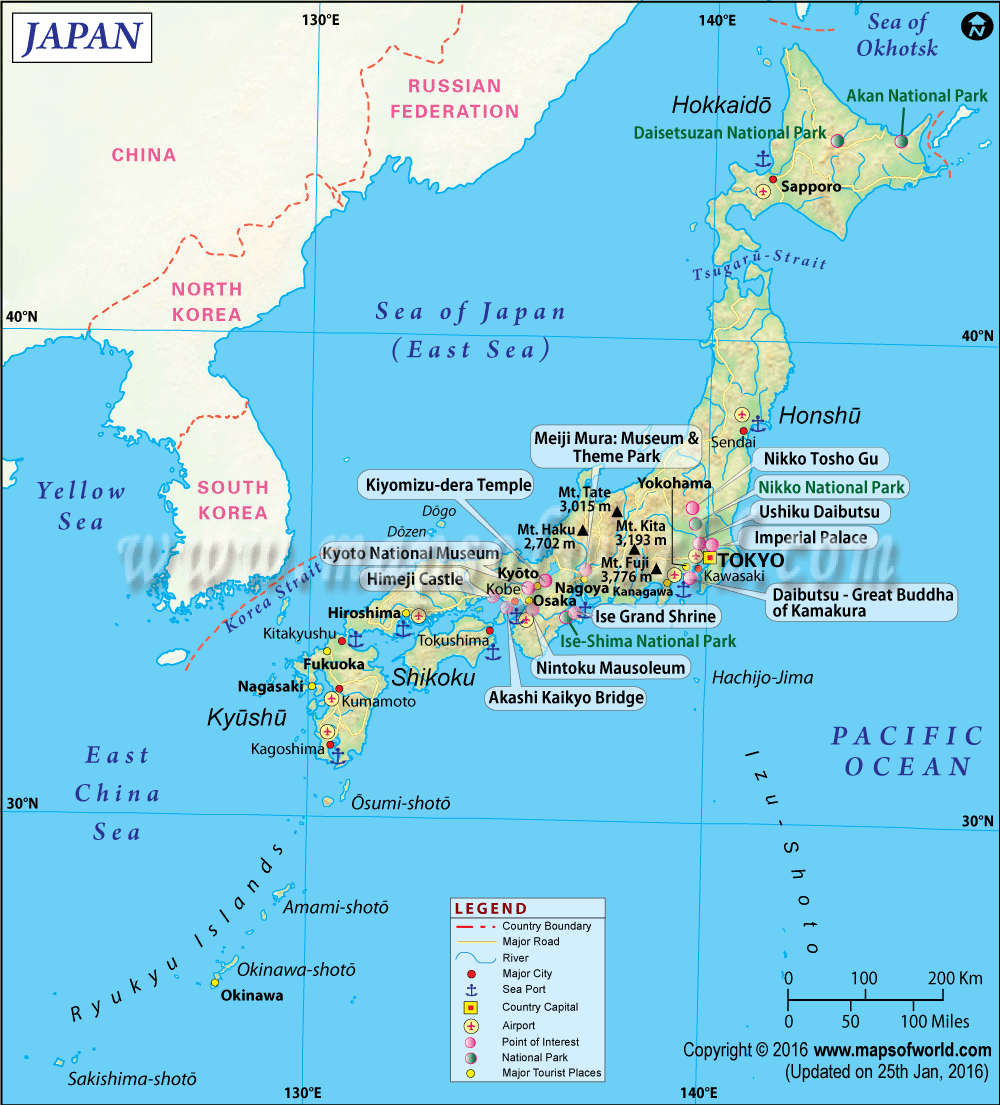
- Japan Cities - Hiroshima, Sagamihara, Tokyo
- Neighboring Countries - South Korea, North Korea, China, Russia
- Continent And Regions - Asia Map
- Other Japan Maps - Where is Japan, Japan Blank Map, Japan Road Map, Japan Rail Map, Japan River Map, Japan Political Map, Japan Physical Map, Japan Flag
Explore this Japan Map to learn everything you want to know about this country. Learn about Japan’s location on the world map, official symbol, seal, flag, geography, climate, postal/area/zip codes, time zones, etc. Check out Japan’s history, significant states, provinces/districts, & cities, most popular travel destinations and attractions, the capital city’s location, facts and trivia, Top FAQs (Frequently Asked Questions), and many more.
Key Facts of Japan
Japan is an Island nation of East Asia located in the Pacific Ocean, officially called Nippon Koku. Japan is also known as the “land of rising sun” due to its location east of Asia, from the direction the sun rises. The country is a part of the Pacific Ring of Fire, comprising an archipelago of 6,852 islands. The five largest islands of Japan are Hokkaido, Okinawa, Kyushu, Honshu, and Shikoku. The Nano Island and the Ryukyu Islands are situated east and west of the country’s main islands. Japan is the fourth largest island country in east Asia and has the 8th largest Exclusive Economic Zone of 4,470,000 km2 (1730,000 sq mi) worldwide. The island nation is a country of contrasts where the old and the new coexist in perfect harmony. The official language of the Japan is Japanese.
Japan Flag
The flag of Japan is rectangular with a ratio of 2:3, although the original proportion of the flag was 7:10. The official name of the flag is Nisshoki. Still, it is more commonly known as Hinomaru in Japan. The design of the Japanese flag is white with a deep red disc in the Center. The red disc in the flag’s Center is believed to be the sun.
Japan Location
Japan Location Map shows the exact location of Japan on the world map. This map shows the boundaries of this island nation, neighboring countries, and oceans. Japan, the island nation, is located in Eastern Asia. Japan is a chain of islands towards the east of the Korean Peninsula between the Sea of Japan and the North Pacific Ocean. The neighboring countries of South Korea, North Korea, Russia, and China are located west of the island nation. The East China Sea is situated to the south of Japan, and the Philippines Sea lies to its southwest.
The Latitude and Longitude extent of Japan is 24. and 46. N Latitude and 122. and 146. E Longitude in Asia. One can check this Latitude and Longitude Map of Japan for more information.
Japan Capital
The capital city of Japan is Tokyo. The city is one of the prominent economic centers of the world. Tokyo is also the largest city in Japan. The town is situated at the head of Tokyo Bay, which formed part of the Kanto region. Kanto region is located on the central coast of Honshu, which is Japan’s largest island. Tokyo is the seat of the Japanese government and the Emperor of Japan. The city is home to the world’s tallest tower, the Tokyo Skytree. Tokyo is categorized as an Alpha+City by the Globalization and World cities research network.
Japan Time Zone
The whole of Japan uses only a one-time zone, which is Japan Standard Time (IST). JST is nine hours ahead of UTC (coordinated universal time), that is, UTC+9. The country does not observe daylight saving time, though its introduction has been debated over the years. During World War || the time zone was often referred to as Tokyo Standard Time.
Japan Geography
The physical map of Japan reveals all the details of the country’s physical features. The total area of the country is 145,937 sq. mi (377,975 sq.km) out of which land area is 140,728 sq.mi (364,485 sq km) and water area is 5,185.4 sq.mi (13,430 sq.km). Japan has a long coastline of 18,486 mi (29,751 km), making it the 6th longest coastline in the world. The country, for the most part, consists of rugged and mountainous terrain. Around 3/4th of the landforms in Japan are made up of mountains and forested. Mount Fuji is the highest elevation point in the country at 12,388.5 ft (3,776 m), and the lowest point in the country is at Hachiro-gata, -13.12 ft (- 4 m). The Japanese alps run down the Center of the largest island of Japan, Honshu. The longest rivers in Japan are Shinano (or Chikuma), Tone, Ishikari, Teshio, and more. Check Rivers Map of Japan to locate them.
Japan Climate
The country has four distinct seasons with a climate ranging from subarctic in the north to temperate in the central to subtropical in the south. Climatic conditions vary between the Pacific side and the Sea of Japan. However, the climate of Japan is predominantly mild but greatly varies from north to south. There is abundant rain almost everywhere between the summer and the autumn season. Torrential rains and typhoons hit Japan. On the Sea of Japan, Northern Japan has warm summers and freezing winters with hefty snow. Western Japan has hot and humid summers and moderately cold winters. Amani and Okinawa have subtropical oceanic climates.
Japan History
The history of Japan dates back to about 30,000 years ago, when people first came to this Island nation. The main islands were connected to Siberia and Korea by the bridges of dry land at that time, and people crossed on foot. The Jomon Culture was the first society that arose about 12,000 years ago. It was also the time when the Ainu people arrived from Siberia by boat.
In 300 B.C, the Yayoi people came to Honshu Island from China and Korea. They were skilled farmers, weavers, and tool makers. The first emperor of Japan’ Jimmu Tenno, Came to power in 660 B.C. Emperors controlled ancient Japan until the 12th century A.D, and then military rulers called shoguns took control of Japan.
In 1543, Europeans first arrived in Japan. The ruling shogun closed Japan to foreigners and forbade the Japanese to travel abroad, and this isolation lasted more than 200 years. In 1868 emperors of Japan returned, and shoguns were overthrown. It was the time of modernization in Japan. In 1941 on December 7, Japan bombed the United States Navy fleet at Pearl Harbor in Hawaii; the U.S entered World War II. The military leaders of Japan fought against the U.S and allied forces. The U.S dropped atomic bombs on the Japanese cities of Hiroshima and Nagasaki in August 1945, killing about 115,000 people, and a few days later, Japan surrendered.
Prefectures of Japan
The country is divided into eight regions and 47 prefectures or provinces. The prefectures of Japan are contiguous with the ancient ritsuryo provinces of Japan. These prefectures rank immediately below the national government and form the country’s first level of Jurisdiction and administrative division. This Political Map of Japan shows all the prefectures on the map. There are 43 prefectures, two urban prefectures, one” circuit” or” territory,” and one metropolis. Below are the maps of all prefectures of Japan :
- Aichi Map
- Akita Map
- Aomori Map
- Chiba Map
- Ehime Map
- Fukui Map
- Fukuoka Map
- Fukushima Map
- Gifu Map
- Gunma Map
- Hiroshima Map
- Hokkaido Map
- Hyogo Map
- Ibaraki Map
- Ishikawa Map
- Iwate Map
- Kagawa Map
- Kagoshima Map
- Kanagawa Map
- Kochi Map
- Kumamoto Map
- Kyoto Map
- Mie Map
- Miyagi Map
- Miyazaki Map
- Nagano Map
- Nagasaki Map
- Nara Map
- Niigata Map
- Oita Map
- Okayama Map
- Okinawa Map
- Osaka Map
- Saga Map
- Saitama Map
- Shiga Map
- Shimane Map
- Shizuoka Map
- Tochigi Map
- Tokushima Map
- Tokyo Prefecture Map
- Tottori Map
- Toyama Map
- Wakayama Map
- Yamagata Map
- Yamaguchi Map
- Yamanashi Map
Japan Major Cities
The Japan Cities Map reveals valuable details. Major cities in Japan are:
- Tokyo
- Kyoto
- Himeji
- Sapporo
- Sendai
- Kawasaki
- Yokohama
- Osaka
Japan Airports
Japan has a total of 29 airports located across its four main islands and smaller islands. There are five International airports in the country, and the remaining twenty-four are local airports that operate domestic flights. Check Japan Airports Map to locate all the airports on the map. The most popular and busiest airports in Japan are:
- Tokyo International Airport (Tokyo)
- Osaka International Airport (Osaka/Hyogo)
- Narita International Airport (Chiba, nearby Tokyo)
- Kansai International Airport
- Chubu Centrair International Airport (Aichi)
Japan Postal Codes
Japan uses 7-digit numeric postal codes using the format NNN-NNNN (N is the digit). The first two digits in the postal code refer to one of the 47 prefectures. The third digit is for a set of adjacent cities in the prefecture, the following numbers are for a neighborhood, and the last two are for a town or other subdivision. For example, 40 for the Yamanashi prefecture, 408 for Hokuto Yamanashi, and 408-0301 to 408-0307 for the Mukawa-cho neighborhood in Hokuto).
Japan Travel
One can explore Japan Road Map and Japan Rail map for more detailed information on travel options in the country. Japan is a perfect blend of modernity and old-world charm. The country has 21 World Heritage sites, making it a popular tourist destination among foreigners. Japan is ranked 4th out of 141 countries in the 2017 travel and tourism competitiveness report. It is also a famous destination for business travel. Some of the most popular travel destinations in the country are:
- Tokyo Tower
- Hiroshima Peace Memorial Park
- Ghibli Museum
- Edo Museum
- Ueno Park
- Sensoji Temple
- Mount Fuji
- Universal Studios Japan
- Himeji Castle
- Tokyo Disneysea
- Aka Island
- Kinkakuji
- Historic Monuments of Ancient Kyoto and Nara
- Niseko in Hokkaido
- Okinawa
Top FAQs on Japan
FAQ #1: Where is Japan located?
Ans: Japan is an Island country located in East Asia to the east of the Eurasian continent in the Pacific Ocean
Faq #2: What is the capital of Japan?
Ans: The capital of Japan is Tokyo.
Faq #3: What is Japan known for?
Ans: Japan is known for its traditional arts, distinctive gardens, flowers, sculpture, electronics, bullet trains, Mount Fuji, and more.
Faq #4: Is Japan a democracy?
Ans: The country is a multiparty parliamentary democracy. It is a constitutional monarchy with a parliamentary government.
Faq #5: Is Japan in Asia?
And: Japan is an island country along the Pacific coast of East Asia.
Faq #6: Is Tokyo in Japan?
Ans: Tokyo is the capital of Japan, located on the country’s Kanto plain facing Tokyo Bay,
Faq #7: When was Japan founded?
Ans: Japan was founded on February 11, 660 BC.
Faq #8: Does it snow in Japan?
Ans: The snow season in Japan usually begins in mid-December and continues till early April. Some of the high altitudes in Japan receive snowfall until late May.
Faq #9:Is Japan part of Nato?
Ans: Japan is not a part of NATO.
Ans: FAQ #10: What is the region in Japan?
Ans: Japan is divided into eight regions. They are not official administrative units used by government officials for statistical data.
