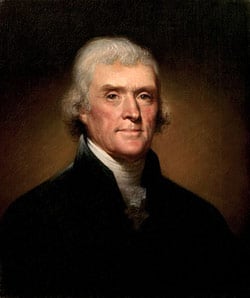
| Date of Birth: | April 13, 1743 |
|---|---|
| Death | July 4, 1826 |
| Presidential Term | March 4, 1801 – March 4, 1809 |
| Political Party | Democratic-Republican |
Bio : Thomas Jefferson was born in Goochland County Virginia on April 13, 1743. Jefferson attended the College of William & Mary, located in Williamsburg, Virginia, where he studied math, metaphysics, and philosophy. Jefferson graduated in 1762, and got a job as at the law firm of George Wythe, and soon became a lawyer in 1767.
Jefferson got married to Martha Wayles Skelton in 1772, and the two had six children, though several of them passed away as children. Martha passed away at the age of 33 in 1782, leaving Jefferson a widower who mourned for a long time and never remarried.
During the American Revolution, Jefferson served in the Continental Congress as a representative of Virginia. As a Founding Father, Jefferson played a major role, by authoring and signing the Declaration of Independence.
Jefferson held several political offices in the new nation, serving as Governor of Virginia from 1779 to 1781, and then became a congressman and minister to France. Jefferson was President George Washington’s Secretary of State from 1790-1793, where he helped start the Democratic-Republican Party.
Jefferson then served as vice president under second President of the United States John Adams. During his stint as vice president, Jefferson anonymously wrote the Kentucky and Virginia Resolutions with James Madison, which spoke out against the Alien and Sedition Acts that Adams had passed.
Jefferson in the American Revolution
Thomas Jefferson, one of the Founding Fathers of America, played a critical role in the American Revolution. Later, he would become the third American President.
“A wise and frugal government, which shall leave men free to regulate their own pursuits of industry and improvement, and shall not take from the mouth of labor the bread it has earned – this is the sum of good government.”
Thomas Jefferson was born on April 13, 1743 in Virginia. After an extensive school education, he studied law and joined the Virginia bar in 1767. He had a remarkable appetite for books, and his extensive reading habits helped him make very important authorial contributions to the Declaration of Independence.
Thomas Jefferson was part of the Second Continental Congress, where he represented the colony of Virginia. When the Congress decided to adopt a declaration of independence, Jefferson was part of the committee of five men appointed the task of drafting it. Part of the reason was that Jefferson had previously sent drafts for the constitution of Virginia, and so could draw on this experience.
During the Revolutionary War, he served as the governor of Virginia. One of the sore points in his political career during this time was the inability to defend Richmond against the attack by Benedict Arnold, who had defected to the British.
Later career and presidency
Jefferson won the presidential election of 1800, defeating John Adams in a close contest. Perhaps the most significant event during his term was the Louisiana Purchase, in which the Louisiana Territory was bought from France and added to the Union. During that time, the western regions still lay unexplored; Jefferson sent the Lewis and Clark Expedition in 1804 to explore and acquire these lands.
Facts |
|
|---|---|
| Full Name: | Thomas Jefferson |
| Date of Birth: | April 13, 1743, Goochland (now Albemarle) County, Virginia |
| Died on: | July 4, 1826, Charlottesville, Virginia |
| Burial site: | Monticello, Charlottesville, Virginia |
| Parents: | Peter and Jane Randolph Jefferson |
| Spouse: | Martha Wayles Skelton (1748-82; m. 1772) |
| Children: | Martha Washington (1772-1836); Jane Randolph (1774-75); infant son (1777-77); Mary (1778-1804); Lucy Elizabeth (1780-81); Lucy Elizabeth (1782-84); in addition, scientific evidence strongly suggest that Jefferson fathered at least one and as many as six c |
| Religion: | Deism |
| Education: | Attended college of William and Mary |
| Profession(s): | Farmer; Lawyer |
| Government ranks: | Virginia House of Burgesses delegate; Continental Congress member; Virginia governor; minister to France; secretary of state under George Washington; vice president under John Adams |
| Political Party: | Democratic-Republican |
| President Term: | March 4, 1801-March 4, 1805 (first term); March 4, 1805-March 4, 1809 (second term) |
| Age when assumed office: | 57 |
Presidential Term and its details |
|
|---|---|
| Dates: | March 4, 1801-March 4, 1805 (first term); March 4, 1805-March 4, 1809 (second term) |
| Vice President: | Aaron Burr (1801-5) |
| George Clinton (1805-9) | |
Snapshot of President Thomas Jefferson’s life |
|
|---|---|
| 1743 | Born in Virginia |
| 1762 | Graduates from College of William and Mary |
| 1769-74 | Serves in Virginia House of Burgesses |
| 1776 | Writes the Declaration of Independence |
| 1779-81 | Serves as governor of Virginia |
| 1785-89 | Serves as minister to France |
| 1790-93 | Serves as secretary of state |
| 1797-1801 | Serves as vice president |
| 1801-9 | Serves as third U.S. President |
| 1803 | Louisiana territory is purchased from France for $ 15 million dollars |
| 1804 | Lewis and Clark expedition begins |
| 1807 | Embargo Act forbids American ships from leaving American waters |
| 1819 | University of Virginia is founded |
| 1826 | Dies in Virginia |
Outcome of the Elections |
|||
|---|---|---|---|
| 1800 | Presidential / Vice Presidential Candidates | Popular Votes | Electoral Votes |
| Thomas Jefferson (Democratic-Republican) | ——- | 73 | |
| Aaron Burr (Democratic-Republican) | ——- | 73 | |
| John Adams (Federalist) | ——- | 65 | |
| Charles C. Pinckney (Federalist) | ——- | 64 | |
| John Jay (Federalist) | ——- | 1 | |
| 1804 | Presidential / Vice Presidential Candidates | Popular Votes | Electoral Votes |
| Thomas Jefferson / George Clinton (Democratic-Republican) | ——- | 162 | |
| Charles C. Pinckney / Rufus King (Federalist) | ——- | 14 | |
Presidency (March 4, 1801 – March 4, 1809)
Thomas Jefferson won the 1800 election against Federalist candidate John Adams, who was serving his first term as president. Jefferson campaigned along with Aaron Burr, who tied the election until Alexander Hamilton swayed the Federalist vote in Jefferson’s favor. Burr became vice president under Jefferson’s first presidential administration.
During Jefferson’s first term as president, he led the country through the First Barbary War, which involved pirate attacks along the Atlantic coast. Though he was originally against war, Jefferson agreed to fight the pirates, rather than making the annual payments to the Barbary States to stop them from attacking.
Other major features of Jefferson’s presidency included the Louisiana Purchase, a significant land acquisition that doubled the size of the United States, extending the boundaries out to modern-day Idaho. This was followed by the Lewis and Clark Expeditions, in which the named explorers traveled around the new territory and mapped its features.
In Jefferson’s reelection campaign in 1804, he defeated Charles C. Pinckney and Rufus King of the Federalist Party. George Clinton became Jefferson’s new vice president for his second term in office.
Post-Presidency
After leaving the White House, Jefferson returned to Virginia and in 1819, he founded the University of Virginia, with his strong belief in the power of higher education. He was very involved in the design of the university, drawing on influences from Roman and Greek styles, as those were the roots of the education and democratic system.
Thomas Jefferson began to get sick in 1825, and fell very ill in June of 1826. Jefferson had been invited to Washington for the fiftieth anniversary celebration of the Declaration of Independence. But with a bad fever on July 3, Jefferson remained in bed surrounded by friends and family, prepared for his death. Jefferson held on until July 4, and died at 83 years old, just hours before fellow Founding Father and former President and friend, John Adams.
