Map of Australia
 Buy Printed Map
 Buy Digital Map
 Wall Maps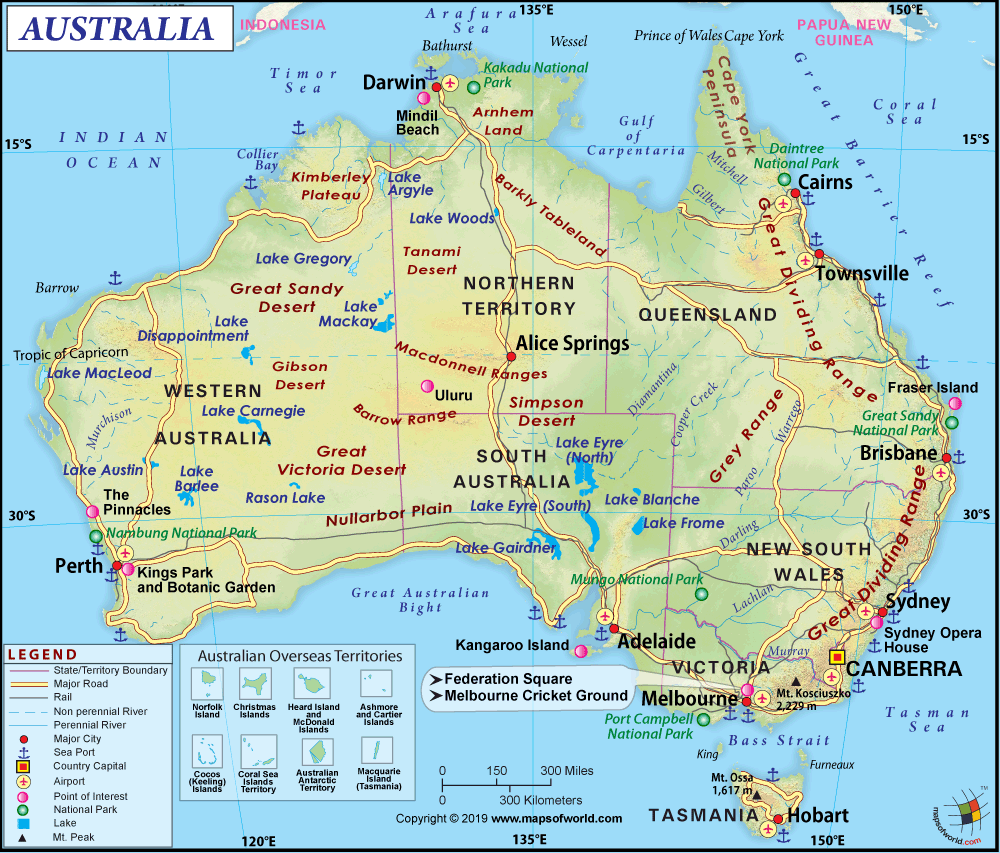
- Australia States - New South Wales, Northern Territory, Queensland, South Australia, Tasmania, Victoria, Western Australia
- Australia Cities - Adelaide, Brisbane, Broom, Cairns, Darwin, Gold Coast, Hobart, Canberra, Newcastle, Perth
- Neighboring Countries - Papua New Guinea
- Continent And Regions - Oceania Map
- Other Australia Maps - Where is Australia, Australia Blank Map, Australia Road Map, Australia Rail Map, Australia Political Map, Australia Physical Map, Australia Flag, How Many Time Zones are in Australia
About Australia
Explore this Australia map to learn everything you want to know about this country. Learn about Australia location on the world map, official symbol, flag, geography, climate, postal/area/zip codes, time zones, etc. Check out Australia history, significant states, provinces/districts, & cities, most popular travel destinations and attractions, the capital city’s location, facts and trivia, and many more.
| Official Name: | Commonwealth of Australia |
| Capital: | Canberra |
| Population: | 22,262,501 (July 2013 est.) | 21,507,717 (2011 Census) |
| Area: | 7.68 million sq km or 2.96 million sq mi |
| Currency: | ($1 = 1.10) Australian Dollar |
| Religion: | Christianity |
| Literacy: | 100% |
| Languages: | English & aboriginal languages |
| Major Cities: | Sydney, Melbourne, Brisbane, Perth, Adelaide |
| Climate: | Mixed in nature, varies from semi-arid to temperate |
It was in the year 1770 when Captain James Cook landed at the Botany Bay, Australia found its place on the world map.
Prior to this discovery,the “aboriginals” who are supposed to belong to one of the oldest civilizations inhabited this vast area of landmass comprising of rocky and steep mountains, sprawling valleys, lush green plains and the most extensive coastline as the country is surrounded by seas.
Today Australia is a federation of six states and two territories, each having a parliament of its own. It became united on 1 st January 1901.
The unique position of Australia in the southern hemisphere and its close proximity to the sea has rendered a distinct climatic conditions to the country. Throughout the year it enjoys a mild temperate climate making it a healthy place and attractive to the tourists.
Australia boasts of rich and varied vegetation. It possesses some of the rarest varieties of flowers. Australia has rich reserves of huge mineral deposits contributing to the prosperity of the country. The country is the highest producer of Opal and Black Opal. The Australian wildlife is thriving with numerous rare animals and birds.
The birds like Kookaburra and Kingfisher are quite common. Kangaroo is the most abundant animal and is also the national animal of the country. Australia is often referred as the ‘Land of the Kangaroos. ‘ Originally dominated by the English Speaking people, Australia is slowly becoming a land of the immigrants . Although English is the official language, the Australians speak in a version of their own, difficult for the tourists to understand at first. The currency of Australia is Australian Dollar.
The Australians are sports loving persons and as a nation Australia is famous for some games like Cricket, Hockey and Badminton. Swimming is their common love. The country attracts visitors to its natural wonders like Great Barrier Reef and Fraser Island among many others. Sydney Harbor Bridge and Opera House are other places of tourist interest.
Flag of Australia :
The flag if Australia is blue in colour with the flag of the UK in the upper hoist-side quadrant and a large seven-pointed star in the lower hoist-side quadrant known as the Commonwealth Star, representing the federation of the colonies of Australia in 1901; the star depicts one point for each of the six original states and one representing all of Australia’s internal and external territories; the remaining half is a representation of the Southern Cross constellation in white with one small five-pointed star and four larger, seven-pointed stars.
History of Australia :
The Aboriginal people were the first inhabitants of the Australian continent. Most anthropologists currently believe they migrated to the continent at least 50,000 years ago and occupied most of the continent by 30,000 years ago. Although Australia was not known to the Western world, it did exist in late medieval European logic and mythology: A great Southland, or Terra Australis, was thought necessary to balance the weight of the northern landmasses of Europe and Asia. In the 15th century Portugal’s navigation around Africa in pursuit of a trade route to India rekindled European interest in the region.
In the 16th and early 17th centuries, Spain, having established its empire in South and Central America, began a series of expeditions from Peru to the South Pacific. The most notable of these, by Luis Vaez de Torres in 1606, passed within sight of the Australian continent along the strait that now bears his name, between New Guinea and Australia. But Spanish interests were farther north in the Philippines, and the voyagers did not return.
Helped by better sailing ships and greater knowledge of global wind systems, they were able to overcome the challenges in the southern Pacific.
later the British made their entry. The 18th century in Western Europe ushered in the Age of Enlightenment, when philosophers and scientists stressed the value of global exploration. British explorers voyaged far and wide in search of new fauna and flora, a mission that chimed well with Britain’s growing power as a maritime empire.
Although its general boundaries were becoming known, Australia appeared to be a remote and unattractive land for European settlement. But Britain’s growing commercial and military ambitions in the Pacific, combined with its domestic social and political tensions, helped to draw Australia into the web of British strategic ambitions.
Australian soils and climate, with the recurrent droughts, were better suited for large-scale livestock grazing than for farming. During the 1830s and 1840s the continent was rapidly transformed as squatters established huge sheep runs. Paying only a minimal license fee, squatters could claim virtually as much land as they wanted. From 1830 to 1850 wool exports rose from 2 million to 41 million pounds while the population of the colonies increased from 70,000 to 334,000. With new immigrants and the growth of the capital cities, each of which served as the major port for its region, the Australian colonies were poised to enter a new phase of development.
World War I (1914-1918), much more than federation itself, helped to create a sense of national identity in Australia. Responding to the allied call for troops, Australia sent more than 330,000 volunteers, who took part in some of the bloodiest battles. Suffering a casualty rate higher than that of many other participants, Australia became increasingly conscious of its contribution to the war effort.
However, the Great Depression that hit in 1929 cut deeply into the health of the Australian economy, increasing public and private debts at a time of massive unemployment.
Upon assuming responsibility for its own foreign affairs, Australia was guided by its cultural and political ties with Britain. Emphasis was therefore placed on following Britain’s leadership in solving the problems of the depression.
The elections of 1941 returned the Labor Party to power for the first time since 1931, and John Curtin became prime minister. British Singapore, long regarded as one of the world’s strongest fortresses, fell to Japanese forces in February 1942, and shortly thereafter Britain’s Royal Navy suffered defeat in the Pacific. In March Japanese forces occupied the Dutch East Indies and landed on New Guinea. Japanese bombers raided Darwin several times, and Japanese midget submarines entered Sydney Harbour. However, Britain was no longer able to supply naval protection to Australia. Although Australian casualties were lighter than in World War I, Australians were more psychologically affected by World War II because of their fears of Japanese invasion.
Australian industry was again transformed by the needs of war. The economy was redirected toward manufacturing, and heavy industries ringed the capital cities.
After World War II Australia remained active in Western military alliances, contributing troops to the Korean War (1950-1953) and the Vietnam War (1959-1975) as a staunch ally of the United States.
Beginning in the late 1960s, Australia experienced the waves of cultural change that swept through many of the Western democracies: the coming of political age of the postwar baby boomers, movements for women’s liberation and indigenous rights, and a growing awareness of environmental issues.
Among the larger cultural issues with which Australia grappled in the 1980s and early 1990s was the question of Aboriginal land rights. Like other colonial countries such as Canada, Australia was challenged to address the land claims of the indigenous inhabitants of the country, who had been largely ignored for centuries. In 1992, in the historic Mabo v. Queensland case, the High Court of Australia ruled that the people of the Murray Islands, in the Torres Strait, held title to their land, thereby acknowledging that Australia was occupied at the time of European settlement. In 1993 the government passed an act allowing Aboriginal and Torres Strait Islander people to file land claims. See also Aboriginal Land Rights Acts.
By the early 1990s public opinion polls showed that most Australians favored the establishment of a federal republic, with an Australian president replacing the British monarch as head of state. Prime Minister Keating had placed himself at the head of the republican movement, but by 1996 many electors perceived him as arrogant and his government as out of touch with the electorate. Campaigning on a platform of economic reform, and directing its appeal to the “battlers”-disenchanted working class electors of the bush and outer suburbs-the Liberal-National coalition won solid majorities in both houses of parliament.
People of Australia :
Most of the people of Australia live in towns and cities as it is Australia Culture. In fact, about 91 percent of the population lives in cities, about two-thirds in cities with 100,000 or more residents. Only about four out of five Australians live in the coastal plains.
Culture of Australia:
Aboriginal Australians were known for elaborate paintings on rock and bark. This shows the keen interest of Australians in art. Music also had its birth during the ancient Aboriginal era. And today, music plays the central role in both social life and religious life of the people of Australia. Religious songs carry a belief that goes back many centuries when Aboriginal spirits called the Dreamtime sang songs to create living things on the earth, so the tradition is still continuing today and songs are sung to ensure the survival of plants and animals.
Economy of Australia :
Australia has developed into a modern industrial nation and is an outstanding producer of primary products. The country self-sufficient in almost all foodstuffs is also a major exporter of wool, meat, dairy products, and wheat. Wool has been a constant contributor to the progress of economy curve in Australia and in turn has helped the agricultural sector to grow too. In the years between 1960, mining became a leading segment in the economy. Increasing demand of mineral ores in Japan and among other trading partners of Australia led to a rise in the exports of mining and manufacturing goods, which, in turn, exceeded the exports of agriculture. An increasing focus on services and high-tech industries has also helped to diversify and modernize the Australian economy.
In 1999, the estimated annual federal budget included US$97.1 billion in revenues and US$95.4 billion in expenditures. Gross domestic product (GDP), which measures the value of all goods and services produced, was US$368.7 billion in 2001 in which services contributed 70.4 percent of the GDP; industry (including mining and manufacturing) contributed 26.1 percent; manufacturing alone contributed 12.79 percent; and agriculture contributed 3.5 percent.
