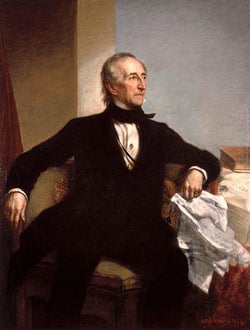
The uniqueness of the Presidency of John Tyler lies in the fact that he was the first Vice President who became a President by the virtue of the death of his predecessor. He was accepted as the 10th US President by the United States Senate and the Cabinet after a series of confusions following the untimely death of the ninth President, William Henry Harrison. He was elected the US Vice President as a candidate of the Whig party. But following a few defiances of the Whig party policies during his Presidential tenure, he was expelled from the party. He continued as a President with no political affiliation.
the national banking act legislation by the Whig leader Henry Clay was vetoed twice by John Tyler during his Presidency. This measure caused the major rift between Tyler and the Whig party. the Secretary of the State, Daniel Webster continued his support for John Tyler and finalized the Webster-Ashburton Treaty in 1842. This Treaty helped the dispute regarding the location of the border of the Maine-New Brunswick to be settled Canada and the United States.
Annexation of Texas and the Rhode Island’s Dorr Rebellion were some of the major events during John Tyler’s Presidency from 4th April, 1841 to 4th March, 1845.
The initiative to annexe Texas to the Union was taken by John Tyler. the annexation was finally made into effect during the Presidency of James K. Polk. the Dorr Rebellion was also tackled effectively by John Tyler. Without causing any major bloodshed by sending federal forces, he was successful in suppressing the rebellion by the Dorrite rebels.
In his early life, John Tyler was a student of the College of William and Mary, after which he went on to study law. John Tyler was introduced to the bar and started his practice in the year 1809 at the Charles City County. Later he also served as a Captain of Volunteer Military Company, and in the year 1811-1816 became a member of the Virginia House of Delegates.
Facts |
|
|---|---|
| Full Name: | John Tyler |
| Date of Birth: | March 29, 1790, Greenway, Virginia |
| Died on: | January 18, 1862, Richmond Virginia |
| Burial site: | Hollywood Cemetery, Richmond, Virginia |
| Parents: | John and Mary Marot Armistead Tyler |
| Spouse: | Letitia Christian (1790-1842; m. 1813); Julia Gardiner (1820-1889; m. 1844) |
| Children: | Mary (1815-1848); Robert (1816-1877); John (1819-1896); Letitia (1821-1907); Elizabeth (1823-1850); Ann Contesse (1825-1825); Alice (1827-1854); Tazewell (1830-1874); David Gardiner (1846-1927); John Alexander (1848-1883); Julia Gardiner (1849-1871); Lach |
| Religion: | Episcopalian |
| Education: | College of William and Mary (1807) |
| Profession(s): | Lawyer |
| Government ranks: | Virginia house delegate; U.S. Representative and senator from Virginia; Virginia governor; vice president under William Henry Harrison; elected as Confederate States congressman (died before term began) |
| Political party: | Whig |
| President Term: | April 4, 1841-March 4, 1845 |
| Age when assumed office: | 51 |
Presidential Term and its details |
|
|---|---|
| Dates: | April 4, 1841-March 4, 1845 |
| Vice President: | None |
Snapshot of John Tyler’s life |
|
|---|---|
| 1790 | Born in Virginia |
| 1807 | Graduates from the College of William and Mary |
| 1811-16 | Serves in Virginia House of Delegates |
| 1817-21 | Serves in U.S. House of Representatives |
| 1823 | Elected to Virginia state legislature |
| 1825-26 | Serves as governor of Virginia |
| 1827-36 | Serves in U.S. Senate |
| 1838-40 | Member of the Virginia House of Delegates as Speaker |
| 1839 | Loses Virginia gubernatorial election |
| 1841 | Serves as vice president under William Henry Harrison for thirty-one days; becomes president following Harrison’s death |
| 1841-45 | Serves as tenth U.S. President |
| 1845 | Signs the Congressional Resolution annexing Texas |
| 1861 | Elected to Confederate States Congress |
| 1862 | Dies in Virginia |
John Tyler had served in a number of important administrative offices before he assumed the office of the Vice-President of US. Some of the high points of his political career include:
- Tyler was elected as a Jacksonian to the United States Senate in 1827
- He served as President pro tempore of the Senate during the Twenty-third Congress
- He was the chairman of the Committee on the District of Columbia
- He was the Chairman of the Committee on Manufactures
- He was a member of the Virginia State constitutional convention in 1829 and 1830
- He was a member of the Virginia State house of delegates in 1839
After his retirement from the US President’s office, John Tyler continued his social activities. His valuable advices were treasured and used by the State democrats. He played a major role in spreading messages for peace. In 1861, he presided over the peace convention organized in Washington, D.C. At the age of 71, he took his last breath at Richmond in Virginia.
His characteristics and actions had won him few nicknames like ‘Honest John’, ‘His Accidency’, ‘the Veto President’.
A few of the famous quotations by John Tyler include:
- “Wealth can only be accumulated by the earnings of industry and the savings of frugality”.
- “Popularity, I have always thought, may aptly be compared to a coquette-the more you woo her, the more apt is she to elude your embrace”.
- “Let it be henceforth proclaimed to the world that man’s conscience was created free; that he is no longer accountable to his fellow man for his religious opinions, being responsible therefore only to his God”.