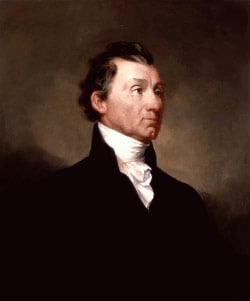
The 5th US President, James Monroe was a Democrat-Republican with non-sectarian tendencies. Besides being the mastermind behind the controversial Missouri Compromise and the Louisiana Purchase, James Monroe authored the famous Monroe Doctrine.
Fifth in the line of American Presidents, James Monroe took to office on 4th March 1817. It was during the early years of his Presidency, that the ‘Era of Good Will’ was ushered in American politics.
James Monroe was born in Westmoreland County of Virginia in the year 1758. He studied in the William and Mary College and practiced law at Fredericksburg in Virginia. He joined the Continental Army where he fought with recognition. Monroe joined politics in his youth. When the Virginia Convention formally approved the Constitution, James Monroe joined the anti-Federalists. In 1790, he supported the Jeffersonian policies. This ultimately went long way in earning him the post of the United States Senator. During Jefferson’s Presidency, he was posted as the Minister to France where he worked from 1794 to 1796.
He also played a major role in negotiating the Louisiana Purchase in association with Robert R. Livingston in the times of James Madison. It was largely due to his presence of mind that the Louisiana Purchase was perpetuated.
This step was later much appreciated by President Madison, who applauded Monroe’s ability of taking prompt decision in the face of crisis.
the Louisiana Purchase catapulted James Monroe to public fame overnight. James Monroe was appreciated by the senior politicians for his ambitious outlook and energy. He was backed by the then President James Madison to contest the Presidential Election in favor of the Republicans in the US Elections of 1816. With popularity behind him, his win was all but a matter of time.
The early years of James Monroe Presidency was marked by goodwill. He refashioned his cabinet by attempting to rope in a representative from every geographical corner of America. He traveled extensively to spread the message of non-sectarian goodwill, ushering in an era popularly dubbed as the ‘Era of Good Feelings’. Although his steps met with some kind of an initial success, the economic down-slide of 1819 (popularly called the ‘Panic of 1819’) brought into fore the cracks that already appeared within the folds of the Party. the situation was worsened by the controversial Missouri Compromise.
Facts |
|
|---|---|
| Full Name: | James Monroe |
| Date of Birth: | April 28, 1758, Wesmoreland County, Virginia |
| Died on: | July 4, 1831, New York, New York |
| Burial site: | Gouverneur Vault, Second Street Cemetery, New York, New York; moved in 1858 to Hollywood Cemetery, Richmond, Virginia |
| Parents: | Spence and Elizabeth Jones Monroe |
| Spouse: | Elizabeth Kortright (1768-1830; m. 1786) |
| Children: | Eliza Kortright (1787-1840) James Spence (1799-1800); Maria Hester (1803-1850) |
| Religion: | Episcopalian |
| Education: | Attended College of William and Mary |
| Profession(s): | Farmer; lawyer; military man |
| Government ranks: | Virginia state assemblyman; Continental congressman; U.S. Senator; minister to France and England; Virginia governor; envoy to Spain; secretary of state and secretary of war under James Madison |
| Political Party: | Democratic-Republican |
| President Term: | March 4, 1817-March 4, 1821 (first term); March 4, 1821-March 4, 1825 (second term) |
| Age when assumed office: | 58 |
Presidential Term and its details |
|
|---|---|
| Dates: | March 4, 1817-March 4, 1821 (first term); March 4, 1821-March 4, 1825 (second term) |
| Vice President: | Daniel D. Tompkins (1817-25) |
Snapshot of James Monroe’s life |
|
|---|---|
| 1758 | Born in Virginia |
| 1775 | American revolution begins; Monroe is assigned to Third Virginia Regiment of the Continental Army in 1776 |
| 1783 | Member of continental congress |
| 1787 | Monroe votes against ratification of the constitution on grounds that it establishes excessive federal power; supports Constitution after it is ratified |
| 1790-94 | Serves as U.S. Senator |
| 1794 | Resigns from senate to serve as a diplomat to France |
| 1799-1802 | Serves as governor of Virginia |
| 1803-7 | Serves as minister to France and England; helps negotiate the Louisiana Purchase |
| 1811-17 | Serves as secretary of state |
| 1814-15 | Serves as secretary of war |
| 1816 | Monore elected president; “Era of Good Feelings” begins |
| 1819 | Florida ceded by Spain to the United States |
| 1820 | Missouri Compromise forbids slavery above the southern border of Missouri; Monroe reelected |
| 1823 | Monroe Doctrine delivered to Congress |
| 1831 | Dies in New York |
Outcome of the Elections |
|||
|---|---|---|---|
| 1816 | Presidential / Vice Presidental Candidates | Popular Votes | Presidential Electoral Votes |
| James Monroe / Daniel D. Tompkins (Democratic-Republican) | —– | 183 | |
| Rufus King / John E. Howard (Federalist) | —– | 34 | |
| 1820 | Presidential / Vice Presidental Candidates | Popular Votes | Presidential Electoral Votes |
| James Monroe / Daniel D. Tompkins (Democratic-Republican) | —– | 231 | |
| John Quincy Adams / Richard Stockton (Democratic-Republican) | —– | 1 | |
Slavery was prohibited in the entire region of the erstwhile territory of Louisiana except in the Missouri region. the Congress, on the other hand, took steps to gradually free Missouri from slavery. Heated discussions followed the step and the problem was finally resolved by the Missouri Compromise of 1820, attaching the proposed state of Missouri with the newly formed state of Maine, and eliminating slavery from its northern and western regions forever.
Other remarkable features that marked the Presidential rule of James Monroe included the acquisition of Florida in 1818 and the implementation of the Monroe Doctrine in 1823. Although Monroe’s success in dealing with domestic issues stands on dubious grounds, yet his fame as a superb diplomat and a master of foreign affairs remains unquestioned. In 1818, Monroe successfully acquired Florida from Spain. It remains to be one of his greatest political successes. the other highlight of his Presidential period was the declaration that later came to be known as the Monroe doctrine. In this declaration James Monroe stated very clearly that Latin America should be left alone by Europe. He even proclaimed that Russia should not move forward to infringe upon the Pacific coast.
James Monroe spent his post-Presidential days in the premises of the University of Virginia close to his home. However, after the death of his wife, Elizabeth Monroe, he moved to New York to stay with his daughter. He breathed his last on 4th July in 1831.
Some of the famous quotations by James Monroe include :
- “A little flattery will support a man through great fatigue”.
- “Preparation for war is a constant stimulus to suspicion and ill will”.
