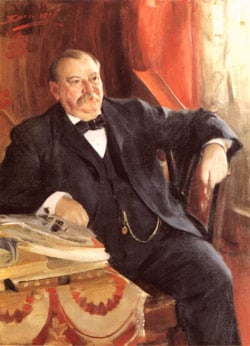
Grover Cleveland became the President of the United States of America twice, once in the year 1885 and for the second time in the year 1893. He was the first US President, who was reelected after a period of four years.
He was elected as the 22nd President in 1885 and 24th President in 1893. Belonging to the popular Democratic Party, he was the first President, who was elected after the American Civil War.
US President Grover Cleveland was born on 18th March 1837 in Caldwell, New Jersey. His parents were Anne Neal and Richard Cleveland. His family had to shift from one place to another as his father was a pastor in the Church and the Church kept on transferring its ministers from one place to the other. However, he studied Law and also started practicing in Buffalo, United States of America. Grover Cleveland was married to Frances Clara Folsom, the daughter of his old friend and law partner in 1886.
Cleveland was involved in politics from the young age of 19. An ardent supporter of the Democratic Party in the US, he had campaigned hard for James Buchanan.
His active political career began in 1871, when he was elected for the designation of a Sheriff of the County of Erie in New York. After this, he progressed rapidly in the political sphere and became the Mayor of Buffalo in 1881. Just a year later, he was nominated as the Governor of New York and even managed to work with theodore Roosevelt.
In 1885, Grover Cleveland was elected as the 22nd President of the country, with support from the Democrats as well as from the Republicans, who were ready to take up reform-steps. After being President, he pursued certain policies, which garnered both support and opposition from the common people of the country. the first policy was regarding prohibition of special favors to any particular economic group. A bill of $10000 was proposed to help the farmers, who were badly affected by drought in Texas. However he discouraged the bill as he felt that would make the farmers weak as they would thereafter continue expecting benefits from the government. He was also against the private pension bills that were to be provided to the American Civil War veterans. Many veterans had fraud claims and that could be checked only through this process. there was another important decision that he had made in 1887. He had summoned the American Congress and asked them to reduce the high protective tariffs.
Facts |
|
|---|---|
| Full Name: | Stephen Grover Cleveland |
| Date of Birth: | March 18 1837, Caldwell, New Jersey |
| Died on: | June 24, 1908, Princeton, New Jersey |
| Burial site: | Princeton Cemetery, Princeton, New Jersey |
| Parents: | Richard and Anne Neal Cleveland |
| Spouse: | Frances Folsom (1864-1947; m. 1886) |
| Children: | Oscar Folsom (1874-?; Cleveland claimed paternal responsibility for this child, named after his law partner and future father-in-law; the mother later gave him up for adoption); Ruth (1891-1904); Esther (1893-1980); Marion (1895-1977); Richard Folsom (189 |
| Religion: | Presbyterian |
| Education: | High School |
| Profession(s): | Lawyer |
| Government ranks: | Erie County, New York, sheriff; Buffalo, New York, mayor; New York governor |
| Political party: | Democratic |
| President Term: | March 4, 1885-March 4, 1889 (first term); March 4, 1893-March 4, 1897 (second term) |
| Age when assumed office: | 47 |
Presidential Term and its details |
|
|---|---|
| Dates: | March 4, 1885-March 4, 1889 (first term) |
| March 4, 1893-March 4, 1897 (second term) | |
| Vice President: | Thomas A. Hendrics (1885) |
| None (1885-89) | |
| Adlai E. Stevenson (1893-97) | |
Snapshot of Grover Cleveland’s life |
|
|---|---|
| 1837 | Born in New Jersey |
| 1870-73 | Serves as sheriff of Erie County, New York |
| 1881-82 | Serves as mayor of Buffalo, New York |
| 1883-85 | Serves as governor of New York |
| 1885-89 | Serves as twenty-second U.S. President (first term) |
| 1888 | Loses bid for reelection to Benjamin Harrison |
| 1893-97 | Serves as twenty-fourth U.S. President (second term), becoming the first chief executive to serve nonconsecutive terms |
| 1893 | Financial crisis hits the United States |
| 1908 | Dies in New Jersey |
Some of these reasons enraged the various political parties in the country. Cleveland was not re-nominated for the post of President in 1888. But again in 1892, he got re-elected and returned to the White House for the second time. There were many problems that the country was facing at that time. there was acute treasury crisis as well as various problems related to business and trade in the country. The President also repealed the Sherman Silver Purchase Act. these and many other minor policies that were undertaken by the President were extremely unpopular with the people of the country. the pathetic part is that he even lost the support of his political party. His tenure as President for the second time ended in 1897.
After his tenure as a President, Grover Cleveland went back to his estate, which was located in Princeton, New Jersey. He suffered from various ailments before he succumbed to a massive heart attack and expired on 24th June 1924. He was 71 years at the time of his death. His body was buried in the Princeton Cemetery.
There were many interesting facets in the life of President Cleveland, including the following :
- He was one US President, who personally received calls on the White House telephone.
- President Cleveland’s daughter was born in the White House in 1895 and he was the first US President whose child was born in the White House.
- there is no President in the US, who has been elected to two non-consecutive terms, apart from Grover Cleveland.
- His marriage ceremony also took place in the White House on 2nd June 1886.
Some of the selected quotes of Cleveland include the following:
- I know there is a Supreme Being who rules the affairs of men and whose goodness and mercy have always followed the American people, and I know He will not turn from us now if we humbly and reverently seek His powerful aid”.
- Minds do not act together in public; they simply stick together; and when their private activities are resumed, they fly apart again”.
- A government for the people must depend for its success on the intelligence, the morality, the justice, and the interest of the people themselves”.
- It is better to be defeated standing for a high principle than to run by committing subterfuge”.