Florida Map
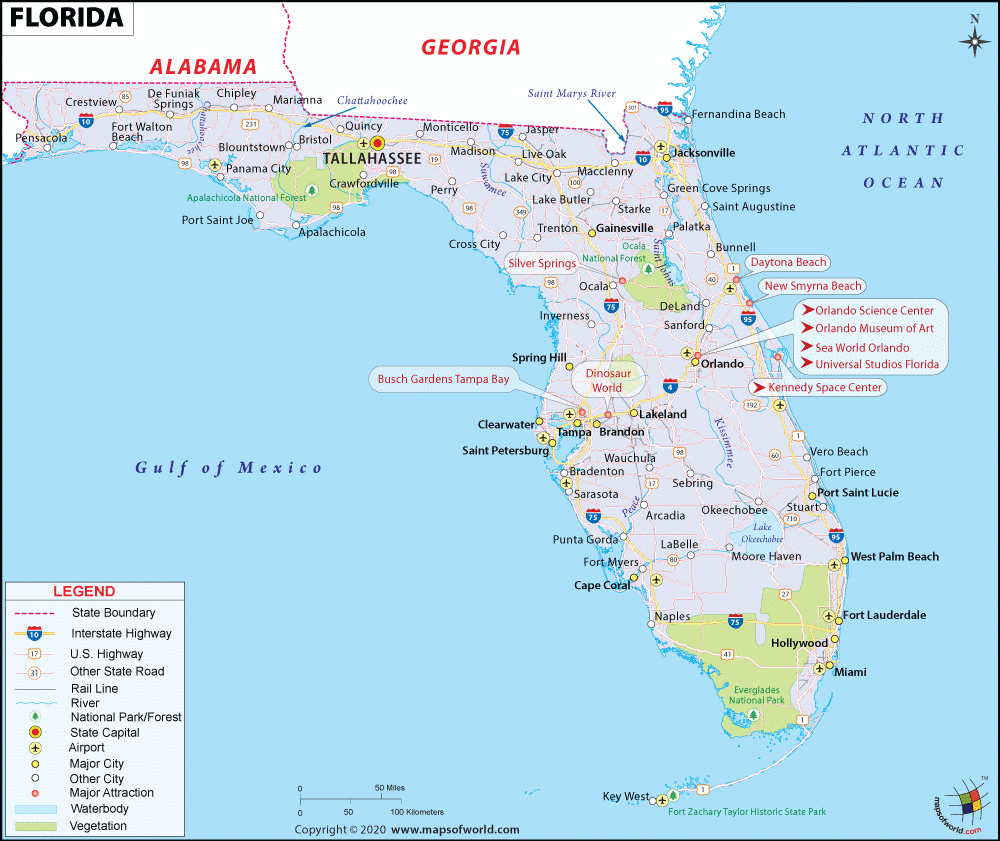
- Florida Counties - Florida County Map, Maps of Florida Counties
- Major Cities of Florida - Miami, Ocala, St Augustine, Stuart, Tallahassee, Tampa, Venice, Jacksonville
- Neighbouring States - Alabama, Georgia, South Carolina, Louisiana, Mississippi
- Regional Maps - Map of USA
- Other Florida Maps - Where is Florida, Florida Physical Map, Florida Airports Map, Florida Map with Cities, Florida Lat Long Map, Florida Zip Code Map, Florida Area Code Map, Florida National Parks Map
Explore this Florida map to know everything you want to know. Learn about the location of this state in the United States of America. Check out its geography, time zones, history, major cities, national parks, trails, flag, capital, and many more.
About Florida
Florida is the 27th state of the United States, which was admitted to the union on March 3, 1845. Tallahassee is Florida’s capital city. While Jacksonville is the largest city in Florida, Miami is the largest metro/urban area. English and Spanish are the predominantly spoken languages. In the US, Florida is one of the most populous states. While The Sunshine State is its nickname, “In God, We Trust” is the State Motto. Know more about this US state from Facts of Florida.
Florida History
Archaeological evidence says that around 14,000 years ago, the first native Americans inhabited this peninsula. However, the first history of Florida was written after Europeans (especially the Spaniards) arrived. You can trace the first textual records of Florida back to 1513, written by Juan Ponce de León, a Spanish explorer. Florida is the first mainland area of the US where the European settlers settled.
During the 16th to 19th century, the colonial power of Spain ruled Florida. Great Britain ruled this place from 1763 to 1783. It became a US territory in 1821 and was admitted to the union on March 3, 1845, as the 27th State of the USA. Two significant battles in 1777-1778 were the Battle of Thomas Creek and the Battle of Alligator Bridge. During the Civil War, the Battle of Olustee was the only major battle in Lake City, Florida.
Florida Flag
According to Florida Statutes 15.012, Florida State Flag is called the state’s seal. It consists of a St. Andrew’s cross (diagonal red bars) in the center of a white background. The red cross extends from each corner of the flag and towards the center till the seal’s outer rim.
Florida State Symbols
Florida State Seal is also called the Great Seal. The words “Great Seal of the State of Florida – In God We Trust” encircle the seal. The Great Seal features a Seminole woman who is spreading hibiscus flowers along the shoreline. A steamboat can be seen sailing during sunset along the horizon.
Florida Location Map
The Florida location map shows the exact location of the US state of Florida on the US map. It also shows the boundaries of different states in the US, neighbouring countries, and oceans all around.
The state of Florida is situated in the southeastern part of the US. It shares its border with Georgia (to the north), the Atlantic Ocean and the Bahamas (to the east), Alabama (to the northwest), the Gulf of Mexico (to the west), and Alabama (to the northwest). Among the 48 contiguous states, Florida is the southernmost state. Its precise location is 24° 27′ N to 31° 00′ N Latitude and 80° 02′ W to 87° 38′ W Longitude. To know more about the location, check Florida Longitude and Latitude Map.
Florida Counties
Florida has 67 counties. In terms of area, Palm Beach County is the largest and Union County is the smallest county. While Palm Beach County has a total area of 2,034 sq mi (5,268 sq km), Union County’s total area is 240 sq mi (622 sq km). Check out this Florida County Map which shows the location and boundaries of all different counties in Florida.
Florida Area Codes
The US State of Florida has 17 area codes: 754, 954, 941, 904, 863, 850, 813, 786, 772, 727, 561, 407, 386, 352, 321, 305, 239. Some of the most important area codes associated with major cities are 850 (Tallahassee), 904 (Jacksonville), 305 & 786 (Miami), and 321 (Orlando, Cape Canaveral), 386 (Daytona Beach), 813 (Tampa), and many more. The Florida Area Code Map helps you locate a particular area code and also shows the area code boundary, county and state boundaries, and state capital.
Florida Zip Codes
There are 961 active zip codes in Florida. Some of the best zip codes to live in are 32605, 32308, 32606, 33131, 32803, 33629, 33606, 33146, 32313, 33609, and many more. The Florida Zip Code Map helps you locate the location of a particular zip code and also shows the zip code boundary, state boundary, and state capital.
Florida Cities
Check out this: Florida Map with Cities. This map will help you know about the various major cities in the state along with their location. It also showcases the state capital, state boundary, other cities, neighbouring oceans, and many more. Some of the largest and major cities in Florida are Jacksonville, Miami, Tampa, Orlando, the City of St. Petersburg, Hialeah, Port St. Lucie, Cape Coral, Tallahassee, and Fort Lauderdale, and many more.
Florida Airports
The busiest airports in this US state are Orlando International Airport, Miami International Airport, Fort Lauderdale–Hollywood International Airport, and Tampa International Airport. Check the location of different airports (both public-use and military) in the state in the Florida Airports Map. This map also shows the state and country boundaries of Florida, cities, the state capital, neighbouring states, and oceans.
Florida National Parks
Florida has 11 national parks. Around 8,964,085 visitors visit these national parks annually. These national parks are Biscayne (Miami, Homestead, and Key Biscayne), Dry Tortugas (Key West), Everglades (Miami, Homestead, and Naples), and others. You can enjoy more than 1,300 recreational trails in Florida. Some of the most popular ones are the Black Bear Wilderness Area Trail, Kolokee Loop Trail, Anhinga Trail, etc. Check out the locations of different national parks, monuments, and preserves in the National Parks in Florida Map.
Florida Time Zones
The time zones of Florida are UTC−05:00 (Eastern) in the Peninsula and “Big Bend” region, UTC−04:00 (EDT) and UTC−06:00 (Central) in the Panhandle west of the Apalachicola River, and UTC−05:00 (CDT) in Summer (DST).
Florida Geography
This state is spread across a total area of 65,758 sq mi (170,312 sq km), out of which 53,625 sq mi (138,887 sq km) is land area and 12,133 sq mi (31,424 sq km) is water area. In terms of area, it is the 22nd largest state in the United States. The coastal plains (the Gulf Coast), an archipelago of more than 1,500 islands (the Florida Keys), wetland and swamp (Everglades), and a hilly area (the upland) characterise Florida’s geography. Check this Topographic Map of Florida to learn more. Know about the location of mountain peaks, rivers, lakes, the state capital, state boundary, ocean, and neighbouring states from this Physical Map of Florida.
Florida Climate
Florida has a humid subtropical climate in the northern and central parts of the state. Hot and sunny summers, as well as mild winters, characterise the subtropical climate. You can get short cold spells during winter. Summer in most of Florida starts in June and continues till September. The far southern part of Florida experiences a tropical climate. While hurricanes are frequent in early autumn and summers, the average January temperature hovers around 20 °C (68 °F).
FAQs on Florida
FAQ #1: When is Hurricane Season in Florida?
Ans: In Florida, June 1 (active mid-summer) to November 30 is the hurricane season. Most landfall hurricanes take place in September.
FAQ #2: How Many People Live in Florida?
Ans: The US Census Bureau report shows that 21,781,128 people were living in Florida till July 1, 2021. By 2022, it is expected to hit 22 million.
FAQ #3: Where Is Surfside Florida?
Ans: Surfside is a residential beachside town in Florida’s Miami-Dade County. This town is bordered by Bal Harbour (in the north), Biscayne Bay (in the west), North Beach (in the south), and the Atlantic Ocean (in the east).
FAQ #4: Are There Crocodiles in Florida?
Ans: Yes, you’ll find American crocodiles, especially in South Florida.
FAQ #5: Where Is Destin Florida?
Ans: Destin city is situated in Florida’s Okaloosa County. It is located on the Emerald Coast of the state.
FAQ #6: Where Is North Port Florida?
Ans: North Port is a city in the Metropolitan Statistical Area of North Port–Bradenton–Sarasota. It is located in Florida’s Sarasota County.
FAQ #7: How Far is Cuba From Florida?
Ans: 485 miles (780.53 km) is the distance between the US state of Florida and Cuba.
FAQ #8: What Crops Primarily Come From Florida?
Ans: Citrus is the major crop of Florida. Oranges, tangerines, limes, tangelos, and grapefruit are important citrus fruits. The second leading crop in the state is tomatoes.
FAQ #9: How Much Is Gas In Florida?
Ans: In Florida, the regular gas price is US$4.625, and the premium gas price is US$5.352 (as of June 2022 end).
FAQ #10: What is Florida Known For?
Ans: Florida is known for its warm and sunny climate, amusement parks, beach resorts, and nautical recreation. Every year, tens of millions of visitors visit the major attractions in Florida, like Miami Beach, the Kennedy Space Center, and Walt Disney World.
 Buy Printed Map
 Buy Digital Map
 Wall Maps
 Customize