South America Physical Map
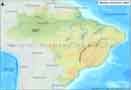
South America is surrounded by the Pacific Ocean on the west, Atlantic Ocean on the east, and the Caribbean Sea to the north. South America is the fourth largest continent on Earth, and because of its triangular shape, it has a relatively short coastline.
Search Physical Maps of Continents & Countries
Physical map of
Continents
and
Countries
- Algeria
- Angola
- Benin
- Botswana
- Burkina Faso
- Burundi
- Cameroon
- Cape Verde
- Chad
- Democratic Republic of The Congo
- Egypt
- Eritrea
- Ethiopia
- Kenya
- Lesotho
- Libya
- Madagascar
- Mali
- Mauritania
- Mauritius
- Morocco
- Mozambique
- Namibia
- Niger
- Nigeria
- Somalia
- South Africa
- Sudan
- Tanzania
- Uganda
- Zimbabwe
- Afganistan
- Armenia
- Bangladesh
- Bhutan
- Brunei
- China
- India
- Indonesia
- Iran
- Iraq
- Israel
- Japan
- Jordan
- Kazakhstan
- Kuwait
- Kyrgyzstan
- Laos
- Lebanon
- Malaysia
- Mongolia
- Myanmar
- Nepal
- North Korea
- Pakistan
- Philippines
- Qatar
- Russia
- Russia
- Saudi Arabia
- Singapore
- South Korea
- Srilanka
- Syria
- Thailand
- Turkey
- United Arab Emirates
- Uzbekistan
- Vietnam
- Albania
- Andorra
- Austria
- Belarus
- Belgium
- Bosnia and Herzegovina
- Bulgaria
- Croatia
- Cyprus
- Czech Republic
- Denmark
- England
- Estonia
- Finland
- France
- Georgia
- Germany
- Greece
- Hungary
- Iceland
- Ireland
- Italy
- Kosovo
- Latvia
- Lithuania
- Luxembourg
- Malta
- Montenegro
- Netherlands
- Netherlands
- Norway
- Poland
- Portugal
- Romania
- Serbia
- Slovakia
- Slovenia
- Spain
- Sweden
- Switzerland
- Turkey
- United Kingdom
- Ukraine
- Antigua and Barbuda
- Barbados
- Belize
- Canada
- Costa Rica
- Cuba
- Dominican Republic
- El Salvador
- Grenada
- Guatemala
- Haiti
- Honduras
- Jamaica
- Mexico
- Nicaragua
- Panama
- Trinidad and Tobago
- United States of America
- Argentina
- Bolivia
- Brazil
- Chile
- Colombia
- Ecuador
- Paraguay
- Peru
- Uruguay
- Venezuela
- Australia
- Fiji
- New Zealand
- Papua New Guinea


 Buy Printed Map
 Buy Digital Map
 Customize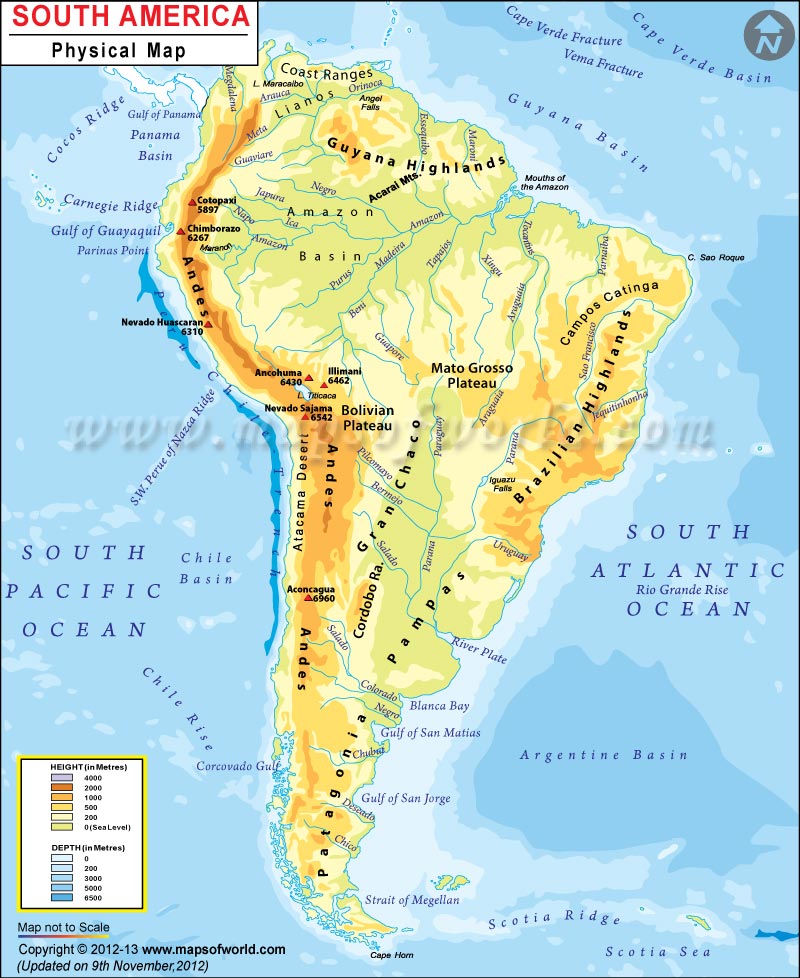
| Description : Physical map of South America showing mountain ranges, plateaus, rivers, plains etc. | Disclaimer |
Close Disclaimer : All efforts have been made to make this image accurate. However MapSherpa, Inc, its directors and employees do not own any responsibility for the correctness or authenticity of the same. |
Physical maps of South American Countries
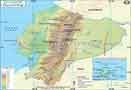
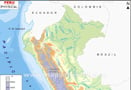
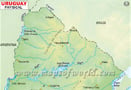
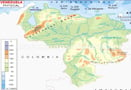
South America is located in the Western Hemisphere, and is the southern portion of the Americas, which are sometimes grouped together as one continent.
South America is linked to North America at the Isthmus of Panama, a region that is known as Central America. South America is situated primarily in the Southern Hemisphere, though part of the continent extends into the Northern Hemisphere.
South America can be divided into three major natural regions, each of which contains many subregions.
The Andes Mountains
Traversing the western coast of South America from north to south, the Andes are the longest continental range of mountains in the world, at about 7,000 kilometers in length. The Andes run through Venezuela, Colombia, Ecuador, Peru, Bolivia, Chile, and Argentina. The Andes region was created is home to many volcanoes, including the world's highest, Ojos del Salado.
Eastern Highlands
The Highlands across the eastern side of the continent belong to the older geologic period, around the same time as the Appalachian Highlands. The Highlands are divided into two sections: the Guiana Highlands in the north and the Brazilian Highlands in the south.
Plains
In the lowland basin between the Eastern Highlands and the Andes Mountains, the plains are drained by the Amazon River and the Paraguay-Parana River system. The Amazon flows through the equatorial evergreen forest, while the Paraguay-Parana basin covers the fertile plains of the Pampas.