Cities in Australia
 Buy Printed Map
 Buy Digital Map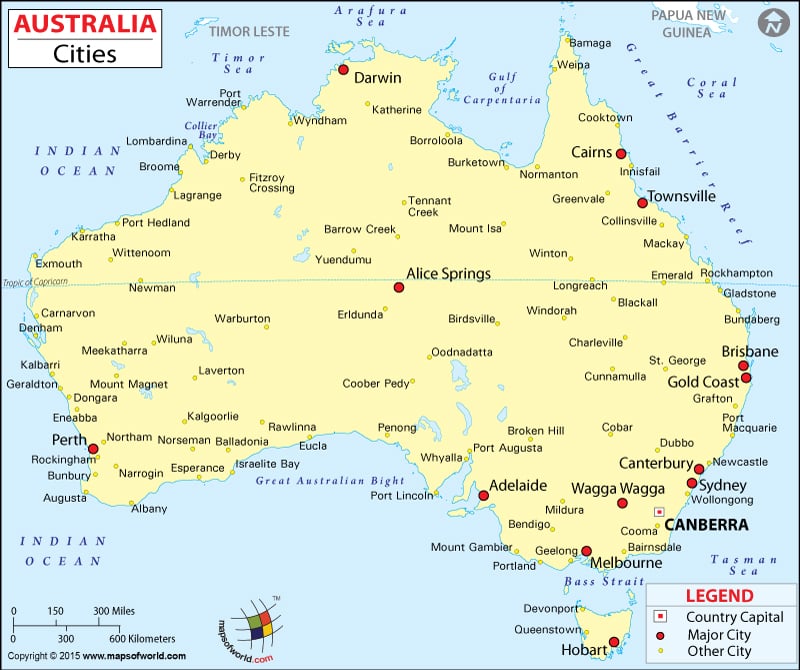
Australia’s major cities include Sydney, Melbourne, Brisbane, Perth, Adelaide, Cairns, Darwin, and Canberra, the capital.
Major Cities in Australia |
|---|
| Rank | GCCSA/SUA | State/Territory | Population (2015) |
|---|---|---|---|
| 1 | Sydney | New South Wales | 4,920,970 |
| 2 | Melbourne | Victoria | 4,529,496 |
| 3 | Brisbane | Queensland | 2,308,720 |
| 4 | Perth | Western Australia | 2,039,193 |
| 5 | Adelaide | South Australia | 1,316,779 |
| 6 | Gold Coast-Tweed Heads | Queensland/New South Wales | 624,918 |
| 7 | Newcastle-Maitland | New South Wales | 434,454 |
| 8 | Canberra-Queanbeyan | Australian Capital Territory/New South Wales | 424,666 |
| 9 | Sunshine Coast | Queensland | 302,122 |
| 10 | Wollongong | New South Wales | 292,388 |
| 11 | Hobart | Tasmania | 220,593 |
| 12 | Geelong | Victoria | 187,417 |
| 13 | Townsville | Queensland | 180,333 |
| 14 | Cairns | Queensland | 147,993 |
| 15 | Darwin | Northern Territory | 142,258 |
| 16 | Toowoomba | Queensland | 114,622 |
| 17 | Ballarat | Victoria | 99,841 |
| 18 | Bendigo | Victoria | 92,888 |
| 19 | Albury-Wodonga | New South Wales/Victoria | 88,949 |
| 20 | Launceston | Tasmania | 86,633 |
| 21 | Mackay | Queensland | 85,455 |
| 22 | Rockhampton | Queensland | 80,665 |
| 23 | Bunbury | Western Australia | 75,628 |
| 24 | Bundaberg | Queensland | 70,588 |
| 25 | Coffs Harbour | New South Wales | 68,572 |
| 26 | Wagga Wagga | New South Wales | 55,820 |
| 27 | Hervey Bay | Queensland | 52,288 |
| 28 | Mildura-Wentworth | Victoria/New South Wales | 50,011 |
| 29 | Shepparton-Mooroopna | Victoria | 49,371 |
| 30 | Gladstone-Tannum Sands | Queensland | 49,248 |
| 31 | Port Macquarie | New South Wales | 45,341 |
| 32 | Tamworth | New South Wales | 42,255 |
Cities in Australia
Australia’s major cities include Sydney, Melbourne, Brisbane, Perth, Adelaide, Cairns, Darwin, and Canberra, the nation’s capital. Australia comprises six states and two mainland territories: The states are New South Wales, Queensland, South Australia, Tasmania, Victoria, and Western Australia. Australia’s mainland territories are, the Australian Capital Territory, and the Northern Territory.
The capital of Australia is Canberra, which is located in the Australian Capital Territory, in southeastern Australia. Canberra has a population of approximately 381,488, making it the largest inland city in the country. Nationally, Canberra is the eighth largest city in the county, and covers an area of 314 square miles (814 square kilometers).
The most populous city, and world renowned, in Australia is Sydney, which is the capital of New South Wales. Sydney covers an area of 4,775.2 square miles (12,367.7 square kilometers), and is home to nearly 5.07 million people, as of 2017. Sydney is also the Prime Minister and Governor General of Australia’s second official seat, and second official residence.
Sydney is the major cultural center of Australia, with a thriving art & music scene, and is known for cultural events and festivals. It is also known for its multi-venue performing arts center – Sydney Opera House, which is a masterpiece of great 20th century architecture. Sydney ranks as one of the best cities to live in, according to the ‘Mercer Quality of Living Survey,’ that ranked it tenth-best among all the cities of the world, regarding the quality of living.
Melbourne, the capital of Victoria, is the second most populous city in Australia, with a population of 4.67 million, as of (2016) with growth rate of 2.98%. The area of Melbourne is about 3,857.4 square miles (9,990 square kilometers), and it is called ‘Garden City.’ Melbourne is often considered the cultural capital of Australia, as it houses the headquarters of the country’s film and television industry, and major sports and arts centers.
Brisbane is Queensland’s capital, and is the third most populous city in Australia with a population of 2.2 million people. Brisbane covers an area of 6,110.5 square miles (15,826 square kilometers). Established on May 13th, 1835, it is one of the oldest cities of Australia. Some of the popular sporting events that have been held in the city are the 1982 Commonwealth Games, the Goodwill Games in 2001, and the 2014 G-20 summit.
Perth is situated in Western Australia, and is the largest city and capital of the state. Perth has a population of 2.04 million people living in its metropolitan area, which covers 2,079 square miles (5,386 square kilometers). In 2016, The Economist Intelligence list, ranked Perth as the seventh most livable city in the world.
The fifth largest city in Australia is Adelaide, the South Australian capital. Adelaide’s population numbers about 1.34 million as of (2016) with growth rate of 1.82%, and it has an area of 705 square miles (1,827 square kilometers). Since the mid-19th century, Adelaide has been known as the ‘City of Churches.’ Some of attractions in the city include; Adelaide Botanic Garden, Adelaide Central Market, North Terrace, Bonython Park, and Elder Park to name a few. Cairns in Queensland, and Darwin, the capital of the Northern Territory are some other important cities in Australia.
