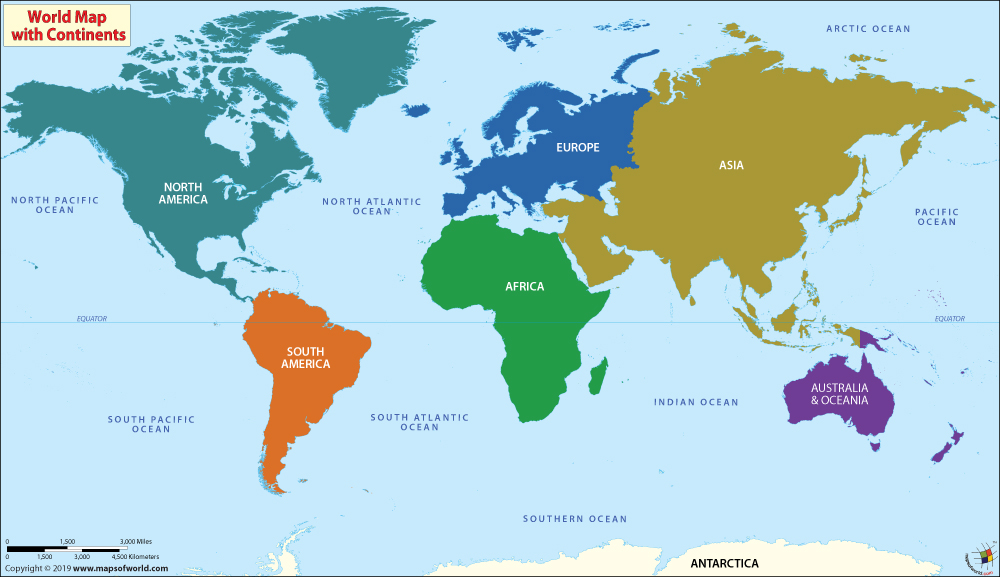
Explore this World Continents Map to know everything you want to know about the continents of the world. This World Continents Map shows all the seven continents of the world labelled on a map. The map also shows all the oceans.
What are the Continents
A continent can be defined as one of the very large landmasses on the surface of the earth. Comprising many countries, continents are mainly surrounded by sea. The earth is divided into seven continents; however, there is great variation in the size of all these continents. Asia is the largest continent, followed by Africa, North America, South America, Antarctica, Europe, and Australia. At times, the two continents of Europe and Asia are considered a single continent, Eurasia. The continental landmasses are concentrated more in the Northern Hemisphere than in the Southern Hemisphere in terms of area.
Continents of the World
The Isthmus of Suez connects Africa and Asia, while the North & South America are joined by the Isthmus of Panama. These isthmuses are considered quite narrow if we take into the account the area of the landmasses they join. No isthmus or sea separates Asia from Europe, which explains the reasoning behind the concept of Eurasia, that is Europe and Asia as one continent. This is one of the six-continent models of the world. This view, however, is only popular in Japan, some Eastern European countries, and Russia. The continents North and South America are considered separate ones. However, in earlier times, they were considered a part of a single continent and were collectively referred to as America. Still today, a few South American countries consider the two to be a single continent. There’s another theory concerning the division of the continents, called the four-continent model. As per this theory, Africa, Europe, and Asia are considered a single continent and are collectively called Afro-Eurasia. And, thus, the total number of continent reduces to four, namely, Australia, Antarctica, America, and Afro-Eurasia.
List of Continents |
|---|
| Continent | Area | Approx. population | Density (People per km²) |
| Asia | 17.21 million sq mi (44.58 million sq km) | 4.436 billion | 86.70 |
| Africa | 11.73 million sq mi (30.37 million sq km) | 1.216 billion | 29.30 |
| North America | 9.54 million sq mi (24.71 million sq km) | 579 million | 21.0 |
| South America | 6.888 million sq mi (17.84 million sq km) | 422.5 million | 20.8 |
| Antarctica | 5.405 million sq mi (14 million sq km) | 5,000 temporary residents | 0.00007 |
| Europe | 3.931 million sq mi (10.18 million sq km) | 743.1 million | 69.7 |
| Australia and Oceania | 3.292 million sq mi (8.526 million sq km) | 41,050,699 | 3.6 |
Oceans in the World |
|---|
| Rank | Ocean | Remark |
| 1 | Pacific Ocean | Separates Oceania and Asia from the Americas |
| 2 | Atlantic Ocean | Separates the Eurasia and Africa from Americas |
| 3 | Indian Ocean | Spreaded upon southern Asia and separates Africa and Australia |
| 4 | Southern Ocean | It encircles Antarctica, considered an extension of the Pacific, Atlantic and Indian Oceans |
| 5 | Arctic Ocean | A sea of the Atlantic, which washes upon northern North America & Eurasia and covers much of the Arctic |
Variations of Continents Other continental divisions include super continents and subcontinents. Super continents Super continents are those landmasses that have more than one continental core or craton. The contemporary instance is Eurasia. Other examples include Rodinia, Pangaea, Laurasia, Kenorland, Gondwana, and Columbia. Subcontinents Subcontinents are those parts of a continent that fall on tectonic plates different than the rest. Arabian Peninsula and the Indian subcontinent are the best examples of it. Submerged Continents These are those areas of the crust of the continent that are to a large extent sea-covered. For example, Zealandia, which is buried under the sea. Micro continents Some islands drift off from the main continent body. However, they are too small to be called continents and hence are called micro continents. The largest micro continent is Madagascar.
Asia
| Area | 17.21 million sq mi (44.58 million sq km) |
| Population | 4.436 billion |
| Pop. density | 226/sq mi (89/km²) |
| Countries | 47 (List of Asian Countries) |
| Time Zones | UTC+2 to UTC+12 |
Africa
The second largest and the second most populated continent in the world is Africa. It is bordered by the Indian Ocean to the southeast, the Atlantic Ocean to the west, the Mediterranean Sea to the north, and Suez Canal & Red Sea to the northeast. The continent has 53 countries, not including the disputed territory located in Western Sahara.
Africa Information:
| Area | 11.73 million sq mi (30.37 million sq km) |
| Population | 1.216 billion |
| Pop. density | about 80/sq mi (30.51/km²) |
| Countries | 53 (List of African Countries) |
| Time Zones | UTC-1 to UTC+4 |
North America
The continent is present in the western and northern hemispheres of the earth. It is surrounded by South America and the Caribbean Sea on the southeast, the North Pacific Ocean on the west, the Arctic Ocean on the north, and the North Atlantic Ocean on the east. It is the third largest continent, covering 9,540,198 sq. miles. North America Information:
| Area | 9.54 million sq mi (24.71 million sq km) |
| Population | 579 million |
| Pop. density | 59.3/sq mi (22.9/km²) |
| Countries | 23 (List of Countries in North America) |
| Time Zones | UTC-10 to UTC |
South America
Located in the southern and western hemisphere, South America is the 4th largest continent in the world. In the northern hemisphere, too, a small part of the continent is present.
| Area | 6.888 million sq mi (17.84 million sq km) |
| Population | 422.5 million |
| Pop. density | 55.4 per sq mi (21.4 per km²) |
| Countries | 13 |
| Time Zones | UTC-2 to UTC-5 |
Antarctica
Spread over an area of 5,400,000 square miles, Antarctica is the fifth largest continent in the world. It is also the southernmost continent of the earth. The continent is surrounded by the Southern Ocean and is located in the southern hemisphere. It is the driest, windiest, as well as the coldest continent. Antarctica Information:
| Area (Overall) | 5.405 million sq mi (14 million sq km) |
| (ice-free) | 280,000 km² (100,000 sq mi) |
| (ice-covered) | 13,720,000 km² (5,300,000 sq mi) |
Europe
With an area of 3930519 sq. miles, it is the world’s second smallest continent. However, it is one of the most populous continents on the planet. Europe Information:
| Area | 3.931 million sq mi (10.18 million sq km) |
| Population | 743.1 million |
| Pop. density | 181/sq mi (70/km²) |
| Countries | 50 (List of European Countries) |
| Time Zones | UTC to UTC+5 |
Australia & Oceania
The world’s smallest continent is Australia. One theory suggests that the continent only includes the Australian mainland and not the islands in the vicinity, like Tasmania or New Guinea. However, another says that these islands should be included because the geological landmass shared by them is the same. Australia information:
| Area | 3.292 million sq mi (8.526 million sq km) |
| Population | 41,050,699 |
| Pop. density | 3.7/km² |
| Countries | Australia, Papua New Guinea, and portions of Indonesia. Check List of Oceania Countries. |
| Time Zones | GMT+10, GMT+9.30, GMT+8 |
For a better understanding of each continent, refer to the various world continent maps that have been designed by Mapsofworld.com. Click here for more information on 7 Continents and 7 Wonders and World Currencies.