Canada Map
 Buy Printed Map
 Buy Digital Map
 Wall Maps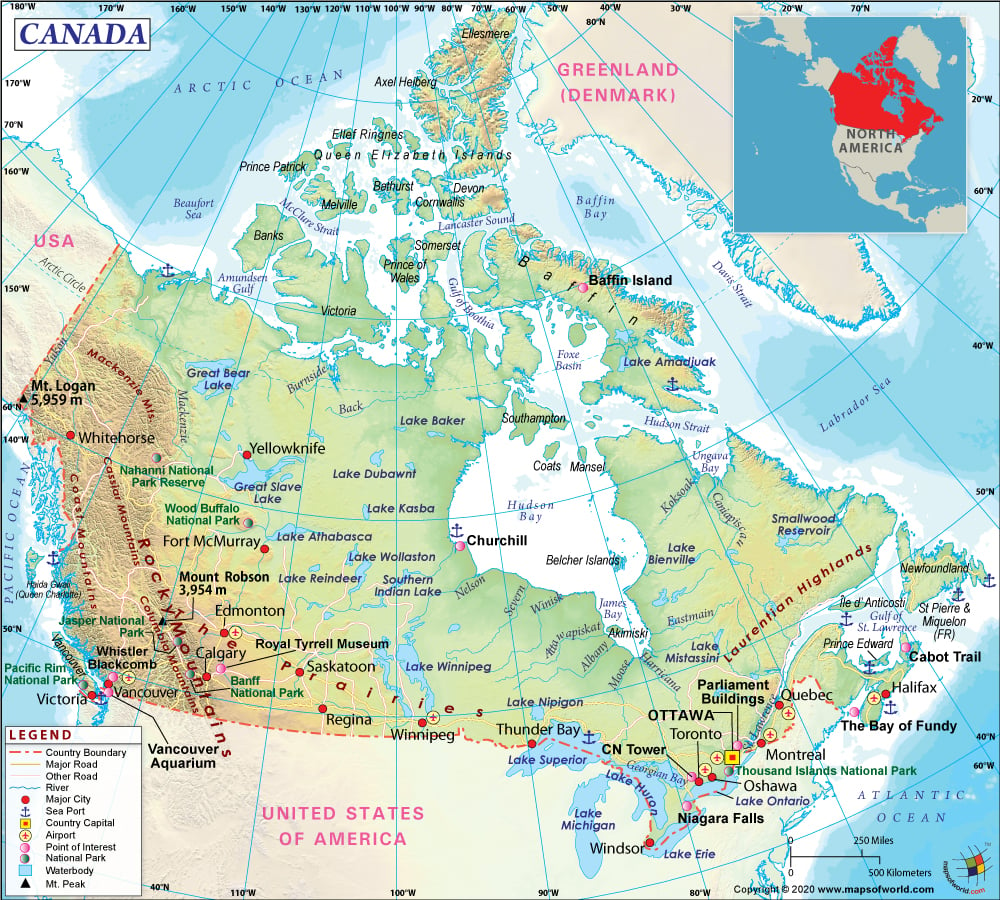
- Canada Provinces and Territories - Alberta, British Columbia, Manitoba, New Brunswick, Newfoundland and Labrador, Northwest Territories, Nova Scotia, Nunavut, Ontario, Prince Edward Island, Quebec, Saskatchewan, Yukon
- Neighboring Countries - Greenland, United States, Iceland
- Continent And Regions - North America Map, Americas Map
- Other Canada Maps - Where is Canada, Canada Blank Map, Canada Road Map, Canada Rail Map, Canada River Map, Canada Cities Map, Canada Political Map, Canada Physical Map, Canada Flag, Country with the Longest Coastline
Explore this Canada Map to learn everything you want to know about this country. Learn about Canada’s location on the world map, official symbol, seal, flag, geography, climate, postal/area/zip codes, time zones, etc. Check out Canada’s history, significant states, provinces/districts, & cities, most popular travel destinations and attractions, the capital city’s location, facts and trivia, Top 10 FAQs (Frequently Asked Questions), and many more.
About Canada
Canada is the world’s second-largest country by total area situated in North America. Canada consists of an entire area above 9.98 million square kilometers. Canada shares southern and western borders with the United States, stretching 8,891 kilometers (5,525 mi), and is the world’s longest binational land border. The capital of Canada is Ottawa, and the three most significant metropolitan areas are Toronto, Montreal, and Vancouver. Canada is a highly developed country with an advanced economy, the eighth-largest in the world. The country has the 24th highest nominal per capita income globally and the sixteenth-highest ranking on the Human Development Index.
Canada Flag
The current flag of Canada was adopted on September 1, 2006. The design of the Canadian flag consists of three vertical stripes. The right and left stripes are red and of equal size. The center stripe is a white square and a red maple leaf in the center. The maple leaf in the center of the flag symbolizes nature and the environment representing the national tree of Canada.
The National Emblem of Canada is the Beaver. On March 24, 1975, Beaver was given official status as an emblem of Canada as a symbol of the sovereignty of Canada. The official other symbols formally adopted by the Government of Canada are:
- The Coat of Arms
- The Maple Leaf Tartan
- The Maple tree
Canada Location
Canada Location Map shows the exact location of Canada on the world map. The physical Map of Canada shows the boundaries of this country, neighboring countries, and oceans.
Canada is often considered a country far north that shares its land boundaries with :
- the U.S state of Alaska to the northwest
- contiguous 12 United States to the south
- Greenland to the northeast
- Newfoundland to the east
- The Arctic Ocean to the south
- The Atlantic Ocean to the east
- The Pacific Ocean to west
The Latitude and Longitude extent of Canada is 42. and 83. N Latitude and 52. and 141° W Longitude. One can check this Latitude and Longitude Map of Canada for more information.
Canada Capital
The capital city of Canada is Ottawa. Ottawa is the fourth largest city in Canada and is situated in southeastern Ontario, about 250 miles (400 km) northeast of Toronto and 125 miles (200 km) west of Montreal. The city of Ottawa is situated on the south bank of the Ottawa River across from Gatineau, Quebec, at the confluence of the Ottawa (Outaouais), Rideau and Gatineau rivers. In 1857, Ottawa had named the capital of the province of Canada and retained its status when Canada became a dominion within the British Commonwealth in 1867.
The climate of Ottawa is continental, with humid and warm summers and usually cold and snowy winters. As the national capital, Ottawa boasts federal government institutions, extensive public transport, and an infrastructure system.
Canada Time Zone
In Canada, six primary time zones cover the provinces and territories. From east to west time zones in Canada are Newfoundland Time Zone (UTC -3:30), Atlantic Time Zone (UTC-4), EST-Eastern Standard Time (UTC-5), CST-Central Time zone (UTC-6), Mountain Time Zone (UTC-7)and the Pacific Time Zone(UTC-8).
Canada Geography
The geography of Canada is vast and occupies much of the Continent of North America. The country extends from the Atlantic Ocean in the east, along the Arctic Ocean to the north, and the Pacific Ocean to the west encompassing 9,984,670 km2 (3,855,100 sq mi) of territory. The country also has a vast maritime terrain, with the world’s longest coastline of 243,042 kilometers (151,019 mi). After Russia, Canada is the second largest country in the world, and in terms of land area, it ranks fourth due to having the world’s largest area of freshwater lakes. The country has over 2,000,000 lakes, of which 563 are more significant than 100 km2 (39 sq mi). Canada has a wide variety of landforms. The country is divided into the following seven physiographic regions.
- The Canadian Shield
- The Interior plains
- The Great Lakes-St. Lawrence lowlands
- The Appalachian region
- The Western Cordillera
- Hudson Bay lowlands
- Arctic Archipelago
Canada Climate
Canada has a wide variety of climates due to its great latitudinal extent. Average summer and winter temperatures vary from region to region across Canada. Winters in Canada are harsh in many parts, particularly in the interior and many provinces. The northern two-thirds of Canada has a climate similar to that of northern Scandinavia, with very cold winters and short, cool summers.
Except for the west coast of Canada, all countries have a winter season with average temperatures below freezing and continuous snow cover. West coast of Canada, Vancouver, has an average January temperature of 37. F (3. C) and an average July temperature of 64. F (18. C), while in the interior plains, Regina, Saskatchewan, average temperatures vary from -1 to 67. F (-18 to 19. C). Check this Canada Climate Map to know more.
Canada History
The history of Canada dates back to the period from the arrival of the paleo-Indians to North America thousands of years ago. Indigenous Peoples inhabited the lands encompassing present-day Canada before European colonization. French and British expeditions explored from the late 15th century. They colonized and fought over various places within North America in what constitutes present-day America. In 1534 the colony of New France was claimed with permanent settlements beginning in 1608.
In 1791 the British Province of Quebec was divided into upper and lower Canada. By the Act of Union 1840, the two provinces were united as the Province of Canada, which came into force in 1841. The province of Canada was joined with two other British colonies of Nova Scotia and New Brunswick through Confederation, forming a self-governing entity” Canada” in 1867. In 1949, Canada expanded by incorporating other parts of British North America, finishing with Newfoundland and Labrador.
Canada Provinces
Canada is divided into 10 Provinces and three territories. One can explore the Provinces and Territories map of Canada to have the details. In alphabetical order, the provinces of Canada are as follows:
- Alberta
- British Columbia
- Manitoba
- New Brunswick
- Newfoundland and Labrador
- Nova Scotia
- Ontario
- Prince Edward Island
- Quebec and Saskatchewan
The three Territories of Canada are Northwest Territories, Nunavut, and Yukon.
Canada Major Cities
As of 2022, the country has three cities with more than a million people. The largest and most populous city in Canada is Toronto. The other most populous and significant cities of Canada are Toronto, Montreal, Calgary, Ottawa, Edmonton, Mississauga, Vancouver, Brampton, and more. One can view Canada Cities Map for more details.
Canada Airports
Canada has about 518 Airports. There are 13 airports currently designated as international airports in Canada. The busiest and the largest airport in Canada is Toronto Pearson International Airport. The other significant airports in the country include Vancouver International Airport, Halifax Stanfield International Airport, Montreal Pierre Elliott Trudeau International Airport, Ottawa McDonald-Cartier International Airport, and Calgary International Airport.
Canada Postal Codes
Canada has an alphanumeric Postal Codes format with six characters different from the ZIP code format of the United States. The first character denotes the province of address, and the second character is a district within that province. The third character in the Canadian Postal code is a letter representing the” postal zone” of the region. The last three letters are numbers that indicate a smaller delivery area. There are 876,445 Postal codes in Canada as of 2019.
Canada Travel
Canada owing to its vast terrain and magnificent natural landscape, offers many options for travel and tourism. It is the ideal hub for outdoor activities, and visitors can enjoy trekking in the beautiful countryside and fishing in numerous lakes and rivers. Canada Travel map is for the detailed information. Some of the most popular tourist destinations in Canada
- Niagara Falls
- CN Tower
- Marineland
- Notre-Dame Basilica
- Museum of Archaeology and History, Montreal
- Vancouver Aquarium Marine Science Center, Vancouver
- Capilano Suspension Bridge and Park, Vancouver
Top FAQs on Canada
FAQ #1: What currency does Canada use?
Ans: Canadian dollar is the currency of Canada
Faq #2: What Is The Capital Of Canada?
Ans: Ottawa is the capital city of Canada, located in the province of Ontario
Faq #3: Is Canada a democracy?
Ans: The country is a parliamentary democracy, a federation, and a constitutional monarchy. The parliament of Canada consists of three parts: the Queen, represented by the governor general; the Senate; and the house of commons.
Faq #4: Where is Quebec in Canada?
Ans: Quebec, the sole Canadian province where citizens of French are in the majority, is located in the eastern part of Canada. The issue of Quebec’s state of being self-governing dominated Canadian politics for the last decades of the 20th century
Faq #5: Where is Canada located?
Ans: Canada is located in northern North America, covering 41% of the Continent. The country shares the longest border in the world with the United States.
FAQ #6: When was Canada founded?
Ans: Canada was founded on July 1, 1876. In 1867, on July 1, Canada was formed as a Dominion by the British North America Act or Constitution Act.
Faq #7: When is Canada day?
Ans: Canada Day is celebrated on July 1.
FAQ #8: How many provinces are in Canada?
Ans: There are ten provinces and three territories in Canada.
Faq #9: Where is Alberta, Canada?
Ans: Alberta is located in western Canada and is one of the three prairie provinces. Alberta shares its boundaries with British Columbia to the west, Saskatchewan to the east, the Northwest Territories (NWT) to the north, and the U.S state of Montana to the south.
FAQ #10: How big is Canada?
Ans: Canada covers about 9,984,670 square kilometers or 3,854,085 square miles. It is the second largest in the world after Russia.