Cameroon Map
 Buy Printed Map
 Buy Digital Map
 Wall Maps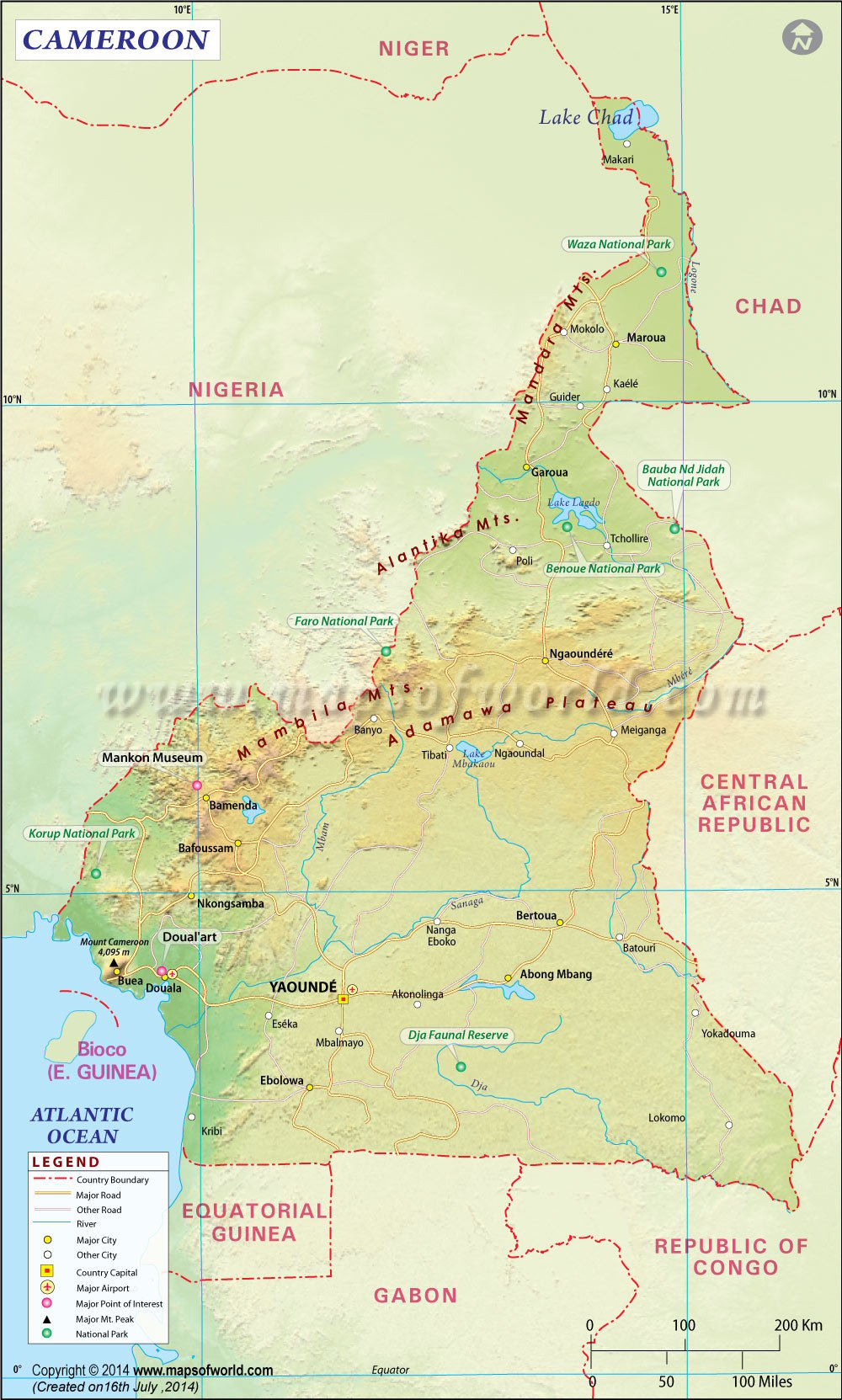
- Cameroon Cities - Yaounde
- Neighboring Countries - Nigeria, Chad, Central African Republic, Equatorial Guinea, Gabon, Republic of the Congo
- Continent And Regions - Africa Map
- Other Cameroon Maps - Where is Cameroon, Cameroon Blank Map, Cameroon Road Map, Cameroon Rail Map, Cameroon River Map, Cameroon Political Map, Cameroon Physical Map, Cameroon Flag
About Cameroon
Explore this Cameroon map to learn everything you want to know about this country. Learn about Cameroon location on the world map, official symbol, flag, geography, climate, postal/area/zip codes, time zones, etc. Check out Cameroon history, significant states, provinces/districts, & cities, most popular travel destinations and attractions, the capital city’s location, facts and trivia, and many more.
| Official Name | Republic of Cameroon |
| Capital | Yaounde |
| Population | 15.2 million |
| Area | 475,422 sq km or 183,561 sq mi |
| Currency | CFA Franc ($1=724.11) |
| Religion | Christianity, Islam and tribal beliefs |
| Literacy | 63% |
| Languages | French, English |
| Major Cities | Yaounde, Douala, Bafoussam |
| Climate | Tropical climate |
Originally part of the German colony in West Africa, Cameroon became a republic in 1960. The country is in the shape of an elongated triangle and forms a bridge between West Africa and Central Africa.
Physical Map of Cameroon
Cameroon can be divided into four distinct topographical regions – the south which is a coastal plain having dense equatorial rain forests; the center, the Adamawa Plateau, consisting of a region with elevations reaching about 4,500 ft above sea level; the far north comprising of the savanna which gradually slopes into the marshland surrounding Lake Chad; and the west consisting of high, forested mountains of volcanic origin, where the highest peak in western Africa measuring 13,435 ft is situated.
The principal rivers of Cameroon include the Sanaga and Nyong rivers which flow west to the Atlantic Ocean, and the Mbèrè and Logone rivers that flow north from the central plateau into Lake Chad.
Location of Cameroon
Cameroon is bound on the north by Lake Chad; on the east by Chad and the Central African Republic; on the south by the Republic of the Congo, Gabon, and Equatorial Guinea; and on the west by the Bight of Biafra (a part of the Atlantic Ocean) and Nigeria.
Climate of Cameroon
Cameroon has a tropical climate – humid in the south but increasingly dry towards the north. Along the coast, the average annual rainfall is about 4,060 mm while on the slopes of Cameroon Mountain and other peaks of the west, rainfall is almost constant. In the semiarid northwest, annual rainfall measures about 380 mm. A dry season in the north lasts from October to April. The average temperature in the south is 25°C, on the plateau it is 21°C, and in the north it is 32°C.
Flag of Cameroon
The flag of Cameroon is made up of three equal vertical bands of green (hoist side), red, and yellow. The middle red band has a yellow five-pointed star.
Flora And Fauna of Cameroon
Cameroon is home to rain forests that contain a number of different kinds of trees, including oil palms, bamboo palms, mahogany, teak, ebony, and rubber. Variety of wildlife can be found which includes monkeys, chimpanzees, gorillas, antelope, lions, and elephants, as well as numerous species of birds, squirrels, frogs, and snakes.
People of Cameroon
Cameroon is made up of about 200 ethnic groups who speak as many different languages. The Bantu-speaking peoples inhabit the south, and Sudanic-speaking people dominate the north. Among the more important ethnic groups are the Bamileke, a Bantu-speaking people, and the Fulani who are Muslims. French and English are both official languages but the former is widely used.
While about half of the people of Cameroon live in urban areas, the other half, consisting of farmers, live in small towns or villages in southern and central Cameroon. The people follow various religious beliefs- 24 percent adhere to traditional religions, about 21 percent follow Islam and the remaining population follow Christianity.
Economy of Cameroon
The economy of Cameroon is to a certain extent dependent on agriculture, which is the main occupation of about 70 percent of Cameroon’s population. Then the country has a rich resource of timber but the main source of revenue is generated through petroleum reserves. The country has also large reserves of bauxite and natural gas, though they have yet to be exploited. Hydroelectric power stations on Cameroon’s rivers, particularly the Sanaga, provide enough electricity to meet almost all of the country’s needs. In 1999, the national budget showed revenues of $1.4 billion and expenditures of $1.4 billion.