Bulgaria Map
 Buy Printed Map
 Buy Digital Map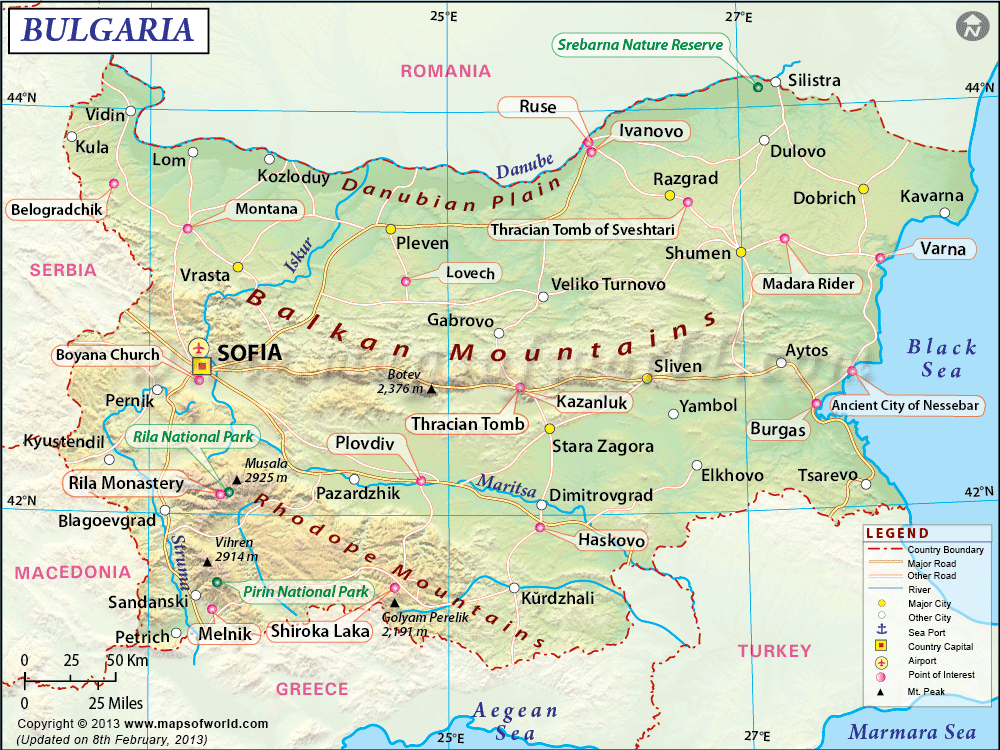
- Bulgaria Cities - Plovdiv, Sofia, Varna
- Neighboring Countries - Macedonia, Greece, Serbia, Romania, Kosovo
- Continent And Regions - Europe Map
- Other Bulgaria Maps - Where is Bulgaria, Bulgaria Blank Map, Bulgaria Road Map, Bulgaria Rail Map, Bulgaria River Map, Bulgaria Political Map, Bulgaria Physical Map, Bulgaria Flag
Explore this Bulgaria map to learn everything you want to know about this country. Learn about Bulgaria’s location on the world map, official symbol, seal, flag, geography, climate, postal/area/zip codes, time zones, etc. Check out Bulgaria’s history, significant states, provinces/districts, & cities, most famous travel destinations and attractions, the location of the capital city, facts and trivia, Top FAQs (Frequently Asked Questions), and many more.
About Bulgaria
Bulgaria, officially known as the Republic of Bulgaria, is a small country in southeastern Europe. The country is situated on the eastern flanks of the Balkans and encompasses a territory of 110,994 square kilometers (42,855 sq mi). Bulgaria is the sixteenth-largest country in Europe. The largest city and the national capital of Bulgaria are Sofia. Bulgaria declared its Independence from the Ottoman Empire on October 5, 1908. Check Key Facts of Bulgaria to learn more about the country.
Flag of Bulgaria
The flag of Bulgaria was adopted after the Russo-Turkish War of 1877-1878 and re-established in 1991. The flag’s design is a tricolor consisting of three equal-sized horizontal bands white, green, and red (from top to bottom). White is for peace and prosperity, Green depicts agriculture and wealth, and red is for Independence.
Bulgaria Location
The Bulgaria Location Map shows the exact location of Bulgaria on the world map. This map depicts the boundaries of this country, neighboring countries, and oceans. Bulgaria shares its border with Romania to the north, Turkey and Greece to the south, North Macedonia and Serbia to the west, and Black towards the east.
The Latitude and Longitude extent of Bulgaria is 42.3755.N Latitude and 25.1629. E Longitude in Europe One can check Bulgaria Latitude and Longitude Map for more information.
Bulgaria Capital
The capital city of Bulgaria is Sofia. The Eastern European city is home to many architectural and historical sites. Sofia features several beautiful churches, museums, monuments, and public buildings. The city is also home to the Amphitheater of Serdica and Sofia Public Mineral baths. Sofia is one of the oldest cities, built in the 6th century, and has been an essential cultural site in the country’s history. Check Map of Sofia to learn more.
Time Zones in Bulgaria
The country uses only a one-time zone, Eastern European Standard Time (EET). EET is two hours ahead of UTC (coordinated universal time), that is, UTC+2. Bulgaria observes daylight saving time as Eastern European Summertime (EEST), where the clocks are switched forward by 1 hour in summer. Check Bulgaria Time Zone Map to learn more.
Bulgaria Geography
The physical map of Bulgaria has revealed all the details about the country’s physical features, including mountain peaks, rivers, and lakes. Geographically, the country is located in Southeastern Europe, occupying the eastern quarter of the Balkan Peninsula. Bulgaria runs 1808 kilometers (1,123 mi), and its coastline is 354 kilometers (220 mi) long. The most prominent topographic features of the country are:
- Danubian Plain
- Balkan Mountains
- Thracian Plain
- Rila-Rhodope massif
Bulgaria Climate
Two climatic regions generally characterize the climatic conditions of Bulgaria:
- Continental climate in the north- Have higher temperature and precipitation variation than coastal regions.
- Mediterranean climate in the south- Hot and dry in summers and cool in winters.
Bulgaria Major Cities
The Bulgaria Cities Map shows valuable details, including the capital city and administrative divisions. Major cities of Bulgaria are:
Provinces in Bulgaria
The country is divided into twenty-eight provinces that are further divided into 265 municipalities since 1999. Provinces in Bulgaria are the first-level administrative subdivisions of the country. Check Bulgaria Political Map to locate all the provinces on the map.
Bulgaria Airports
Bulgaria, at present, has five international airports located in different areas of the country. Check Bulgaria Airports Map to learn more. The busiest Airports in the country are:
- Sofia Airport
- Burgas Airport
- Varna Airport
- Plovdiv Airport
Bulgaria Postal or ZIP Codes
Postal codes in Bulgaria consist of four digits, and there are no spaces or separator characters. The first two digits in the Bulgarian ZIP codes indicate the area or certain areas, and the last two indicate the town.
Bulgaria Travel
Travel and tourism options in Bulgaria are diverse, ranging from sandy beaches to rugged mountain ranges flecked with distant villages to mineral springs to enamoring monasteries and churches. There are many UNESCO world Heritage Sites as well. Some of the most significant tourist attractions of Bulgaria are:
- Rila Monastery
- Alexander Nevsky Cathedral
- Sofia Zoo
- Troyan Monastery
- Boyana Church
- Khrelio’s Tower
- The Aquarium Park and Black Sea Museum
Top FAQs on Iran
FAQ #1: Was Bulgaria part of the Soviet Union?
Ans: Bulgaria was closely associated with the Soviet Union during the Cold War. The country remained part of Eastern Block until 1989; after that, BCP began to drift away from the USSR.
FAQ#2: Is Bulgaria in the EU?
Ans: The country joined the European Union on January 1, 2007.
Faq #3: What language do they speak in Bulgaria?
Ans: The official language of Bulgaria is Bulgarian, which is spoken by approximately 85% of the population
Faq#4: Is Bulgaria in NATO?
Ans: Bulgaria has been a member of NATO since 2004.
Faq #5: What is Bulgaria known for?
And: Bulgaria is famous for its diverse landscape, Rose oil, lavender, and wine.
