French Guiana Map
 Buy Printed Map
 Buy Digital Map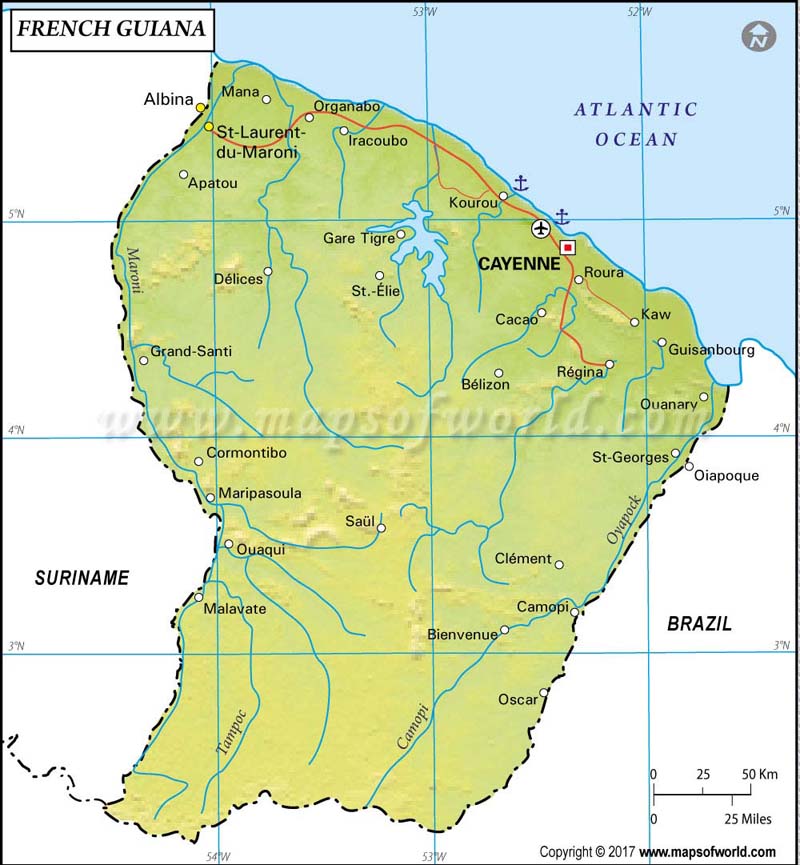
About French Guiana
Explore this French Guiana map to learn everything you want to know about this country. Learn about French Guiana location on the world map, official symbol, flag, geography, climate, postal/area/zip codes, time zones, etc. Check out French Guiana history, significant states, provinces/districts, & cities, most popular travel destinations and attractions, the capital city’s location, facts and trivia, and many more.
| Full name: | Guyane Française |
| Capital City: | Cayenne |
| Language: | French (official), French Guianese creole & Amerindian languages (spoken) |
| Currency: | Euro (€) |
| Religion: | Catholic |
| National Anthem: | La Marseillaise |
| Newspaper: | Saint Laurent du Moroni, Kourou, Rémire-Montjoly |
| Places to Visit: | Trésor & Kaw Nature Reserves, Réserve Animalière Macourienne, Îles du Salut, Kourou, Cayenne |
| Transport: | Air links with Europe, mainly France within French Guiana. Avail passenger ferry to Albina by crossing over Suriname from St Laurent du Maroni. River transport, car and buses are available. |
| Shopping: | Basketry, hammocks, pottery, embroidery,wood sculpture and gold jewelry. |
Get a colorful blend of cultural background where one can explore the astonishing historical significance of French Guiana that still retains itself with the past traces that has been left behind from ages. From canoeing down the clear waters of the river to gazing the delivery of leatherback turtles, from experiencing the beautiful scenic flight of the toucans to looking out for gold, this place has enough to offer.
Location of About French Guiana
French Guiana is nestled within France which is lying adjacent to the European Union. Known as the smallest political entity placed within the South American mainland that engulfs the Atlantic Ocean towards the northend side, Brazil from the eastern and southern side, and Suriname towards the western side.
Physical Map of French Guiana
French Guiana can be separated into two distinct regions:
• The coastal strip along which the majority of the population reside in.
• The dense untouched rainforest area from where the Tumac-Humac Mountains, ascends along the Brazilian frontier.
The highest peak in French Guiana is Bellevue de l’Inini, which extend along with ranges like Mont Machalou, Pic Coudreau and Mont St Marcel, Mont Favard and Montagne du Mahury.
An artificial lake built in the north of French Guiana, which is known as The Barrage de Petit-Saut hydroelectric dam provides hydroelectricity within the region.
Climate of French Guiana
The climatic condition of French Guiana is typical tropical in nature affected with hot and sultry condition. The place experiences mainly two main seasons wherein:
- The month of August to December are considered as Dry season.
- The months of December to June are affected with severe down pouring.
French Guiana is hot throughout the year especially nights being relatively cooler.
The Average annual rainfall is nearly 2,500 mm generally hit by snowfall, while the average temperature being 27°C.
Flora And Fauna of French Guiana
The native flora of French Guiana includes species like the Chlorocardium , which is even referred to as sipiri, beeberu and bibiru. It is an evergreen tree which is strong and hardy which is found in abundance here. Another dry-season deciduous tree that can be sighted here are the Platonia tree, which has its close resembles to a papaya.
The native fauna of French Guiana includes Silky Anteater, Weeper Capuchin, Jaguar, White-faced Saki, Brazilian Squirrel, White-tailed Deer, Lachesis muta, Neotropical Pygmy Squirrel, Black-tailed Hairy Dwarf Porcupine, Dendrobates tinctorius, Corydoras geoffroy and many others.
People of French Guiana
The population of French Guiana who thrive along the coastal regions is known for their cultural diversity and ethnic multiplicity. Among the ethnic group settled in this region mention can be made of:
• The Mulattos People (who are a blend of black and white origin).
• The Haitian community
• And, the Creole population.
The smaller groups thriving here are: The Asian community: Hmong (Laos), Chinese (Hongkong & Zhejiang), Saint Lucia, Maroons and Amerindians.
Roman Catholicism is the sole religion thriving here. The official language of this region is French though American Indian languages are also spoken here. Taki Taki is quite common with the black origins settled here. Hinduism and Islam were slowly introduced in this region that gained wide acceptance.
The people of French Guiana indulge in greeting each other with a hello, which is said through the word “Salut” in their native language. Comment “allez vous” that means “How are you?” is even frequently used among themselves. Festival is an important way through which one socializes with another. These people reside in colorful huts covered with thatched roofs that are usually painted in light blue or yellow tones.
Arts, Culture and Music of French Guiana
Art: The Black, the American Indian and the Vietnamese have influenced the origin of folk art within this region while coming up with crafts made of textiles, pottery, and wood carving.
Culture: French Guiana’s, enjoy watching television or going for a movie during their leisure hours. The young crowd is even attracted towards the ongoing disco clubs, cafes, and dance club. Beaches along the Cayenne offer a suitable location for picnicking and swimming. One even indulges in recreational activity like boating, swimming, fishing and playing soccer.
Music: The French Guiana people resort to music and dance that is accompanied with a drum. A woodwind instrument is the sole instrument that is used while playing the American Indian pro music. French ballads, pop and rock music have made it place in recent time while attracting the present generation.
Flag of About French Guiana
The regional flag of French Guiana is inscribed with a logo, which is denoted through the yellow colored five-pointed star within a blue patch. Another orange figure placed on a yellow colored boat top the green patch striped with two orange colored wavy lines. On the topmost part of the flag the word GUYANE is beautifully placed and at the bottom is inscribed with the word LA RÉGION.
The French tricolor is expressed through the vertical bands that is displayed in colors of blue (from the hoist side), white, and red beautifully adorns the national flag of French Guiana.
Economy of French Guiana
The economic growth of French Guiana has a close bonding with France that supports the place with imported goods and financial backing. The French space center at Kourou, fishing and forestry has a great role in supporting this region economically. The saw logs from the sawmill industry are exported to different parts of the country comes from the huge reserves of tropical hardwoods that are found here in abundance. Rice and manioc are cultivation along the coastal region on which the majority of population thrives.
The commodities that are imported here are: food grains, processed meat, machinery, energy, transport equipment, fuels and chemicals
Exports of goods include: shrimp, timber, gold, rum, rosewood essence, and clothing.
