Egypt Map
 Buy Printed Map
 Buy Digital Map
 Wall Maps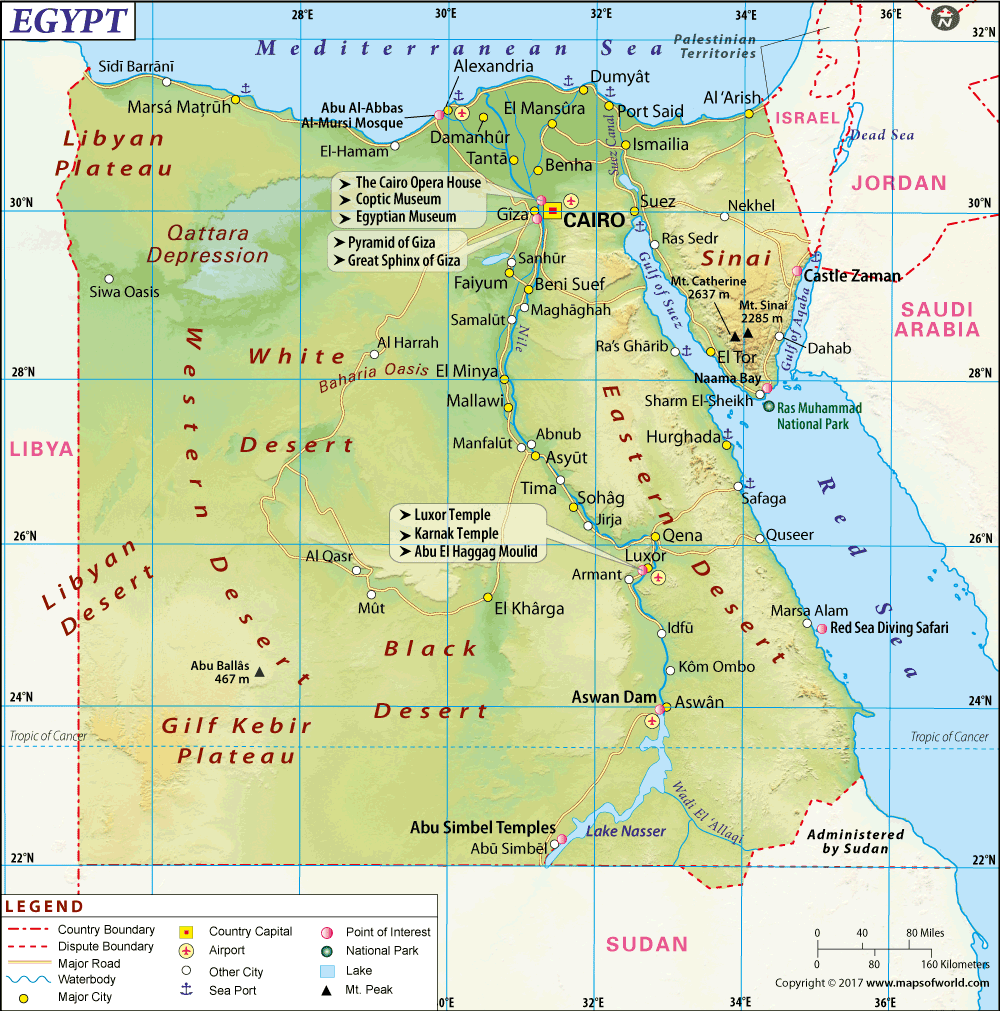
- Egypt Cities - Cairo
- Neighboring Countries - Libya, Sudan, Israel, Jordan, Saudi Arabia
- Continent And Regions - Africa Map
- Other Egypt Maps - Where is Egypt, Egypt Blank Map, Egypt Road Map, Egypt Rail Map, Egypt River Map, Egypt Political Map, Egypt Physical Map, Egypt Flag
About Egypt
Explore this Egypt map to learn everything you want to know about this country. Learn about Egypt location on the world map, official symbol, flag, geography, climate, postal/area/zip codes, time zones, etc. Check out Egypt history, significant states, provinces/districts, & cities, most popular travel destinations and attractions, the capital city’s location, facts and trivia, and many more.
| Official Name: | Arab Republic of Egypt Jumhuriah Misral-Arabiya |
| Capital: | Cairo |
| Population: | 69.1 million |
| Area: | 997,677sq km or 385,205 sq mi |
| Currency: | Egyptian Pound |
| Religion: | Islam and Christianity |
| Literacy: | 51% |
| Languages: | Arabic, English |
| Major Cities | Cairo, Alexandria, Giza |
| Climate: | Hot summers and cool winters |
Egypt, known across the Arab world as Misr, is a country with its mainland in Africa and with its peninsula region of Sinai in Asia. This and the strategic location of the Suez Canal make Egypt’s location invaluable in terms of providing Europe and the western world easy passage to the eastern countries. The country itself boasts of a huge tourism industry owing largely to the ancient culture, colorful traditions, and historic monuments such as the pyramids and temples. The revolution of 2011 has put Egypt in the spotlight with regard to international politics, trade, and security.
The Nile Valley of Egypt stands out in sharp contrast to the desert regions. The valley and delta of the Nile are very fertile regions, teeming with urban populace, and growth and prosperity. The river relieves the country of its dependence on rainwater and has been primarily responsible for the existence and prosperity of Egypt.
History of Egypt:
Gift of the Nile: Herodotus was not inaccurate in observing that Egypt is the gift of the Nile. The country owes its very existence to the river, the major source of water in the midst of the arid and deathly expanse of the Sahara Desert. The nomadic tribes that traversed the African desert in caravans gravitated towards the Nile Valley. The river’s periodic floods and inundations provided these tribes a rich, cultivable land to grow crops. Settlement was the natural outcome. The Nile Valley of Egypt saw its earliest settlements as far back as 6000 BC. Ease of irrigation consolidated the settlements to form a cohesive civilization. Barter of food and other items essential for survival, administrative coherency, and intermarriage unified the country into one political entity.
The Unification of Egypt: 3100 BC saw the rise of the first political dynasty of Egypt. The first Pharaoh accredited with unifying Upper and Lower Egypt is Narmer, known popularly as Menes, the founder. Menes established sovereign authority over the entire stretch of the Nile Valley starting from the first cataract at Aswan, down south (Upper Egypt) up to the fan-like delta where the river empties itself into the Mediterranean Sea (Lower Egypt). The early capital is believed to be Ineb-Hedg (Memphis), a center of immense cultural and political importance in ancient Egypt. Pharaohs of the later eras are believed to have favored Thebes as the capital of the country. Even in these early ages, Egyptian society was known for its use of hieroglyphs and written records. The use of numbers and calendars was not unknown.
The Old Kingdom: The period roughly spanning from 2500 BC to 2130 BC has been termed by historians as the Old Kingdom of Egypt. This is primarily due to the revolutionary changes in art, architecture, and culture, and with regard to the political stability of the country. The Old Kingdom is the era when Egypt was ruled by the Third Dynasty through the Sixth Dynasty and the country’s capital was at Mempis. The Pharaoh attributed with bringing about the most remarkable changes in administration and culture is Zoser of the Third Dynasty. Imhotep, Zoser’s scribe and architect was the man who envisioned the Step Pyramid. Zoser’s own pyramid at Saqqara is the earliest known colossal structure of Egypt.
The fourth Dynasty Pharaohs Khufu, Khafre, and Menkure commissioned the construction of the pyramids of Giza and the Sphinx. These are probably the best known symbols of Egyptian architecture and have captured the imagination of scholars across the world. It is this period that the initial evidences of mummification in Egypt are found. The rule of the Fourth Dynasty pharaohs such as Sneferu is known to have been excellent in terms of strengthening the kingdom’s political and trade ties with the outside world. A number of records of the Old Kingdom have been found by archeologists and these testify to the advancement of civilization under the rule of these Pharaohs.
The Fifth and Sixth Dynasty pharaohs administered the land well but did not add significantly by way of novelty. By the Seventh Dynasty, anarchy had taken hold of the country. The rule of the Seventh, Eighth, Ninth, and Tenth Dynasties called the First Intermediate Period by historians and lasted approximately from 2130 BC to 2000 BC.
The Middle Kingdom: The end of political chaos and the establishment of the Middle Kingdom (2000 BC to 1630 BC) were brought about the reign of Pharaoh Nebhepetre (Mentuhotep II). Nebhepetre made Thebes his capital and gained administrative control over all of Egypt. The Eleventh and Twelfth Dynasty Pharaohs took historic trade ahead and made attempts to annex Nubia. The treasures of the Pharaohs coffers came from Nubia which was rich in gold, precious stones, ivory, ebony, and animal skin.
The Second Intermediate Period that followed the Middle Kingdom was, again, a period of general chaos and did not see much advancement culturally. This era saw the invasion of Egypt by the Hykos who were eventually ousted by the rise of the Seventeenth Dynasty in Thebes. Soon after this Pharaoh Amhose established the Eighteenth Dynasty and heralded the start of the New Kingdom.
The New Kingdom: The New kingdom lasting from approximately 1540 BC to 1080 BC was the golden period for art and architecture in Egypt. The Temples of Karnak and Luxor and the tombs located in the Valley of the Tombs were commissioned by the pharaohs near their capital city of Thebes. The Eighteenth, Nineteenth, and the Twentieth Dynasties reigned in Egypt through these glorious years.
The history of the New Kingdom was one of expansion, consolidation, and strengthening of trade ties. Thutmose I initiated the policy of conquest by expanding the boundaries of Egypt to include Nubia in the south and parts of Syria in the north. His son, Thutmose II, married Princess Hatshepsut. Hatshepsut ruled the land as sovereign monarch at the demise of Thutmose II, since her son was just an infant. She styled herself pharaoh and donned male attire while conducting the affairs of the state. In 1470 Thutmose III took up the reigns of the throne and proved himself an excellent warrior and statesman. He quelled all rebellion in the vassal states and begot himself strong allies in various parts of the kingdom. The vassals who had once rebelled against the monarch were provide cultural and educational aid and converted into faithful allies. This era also saw the rise of the cult of the god Amun-Re to whom the temple at Luxor is dedicated. This temple was commissioned by Pharaoh Amenhotep III.
Amenhotep IV changed his name to Akhenaten and prohibited worship of the traditional Egyptian gods and goddess. His loyalty to the deity Aten resulted in the commissioning of the great temple of Aten by the pharaoh. This monotheistic thought was not received by the Egyptians who were used to a worshipping a pantheon of gods and goddess. Within a year of Akhenaten’s demise the kingdom fell back to the old practices and worship of Amun was restored to its former glory. The next significant ruler of the New kingdom was Pharaoh Tutankhamen. While the king’s rule itself was short-lived and insignificant, the discovery of his tomb in the year 1922 by Howard Carter was a significant event in the study of ancient Egypt. Ay and Horemheb were the next pharaohs and were succeeded by Ramses who founded the Nineteenth Dynasty.
The reign of Ramses I was short-lived. His son Seti provided the kingdom much stability in a eleven year long rule and was succeeded by the popular Pharaoh Ramses II who ruled Egypt from 1279-1213 BC. In his spectacular reign, Ramses III commissioned spectacular architectural projects including a monument at Abu Simbel dedicated to his family. The sculptures at this monument depicted his likeliness and that of his family. Ramses II completed building the celebrated columns at Karnak. An efficient administrator, Ramses II ensured that the Egyptians saw a period of unparalleled prosperity. Conflicts with Syria were settled amicable and peace flourished in the kingdom. In 1190 BC, Setnakht ascended the throne. His descendants took the name Ramses acknowledging the success of the reign of Ramses II. The pharaohs Ramses III through Ramses IX were unsuccessful in administering the kingdom well. Syria, Palestine, Libya, and Nubia broke free from the weakening kingdom. In 1075 BC Tanis, the Egyptian city declared its independence from the kingdom of Egypt.
Rise and Fall of Cush: The governor of Tanis, founder-pharaoh of the Twenty-First Dynasty could not impose his rule over Thebes. The Libyan kings who formed the Twenty-Second Dynasty ruled as weak monarchs. The Twenty-Third Dynasty kings at Thebes were not much stronger. The only stable empire in Egypt during this period was the monarchy at Cush.
Kashta, the monarch of Cush, embarked on a conquest of the Nile Valleyin about 750 BC but success was achieved by his son, Piankhi who managed to unify the kingdoms along the length of the Nile, including Memphis. Shabaka, his brother, ruled next and exercised considerable control over Thebes and Memphis. Shabaka’s nephew, Sennacherib, the next ruler, suffered humiliating defeat in the hands of the Assyrian king, Esarhaddon. In the year 663 BC, Egypt is captured by the Assyrians and all of the land from Memphis to Thebes is subjugated.
An Era of Instability: The Assyrians had captured Egypt but were unsuccessful in administering a stable government due to the distance. The vassal king designated by the Assyrians usurped control and restored a semblance of stability. The following years saw the defeat of the Egyptian army at the hands of the Babylonian army and again at the hands of the Persians. Egypt remained under Persian dominion from 525 BC through 332 BC.
Alexander and the Greeks in Egypt: Alexander the Great, the Greek monarch liberated Egypt from the Persian rule in 332 BC and was greatly liked due to his love of Egypt. Alexander showed great regard for the customs of natives and set up the great city of Alexandria. Acknowledged Pharaoh by the priests at Memphis and Siwa, Alexander received the authentication required to make Greeks rule Egypt peacefully for the next three centuries. Ptolemy restored peace after a brief period of chaos that followed Alexander’s demise. He built Alexander’s famous tomb in Alexandria.
Ptolemy followed a policy of conquest and consolidation and the Ptolemaic Dynasty ruled Egypt till the Romans set their sights on the Egyptian land. Cleopatra VII was the last pharaoh of the dynasty, best-known for her ravishing beauty and sexual appeal. Her love affairs with Julius Caesar and Mark Anthony are legends that historians never fail to recall. Anthony and Egypt fell to Augustus Caesar’s sway in 30 BC. Anthony stabbed himself and died. Cleopatra chose the Egyptian traditional method of suicide by allowing herself to be bitten by the asp.
Introduction of Christianity: The Romans ruled Egypt for over six centuries but did not influence the country’s cultural thought much with the exception of playing an important role in the introduction of Christianity in the country. Alexandria was the center of dissemination of Christian though and by the 5th century AD the Copts emerged as the harbingers of the Coptic Church in Egypt. In the 7th century AD, when the Arabs had launched their conquest of Egypt, the Copts lost their language to the use of Arabic but gained a distinct identity in the country.
Introduction of Islam: Egypt fell to the sway of Arab conquest in the seventh century AD. In 640 AD, the Arabs proclaimed their rule over the town Al Fustat near Cairo. Alexandria held them off till 642 AD when the city was taken over by the Muslims. The Abbasid caliphs, with their base in Baghdad found it increasingly difficult to control the governors appointed in Egypt and to administer effective control. This allowed the Mamelukes, who had advanced from being slaves to positions of military importance, to take charge of administration and usurp control. Ahmad Ibn Tulun is known in the history of Egypt as one of the earliest Mamelukes to have taken control of the country (870’s). His conquest of Palestine and Syria ensured that the two regions remained Egyptian territory under the rule of his dynasty. The Tulunid dynasty retained power till 905 AD and was displaced in 935 AD by the Ikhshidid Dynasty which ruled till 969 AD.
Starting 969 AD, Egypt was under the governance of the Fatimid Dynasty. Al Kahira meaning ‘The Victorious’ was the new capital and the center of political and cultural development. By the early 11th century, Al Kahira, (Cairo) being the capital of a huge Fatimid empire that stretched across Sicily, most of Arabia, and the Mediterranean, attracted the erudite scholars, artists, educationalists, historians, and scientists to become the melting point of cultural and educational activities. It is important to note, here, that the Fatimid rulers were Shi’a Muslims. In 1171, Saladin, founder of the Ayubid Dynasty, brought Egypt to the Sunni practice by capturing the country Jerusalem, and eastern fringes of the Mediterranean. The dynasty ruled Egypt till 1250 AD. The following decade seek the ascent of two Mameluke sultans in quick succession – Aybak and Qutuz has short reigns of not much significance.
The Mameluke Ascendancy: The next Mameluke ruler of Egypt was one who established himself as a soldier of immense ferocity and ruthlessness. Baibars shot to fame in 1250 when he defeated the Seventh Crusade of Louis IX of France as the military commander of Sultan Qutuz. What sealed his rise to authority was the defeat of the hitherto “unvanquished” Mongols by his army at the Battle of Ain Jalut in 1260. Baibars aspired to rule sovereign, murdered Qutuz, and seized power. Baibars and succeeding Mamelukes of Egypt were careful not to ruffle popular sentiments and ruled in the name of the Abbasid sultans of Persia. The rule of the Mamelukes lasted till about 1517 AD.
Egypt as part of the Ottoman Empire: In Selim I, a sultan of the Ottoman Dynasty overtook Cairo and all of Egypt in 1517. Selim I delegated authority to Khair Bey and named Egypt a vassal state. Egypt was directly controlled by the Beys, appointed governors, who were often Mamelukes. Although the early Beys were steadfastly loyal to the Ottoman sultans, the later Beys grew in power. The 17th century Ottoman sultans were not as capable as their predecessors and the Beys often ruled without much interference.
Napoleon and the French army invaded Egypt in July 1798. A defeat of the Mameluke army at Giza allows Napoleon to gain authority over Cairo. A few days after this victory, however, Lord Nelson of the British Navy is believed to have burned the French ships off the Egyptian coast. Napoleon and his army were stranded and the Turkish army took this opportunity to attack. Napoleon won a nominal victory in Syria and left Egypt soon after. By 1801 the French troops were ousted by the Turkey and England. The Mameluke beys regained ascendancy.
19th century Egypt: In 1811, Mohammed Ali a governor loyal to the Ottoman sultans brutally massacred about 300 Mameluke beys ending their rule in Egypt. Mohammed Ali and Ibrahim Pasha were initially loyal to the Ottoman Sultans and won many wars in their stead. But by 1832 Ibrahim Pasha found himself pitted against the Ottoman army. Thereafter, history tells of a series of victories won by Ibrahim Pasha against the Turkish sultan. Acre, Homs, Konya and Nipiz were the scenes where he etched his military supremacy.
In 1840 a treaty was signed in London between Mohammed Ali and Turkey with the former gaining authority over all of Egypt. His long reign was momentous and marked the beginning of an era of modernization, and development of trade and industrial ties with the rest of the world. By the time Abbas I took over from Mohammed Ali, Egypt was a prosperous and modern nation with its importance as Europe’s gateway to the eastern counties growing multifold with many canals and waterways having been commissioned. Abbas was succeeded by Said and later by Ismail.
Said Pasha’s rule saw two very significant events in the development of Egypt. Work on the Suez Canal was commissioned by Said and completed by 1869. Port Said became momentously important due to its strategic location. A robust rail network linking Alexandria and Cairo was also built during this time. Ismail launched a series of reforms in Egypt, rebuilding Cairo and Alexandria on European models. The post and telegraphic services and railways breathed a new life. These reforms and a costly war with Ethiopia emptied the Egyptian coffers. In a desperate bid to raise funds Ismail Pasha sold his Suez Canal shares to the British Government. Pressure mounted from French and British quarters and in 1879 the sultan of Istanbul, as sovereign authority forced Ismail to step down. Ismail Pasha was succeeded by his son Tewfik Pasha. Following the ascendancy of Tewfik, nationalist thought in Egypt flared up. Such pro-Islam and anti-western sentiments were fanned by Urbi Pasha whose raise in the Egyptian armed forces was linked to his protest against Britain, France and the western world. Popularly recognized as the leader of the Egyptian nationalist movement, Urbi Pasha quickly rose to the position of the Egyptian Minister of War. In 1882, British forces confronted the Egyptian army led by Urbi Pasha in a bid to firmly establish the European dominance in the country. Urbi Pasha’s defeat and subsequent exile made way for British occupation of the country.
Evelyn Baring, 1st Earl of Cromer, was posted as Consular-General for the British monarchy in Egypt. Baring pursued a policy of ensuring financial stability in Egypt and brought in significant foreign investment in the country’s cotton industry. Many financial reforms were planned and executed by Baring. Baring, however, lacked the support of the Egyptian nationalists and was replaced by Eldon Gorst in 1907.
The Demand for Independence: Egypt’s1914 political scenario became precarious with Turkey, seat of the Ottoman sultan – sovereign of Egypt, and Britain, occupational authorities of Egypt, at war. Britain declared Egypt free from the sovereignty of the Turkish sultan and ousted his representative, governor Abbas II. Husayn Kamil was named the next Khedive (governor). Husayn was succeeded by Fuad after his lifetime.
Defeat of Turkey and the Axis Powers fueled Egypt’s demand for independence. With the populace crying out to be recognized, internationally, Saad Zaghul formed the Egyptian Delegation, Al-Wafd al-Misri, in 1918. The intent was to make Egyptian presence felt at the Paris Peace Conference of 1919. Britain was unhappy with the Zaghul and the political agitation. When the delegation and its members were arrested and exiled to Malta in 1919, the country broke out in the First Revolution. Demonstrations were held and the demand for independence grew louder in Egypt. In 1922, having realized that the Wafd was an outcome of the nationalist demand of the entire nation, Britain signed a treaty with the Sultan Fuad agreeing to grant Egypt independence despite retaining vested interests in the Suez Canal. In 1922, Fuad was thus declared king and Egypt an independent country.
Internal Dissent: With the introduction of the constitution in 1923 elections became inevitable. The monarch, King Fuad, was inimical to the Wafd and the Prime Minister elect, Saad Zaghul. The issue of Sudan was on the top of the Wafd’s political agenda. When British forces ousted Egyptians from Sudan in 1924, the political relations between the countries reached an all-time low. In the home front there was much dissent between the monarchy and the elected government.
The Muslim Brotherhood, another influential religious and political group was formed in 1928. Mustafa al-Nahas Pasha, the leader of the Wafd after Zaghul continued to keep up the commitment to constitutional administration. Farouk, the heir apparent, inherited the throne at the demise of Kind Fuad. King Farouk was as committed a royalist as his father. The Anglo-Egyptian treaty of 1936 was a major breakthrough in restoring peace between Egypt and Britain. Britain agreed to downsize the troops placed on Egyptian soil. Though not actively involved in World War II, Egypt was used as a base for military operations by Britain.
Following the war, resentment against the British presence in Egypt ran high. The Arab League was formed following the conference of Arab nations in Cairo in 1945. Dissent following the Arab-Israel war and deteriorating security situation in the country led to the outbreak of widespread riots in January 1952. Cairo saw widespread incidences of public violence, destruction of property, and death of British nationals. Later, in July that year, the military group that identified itself as Free Officers led by General Gamal Abdel Nasser overthrew King Farouk and exiled the monarch. On 18 June 1953, Egypt was declared a republic.
Egypt – the Republic: While General Nasser wieldeds all authority in the country, Mohammed Naguib headed the country as the first president. Following a parting of the ways Nasser quickly toppled Naquib’s regime and assumed presidency in 1954. Nasser quickly forged cordial trade ties with many countries in the east and nationalized the Suez Canal. He recognized the importance of building the Aswan High Dam on the agriculture of Egypt. This move did not go down well with the French and British. In 1956, France and Britain launched a combined attack but mounting international pressure forced the countries to declare peace. Nasser maintained his dreams of pan Arabic dominance and maintained antagonistic relations with Israel. In 1970, President Anwar El-Sadat succeeded Nasser upon the latter’s demise. Sadat cultivated diplomatic relations with Israel and achieved much needed peace. This, however, did not go well with other Arab countries and the dream of a united Arab nation seemed a distant dream. Muslim terrorists claimed his life in 1973. President Hosni Mubarak succeeded him and retained his presidency till 2011.
2011 Egyptian Revolution: Starting January 25, 2011, Egypt saw widespread protests and demonstrations. Millions of Egyptians united across traditional religious divides in an attempt to overthrow President Hosni Mubarak and took to the streets of Cairo, Alexandria, Siwa, Luxor, Sinai and Suez, Mansoura, Tanta, and other parts of the country. President Hosni’s thirty year long spell as the President of Egypt had evoked considerable dissent. Inspired by the Tunisian Revolution, Egyptians took to civil disobedience and peaceful protests. Long standing grievances including rampant corruption, police brutality, lack of basic freedoms including the freedom of speech and other legal and political issues propelled the masses to protest. Fuelled by outrage on the Internet based social networking websites and a call for action on the part of youth protestors mobilized an unprecedented millions of citizens to turn up and a redressal of their demands.
On January 25, 2011, widespread protests broke out in Cairo and other cities of Egypt. While the Egyptian police attempted to disperse the protesters by firing tear gas and rubber bullets, the demonstrations at Tahir Square, in Cairo caught international attention.
On January 26, 2011, a call for action on social networking websites such as Facebook and Twitter encouraged hundreds of thousands to return and protest. Water cannons and tear gas could not keep them away. A number of arrests and some incidences of violence used by the police were also reported. The Egyptian government shut down the Internet and telecommunication links in the country.
January 28, was called the ‘Friday of Anger’. Protests reached a crescendo and crowds thronged the streets of Cairo and other cities in protest. Violent clashes broke out in many parts of the country. Prison breaks and looting incidences made it to the news. The military was deployed by the government. The president’s address to the nation did nothing to subvert the night’s clashes and ensuing deaths. Curfew was declared the following day.
Over the next few days demonstrations and protests escalated and the president’s promise to enact reforms was rejected by the protesters. February 2, 2011, saw a huge rise in the death toll with protestors having gone in for a confrontation at Tahir Square in Cairo. President Hosni resigned on February 11, 2011. The constitution was suspended and power was transferred to the Supreme Council of the Armed Forces. Protests continued through a good part of March 2011 and normalcy returned only when the constitutional referendum was passed n March 19, 2011.
The protests cost Egypt over 380 lives and incalculable losses to public property. The stability and security of the country has been severely compromised and travel to the country has been severely hampered.
Geography of Egypt:
Egypt is located in the northeastern fringes of Africa and shares international boundaries with Libya to the west (692 miles), Sudan to the south (791 miles), and Israel to the north-east (165 miles). The Mediterranean Sea to the north of Egypt and the Red Sea, the Gulf of Suez, and the Gulf of Aqaba to the east endow the country with a coastline stretching over 1820 miles in all. Egypt covers an area of 386,660 sq mi and is the 30th largest country in the world.
The highest elevations in Egypt are in the southern part of the country. The southern regions of the Sinai Peninsula are also mountainous. Most of Egypt is an arid desert with little or no vegetation. The Nile, the longest river in the world, flowing from the south to the north, cuts through this desert plateau and renders the county habitable. In fact, the Nile endows its delta with fertility unheard of in desert regions. With the exception of the Nile basin, the rest of the country is an arid desert with little or no vegetation. The ancient Egyptians called the Nile basin Black Land due to its rich alluvial deposits. In contrast, they referred to the desert land as Red Land.
The river Nile is fed by the White Nile, the Blue Nile and the Atbara rivers of central Africa. Nile enters Egypt near Wadi Halfa in Sudan.
Lake Nasser to the south of Egypt is a man-made reservoir resultant from the construction of the Aswan Dam across the Nile. The Aswan Low Dam was constructed at the First Cataract of the Nile in 1902. The High Dam was constructed between 1960 and 1970. The region extending from the Aswan Dam to the city of Cairo is referred to as the Nile Valley. The region further up north is the Nile Delta. Low-lying, flat, and rich in silt deposits, the Nile Delta’s agricultural products support the entire country. The Nile is said to have had seven distributaries creating the fan-shaped valley. At present only two of these distributaries, the Damietta and the Rosetta carry the Nile waters to the Mediterranean Sea. An extensive network of canals now crisscrosses the delta region and assists the flow of the waters into the agricultural fields. A number of lakes and marshes dot the Nile Delta.
In early Egypt, the Nile went through cycles of inundation and relinquishment. When the Nile would flood its banks it irrigated the crops on its banks and endowed the land with great fertility. But the floods could just as easily wreak havoc on the agriculture and spell a year of economic low. The most fertile regions were those where the elevation was high or those where the primary products were tree crops. The relinquishment of the Nile spelt an enhancement of the land’s fertility since the floods left behind a rich deposit of alluvial silt. The flooding of the Nile also depended largely on the amount of rainfall received by Central Africa where the tributaries of the Nile arise.
The construction of an irrigation system and the dams on the Nile, especially the Aswan dams, has changed a lot. The flow of the Nile no longer depends quite as heavily on the rainfall received by Central Africa. The deposit of silt is now around Lake Nasser. This has also significantly affected the fertility of the Nile basin.
Two major deserts make up the Egyptian desert region – the Eastern Desert and the Libyan Desert. The Eastern Desert, thus called due to its location to the east of the Nile, extends upto the Red Sea. The mountain range traversing this region is called the Eastern Desert. Shaiyb al-Banat is the highest peak of the range. To the west of the Nile is the portion of the Sahara Desert which is referred to as the Libyan Desert. The Libyan Desert is characterized by massive sand dunes and eight great depressions. The desert is mostly uninhabited except for sporadic settlements such as those in the Siwa Oasis near the Qattara Depression. The lowest point of Egypt (133 meters below sea level) is in the Qattara Depression. The Temple of Amun in the Siwa Oasis is known for its prophetic oracles. The Fayyum Oasis is another oasis in the Libyan Desert which is cultivable at certain points. Mount Catherine (2,642 meters) in the Sinai Peninsula is the highest elevation in Egypt.
Temperatures in most of Egypt range from 80°F to 90°F in summer and from 55°F to 70°F in winter. The Mediterranean coast enjoys a cooler temperature in comparison to the rest of the country. Frequent dust storms called ‘Khamaseen’ blow south-north in summers. Rainfall is scanty and unpredictable. The higher elevations in the Sinai Peninsula face snowfall occasionally in winters. February-March and October-November are the tourist-friendly months in the country.
Government and Polity of Egypt:
Known locally as Jumhuriyat Misr al-Arabiyah or simply Misr, Egypt has been a republic since the year 1952; prior to that the country was a monarchy. The 29 governorates or administrative divisions of Egypt are: Ad Daqahliyah, Red Sea, El Beheira, El Faiyum, Al Gharbiyah, Alexandria, Ismailia, Giza, El Monofia, Al Minya, Cairo, Al Qalyubiyah, Al Uqsur, New Valley, Suez, Ash Sharqiyah, Aswan, Asyut, Beni Suef, Port Said, Damietta, Helwan, South Sinai, Kafr ash Shaykh, Western Desert, Qena, North Sinai, Sittah Uktubar, and Sohag.
Given the political instability, many constitutions have been adopted by Egypt over the years. In 1923, having gained independence from Britain, Egypt adopted a liberal constitution which declared the country as an ‘independent, sovereign, Islamic state’. At the time, the separation of powers allowed the monarch of Egypt to lead the executive function and created a bicameral parliament to take up the legislative functions of the state. The monarchy replaced the constitution from 1930 to 1935 in a bid to usurp more power. The initial constitution, however, was restored. In 1953, Gamal Abdel Nasser assumed presidency and enforced a constitution that declared Egypt a republic. Universal adult suffrage was granted by the constitution to the people of Egypt. Political parties of the monarchy were replaced by the Arab Socialist Union established in 1962. This constitution was suspended on February 13, 2011 following the resignation of President Hosni Mubarak.
The currently suspended constitution of Egypt describes the country as a democratic and socialist state. The President of Egypt is the head of state and is elected to a term of six years. There is no restriction on the number of consecutive terms the President can serve. The Prime Minister is the head of the government and is appointed by the President. The President also leads the cabinet in its executive functions. The President is also the commander of the military forces. He appoints the Vice President and various civil and military personnel.
The members of the People’s Assembly form the legislature of the country and are elected by proportional representation. The President holds the authority to appoint a few members to the People’s Assembly. The upper house of the Parliament, the Consultative Assembly, proposes constitutional amendments and foreign and economic policies. The President appoints one-third of the members to the Consultative Assembly. The remaining members are elected. As with the constitution, the Legislature was also suspended by the caretaker government on February 13, 2011. An independent judiciary administers law in the country. The judges are appointed by the Supreme Judicial Council.
Since 1960, Egypt has seen strong decentralization of administration. Administration is delegated to the Governorates, the districts, and the villages. The councils that govern the country at these levels are both elected and appointed and are strictly overseen by the central government.
Starting 2005, Egypt saw many candidates contest the presidential elections. Prior to this, a single presidential candidate suggested by the legislature was approved by a vote of the electorate. Egypt is a member of many international organizations including the G-15, IMF, Interpol, UN, UNESCO, and WHO.
MapsofWorld Trivia: The years following the revolution of 1952 have seen several of Egypt’s attempts to form a single Arab state thwarted. In 1958 Syria and Egypt formed the United Arab Republic but Syria’s withdrawal in 1961 was a blow. In 1971, Egypt, Syria, and Libya attempted to forge the Federation of Arab Republics, a federation with a uniform constitution across the states. Egypt’s failure at these attempts can be primarily attributed to the country’s peace dialogues with Israel. These negotiations do not have the support of other Arab countries.
Economy of Egypt:
With a GDP of over $5.9 billion, Egypt is ranked 27th in the list of countries as per 2010 data. The GDP growth rate has, however, slowed to a 5.3% in 2010 as compared to 7.2% in 2008. The global recession and its impact on international trade are partly to blame for this. It must be mentioned here that despite its steady growth in the past two decades, the standard of living in Egypt is rather poor. In 2010, unemployment rates reached 9.7%.
President Gamal Nasser in his rule from 1956 – 1970 practiced a highly centralized economic policy. President Anwar El-Sadat and President Mohamed Hosni Mubarak, in an attempt to attract foreign investment and hasten economic growth, chose a more liberal economic policy that resulted in what is called the “opening up” of Egypt to global collaborations and trade and investment from across the world. In the early 1990’s public sector dominance of the manufacturing industry was withdrawn, making way for private investors. Tax cuts and relaxation in price controls and subsidies allowed for a free flow of funds into the economy. Starting 2004, the country saw a period of economic reforms that resulted in phenomenal growth. The global recession, however, did not leave Egypt unaffected. The dip in tourism affected Egypt’s foreign exchange influx. Shrinking imports markets affected the manufacturing industry. With budget deficit rising to over 8 %, the country’s external debt stands at $30.61 billion as on December 31, 2010.
Egypt’s economic struggles stem from the fact that the economic resources of the country are not quite adequate to support its burgeoning population. In 2010 the country’s imports were $46.52 billion, while the exports were $25.34 billion. Natural gas, crude oil, petroleum products, textiles and cotton yarn, cements and ceramics are the leading export goods. Egypt primarily imports pharmaceutical products, food grains, and automobile parts. Remittances from Egyptians living in foreign countries also contribute significantly to the GDP. In 2009, Egypt reportedly received $7.8 billion by way of such remittances.
The agricultural sector accounts for one-fourth of the work force in Egypt. Allied development of engineering and chemical manufacturing, packaging, and exports are a result of the expanding irrigation network, increased demand for water pumps, canals, pesticides, and machines assisting agriculture. Two crops are cultivated every year. This, however, strains the fertility of the land. Rice, wheat, maize, beans, sugarcane, potatoes, and onions are the primary agricultural products. Animal husbandry and fishing have received considerable encouragement in the past years. Tourism has been another major revenue earner for Egypt. The country’s culture and history have attracted millions of tourists every year. Revenue from the Suez Canal is another significant foreign exchange earner for Egypt.
Egypt saw a series of youth protests and political demonstrations rapidly culminating in political uprising in early January 2011 and resulted in the resignation of President Mubarak. The foreign investment climate in the country is currently uncertain. The economic growth rate for the current fiscal year is predicted to be as low as 2% and the country is in dire need of political stability to reemerge as an economically stable country.
Education in Egypt:
The importance of education has always been acknowledged in Egypt. In ancient Egypt, the scribes were a revered class. Scribe schools were held in temple courtyards and the scribes were instrumental in calculating taxes and record keeping. Scribes were very often healers as they were the only ones who could interpret the medical texts.
Egypt, as we know it today, has an excellent education system and the government has been particularly keen on developing the literacy levels in the country. As of the year 2007, about 12% of the government’s expenditure was towards development of the country’s education system. The Ministry for Education has been responsible for supervising the operational and financial aspects of educational institutions in Egypt. A number of autonomous higher education institutions have been opened and cities like Cairo have seen a number of vocational and business courses on offer for students. With international trade opening up the global market, ESOL institutions in Cairo have gained prominence.
In 1950, the Supreme Council of Universities (SCU) was set up and is currently located at the Cairo University Campus at Giza. The SCU is responsible for the coordination between the eighteen government sponsored universities in Egypt (including the Portsaid University) and also in policy making with regard to education and scientific research in these universities.
The SCU is presided over by the Ministry of Higher Education which was established in 1961. Ever since, the ministry has proposed and implemented the higher education policy in the government and private universities and the intermediate institutes. The ministry also holds supervisory authority over the prestigious Academy of Arabic Language.
The Egyptian Universities Network is instrumental in providing technological support for the various universities of Egypt. Besides technical consultancy, the network offers video conferencing facilities, shared e-library access, e-learning services, email, and Internet access to universities such as Cairo University, Alexandria University, Nile University, Ain Shams University etc.
School education in Egypt shows great promise by way of gender equality and the outreach of primary education. The Middle East and North Africa comparative index shows that the governmental policy of providing free education at all government-run schools has been a success at the primary level. In 2007-2008 the Ministry of Education launched the National Strategic Plan for Pre-University Education Reform with support from three agencies: the National Center of Curricula Development, the National Center for Education Research, and the National Center for Examinations and Educational Evaluation. The ministry has also successfully run a pilot program where the schools of Faiyum, Ismailia, and Luxor have benefited from decentralization of educational funding.
In April 2010, Egypt’s Ministry of Education launched an exercise involving the revision of religious curricula in the context of evolving a more humanitarian educational system. With a population of over 90% Sunni Muslims and 9 % Coptic Christians, the Ministry of Education emphasizes the importance of excluding violence and extremist content from education.
MapsofWorld Trivia: The scribes of ancient Egypt were experts in both the Hieroglyphics and the Hieratic script. The development of Hieroglyphics in ancient Egypt seems to date back as far as 3200 BC. The decipherment of Hieroglyphics has presented many problems to archeologists and scholars due to the variety of symbols used and the general lack of uniformity. While use of alphabets was common, phonetic or symbolic use was also not unknown. The Hieratic script first made its appearance during the Protodynastic Period as a derivative of the Hieroglyphics. The Hieratic script was the favorite of the priests and was used extensively to record religious texts.
Travel to Egypt:
Top 10 Tourist Destinations in Egypt:
Cairo: Cairo, the capital city of Egypt, is everything that you dreamt it would be, and more. As you arrive, the first impression of the city is one of a bustling metropolis, loud and busy. As the sounds sink in, the sights start to overwhelm you. An enchanting city full of historic monuments and stunningly beautiful views, Cairo can most definitely not be covered in a day or even two. Called Al-Qahira by the Arabs and Masr by the Egyptians themselves, the city’s mystique is preserved by the natives who revere the city as Um ad-Dunya – Mother of the World. A heady mix of modern urban culture and centuries-old art, architecture, culture, and traditions of ancient Egypt, Cairo is also the seat of administrative and political organization in the country.
Cairo is called “The City of a Thousand Minarets”. The old parts of the city are the hub of Islamic architecture and culture. The city is home to over 25 famous mosques and madrassas including the Ashraf Barsbay Mosque, Mausoleum Complex of Al-Burdayni, Mosque of Muhammad Ali, Mosque and Madrassa of Sultan Hassan, Al-Azhar Mosque, Al Hussein Mosque, Suleyman Aga El-Silahdar Mosque, and Mosque of Ibn Tulun. Besides being centers of religious worship these mosques are known for their glorious architecture and colorful history.
All of Egypt has strives hard to preserve the history of the country and culture. Cairo is replete with a number of museums including the renowned Museum of Egyptian Antiques. Popularly known as Cairo Egyptian Museum, this repository of ancient Egyptian artifacts and mummies showcases the contents of King Tutankhamen’s tomb as was found by archeologists. Over 120,000 artifacts of immense historic value were displayed here. However, the location of the museum on Tahrir Square, the center of the 2011 revolution, caused immense damage. The museum was reported to have been vandalized and many precious items destroyed. The Pharaonic Village in downtown Cairo is an amazing representation of royal life in ancient Egypt. The Qasr El-Gawhara, Postal and Rail museums, Museum of Islamic Ceramics, Abdeen Palace Museum Complex, and Ramses Wessa Wessa Art Center are other museums well worth a visit in Cairo.
Other popular places of interest in Cairo are the Cairo Tower, the Cairo Opera House, the Dervish Theater, the Emir Taz Palace, and the famous Citadel.
Cairo’s proximity to Giza and Memphis makes it a popular base for the historically inclined tourists. The Colossus of Ramesses and the Alabaster Sphinx at Memphis are tourists’ delights. The pyramids at Giza, Dashur, and Saqqara are a day’s trip from Cairo.
Shopping in Cairo is taken rather seriously. A visit to Khan El –Khalili is an experience to be cherished. Colored pots and earthenware, jewelry, perfumes, precious, and semi-precious stones, gold and metal ware, fabrics, bric-a-bracs, clothes and fabrics, paintings, and carpets are the popular items on sale here. Khan Misr Touloun is another market that you may wish to visit. Old Cairo is full of marketplaces and street side stalls where wares are on display and hawkers keen on making the sales. With the growing number of tourists, Cairo is a gourmet’s paradise. The city is lined with cafes and restaurants and the nightlife is commendable. Jazz clubs and discos such as Casanova, Castle Discotheque, and Sindbad Discotheque are known for their entertainment options. The true spirit of the city comes through in these nightspots which are frequented by the locals and tourists alike.
MapsofWorld Tips: Haggling is part of shopping culture in Cairo. It is advisable to ask a local for the price he/she might be willing to pay for an item before settling a bargain. Learning a few basic Egyptian phrases helps the haggling.
Alexandria: With a population of over 4 million inhabitants, Alexandria is the second largest city in Egypt. The culturally rich history of Alexandria is often referred to as the ‘Pearl of the Mediterranean’. What sets Alexandria apart from the rest of Egypt is that it does not belong to ancient Egypt and yet has played a significant role in the country’s history. Alexander founded the city in the 1st century BC and the city was an important center of education and culture and is home to a large immigrant population.
Pompey’s Pillar and the Catacombs of Kom El-Shukafa are the most popular tourist attractions of Alexandria. The 25m tall Pompey’s Pillar was raised in honor of the Emperor Diocletain. It is still the tallest monument in the city of Alexandria. The Catacombs of Kom El- Shukafa evince the perfect blend of Egyptian and Greco-Roman architecture. The El-Miri Mosque and the lesser tombs in the vicinity only serve to highlight the mystique of the catacombs. The Montaza Palace and Gardens are well worth visiting. The Greco-Roman Museum, the Museum of Natural History, the Royal Jewelry Museum, and the Fine Arts Museum are the notable museums that you may wish to visit. The casinos along the Corniche are a major tourist attraction of Alexandria.
MapsofWorld Trivia –The Pharos of Alexandria, commissioned by Ptolemy, was a well-known lighthouse of Alexandria. The romantic history of the lighthouse is a witness to the dramatic saga of the last Ptolemic Pharaoh, Cleopatra, and Roman Emperor, Mark Anthony. The remains of the lighthouse were discovered in 1994.
Luxor: The historic appeal of Luxor is possibly best preserved among all Egyptian cities. Efforts have been made to recreate ancient Egypt, while maintaining all amenities that tourists to the city require. Known historically as the city of Thabes, Luxor is best known for the temple complexes of Karnak and Luxor. Both the temples were built in the 2nd century BC. The Luxor Temple is known for its massive statue of Amun, the sun court and colonnade and the massive entrance pylon. The road to Karnak from the temple is lined by hundreds of sphinxes. The Precinct of Amun- Re is the only part of the Karnak temple open to visitors. The other parts, Precinct of Montu, Precinct of Mat, and the Temple of Amenhotep IV are closed to visitors. While the city stands on the eastern banks of the Nile, on the western bank is the Valley of the King and the Valley of the Queen, the sites of royal Pharaonic tombs of ancient Egypt. On the western bank, also, are the memorial temples of Ramses II, Ramses III, Deir el- Medina, and Deir el-Bahri, most of which can be covered in a day trip. The city of Luxor also hosts the Luxor Museum which is among the best-known Egyptian museums of the world. The Mummification Museum is also known for preserving and showcasing the ancient ritual graphically.
Giza: Giza, home to the Great Pyramid and the Great Sphinx, is at a distance of about 12 miles south of Cairo. The city of Giza was built over the Giza Plateau. The stunning monument complex at Giza Necropolis is probably the most visited tourist destination in all of Egypt. The Great Pyramids and the Great Sphinx have remained eternal symbols of Egyptian architecture and culture. The Great Pyramids are the Pyramids of Khufu, Khafre and Menkaure, pharaohs of the fourth dynasty. A guided tour of the pyramids is bound to leave you marveling about the complex yet prolific engineering skills applied in the construction of these structures.
A number of smaller tombs, referred to as Queens Pyramids are also found in the complex. Although not quite as stunning in architectural brilliance, the queens’ pyramids have, nonetheless, been of great historic value to the archeologists.
Outside the complex, Egyptologist Mark Lehner discovered the Workers’ Village. This settlement belonged to the laborers who constructed the pyramids and tombs. Besides the Great Pyramids, the Giza Plateau is home to a number of tombs belonging to members of the royal household of the fourth, fifth, and sixth dynasties. Giza, the second largest suburb in the world and is often visited as a daytrip from Cairo. The city shares Cairo’s Metro (subway) network.
Aswan: Modern day Aswan was known as Swenet after the Egyptian goddess of childbirth. The southernmost city of Egypt was also the first settlement in the country to assume the form of a township. The city of Aswan, to the eastern bank of the Nile has housed the armies and garrisons of many armies across the centuries. The culture of this city has its roots in the Nubian traditions and is distinct from the rest of Egypt. The Nubian Museum is a popular tourist attraction of Aswan.
The city’s many attractions include the Unfinished Obelisk in the famous stone quarry area of Aswan. The Ferial Gardens and the city souqs play host to a number of local dance and music troupes.
A visit to the Elephantine Island is imperative. The ancient islands hold many historic artifacts and treasures from the pre-dynastic era. The view of the Nile from Elephantine Island is believed to be one of the most beautiful.
Kitchener’s Island is a short boat ride from the Elephantine Island. The history of the island is overshadowed by the beauty of the gardens.
On the western bank of the Nile are a number of tombs including that of the famous saint, Qubbet el-Hawwa. Further upstream, to the south, is Tomb of Aga Khan which is a popular tourist attraction. The Aswan Dam needs no introduction continues to attract hoards of tourists every year.
Dahab: There must be a reason why a number of tourists make a beeline for off-the-beaten-track Dahab instead of a bustling Cairo or a sparkling Alexandria and choose to spend their entire vacation in Egypt reveling in the sands and sights of Dahab. The word ‘Dahab’ is Arabic for Gold. The city, a prime tourist destination for many years now, lives up to its name and the golden sands of the coast are an ever-popular attraction.
Dahab is a quaint city in the eastern coat of the Sinai Peninsula, located at the mouth of the Gulf of Aqaba. The northern half of the city is the business hub while the Bedouin village of Assalah to the south is popular for its resorts, palm-fringed beaches, eateries, and souqs. Ghazala Bay is a favorite with casual and budget tourists while El-Qura Bay houses luxury resorts catering to an upscale clientele. A plethora of jeep and camel safaris into the desert make Dahab the one stop destination in Egypt for many tourists.
Dahab, the popular “hippie hangout” is one of the best-known windsurfing, diving and snorkeling destinations in Egypt. Masbat Beach, Blue Hole, and Canyon are among the most attractive of over 50 diving sites in and around Dahab. Just off the coastline are beautiful coral reefs that make a trip worthwhile. Saint Catherine’s shrine in Mount Sinai is a day trip from Dahab. A good number of the tourists who visit Dahab are pilgrims who wish to visit the hallowed land where Mosses received the Ten Commandments.
Sharm El Sheikh: To the southern extreme of the Sinai Peninsula is the tourist hotspot, Sharm El Sheikh. The city has developed into the perfect Egypt getaway. Sun, sand, desert safari, golf courses, diving, snorkeling, surfing, camel rides, casinos, discos, and historic monuments – you name it and Sharm El Sheikh has it. The long and beautiful beaches at Sharm El Sheikh Bay, Na’ama Bay, and Shark Bay are the most charming parts of the city. You may want to spend a long day at the beach, drinking in the sights, riding a camel, and playing beach games, and head out to one of the numerous nightclubs, pubs and discos that line the beaches, after a glorious sunset.
The Jolie Ville Golf Resort has become a favorite with tourists and golf enthusiasts over the recent years. The resort has a splendid 18 hole golf course, ideal for a relaxed vacation. Sharm El Sheik is also an excellent snorkeling and diving destination. The trinkets and souvenirs you find at the local souqs and flea markets are bound to be a steal.
Marsa Alam: Tourists who think Egypt is only about history, culture, museums, and legends of pharaohs, treasures, and magic must be ready for a pleasant surprise. The country has some mind-blowing options when it comes to adventure and fun. Marsa Alam, a popular tourist township on the south-western coast of Egypt is just the right getaway to prove them wrong. This beautiful beach resort is located on the western shore of the Red Sea and is a veritable paradise for the adventurous at heart. Scuba diving here is an experience to be cherished and diving sites like Fury Shoal, Elphinstone, and Dolphin House are among the most pristine sites in that part of the world. Snorkeling amidst the beautiful coral reefs is sure to be a memory worth cherishing.
Dolphins, hammerhead sharks, lion-fishes, leopard groupers, masked butterfly fishes, turtles, and muraena are easily spotted in the deep sea fishing trips that Marsa Alam has to offer. A day excursion from Marsa Alam will get you to the famous Emerald Mines. The Temple of Seti I at Khanais and the nature reserve are other famous tourist attractions. Most hotels and resorts at Marsa Alam will be glad to arrange for a guided safari into the Eastern Desert.
Damietta: The port-town of Damietta is located at the mouth of the Nile Delta. The Nile drains into the Mediterranean Sea at a distance of about nine miles from the town itself. Damietta is 130 miles north-east of Egypt’s capital city, Cairo. Tamit, as the town was known in ancient Egypt, fell to the crusaders twice as they occupied the city. The Ottomans rebuilt the city and the port.
Before Alexandria grew in importance, Damietta was an important port and facilitated most of the maritime trade of Egypt. Though Damietta declined in importance following the Crusades, the city still remains a favorite with tourists who wish to take off from the bustle of Cairo and Alexandria and spend a tranquil vacation. The fishing industry of northern Egypt seems to have flourished in Damietta.
Lake El Manzalla, in the outskirts of Damietta is an ornithologist’s idea of paradise. A number of migratory birds including the herons, pelicans, flamingoes, and storks make the lake their winter home. The Abu El- Maati mosque in Damietta, built during the Fatimid era, attracts many religious pilgrims. The resorts of Baltim, Ras el-Bar, and Gamassa attract just as many leisure tourists who enjoy the beautiful Mediterranean beaches.
Hurghada: Over the past decade Hurghada has gone from being a fishing hamlet one of Egypt’s best Red Sea resorts and attracts over 90,000 tourists annually. Besides the exciting swimming, surfing, diving and snorkeling opportunities that Hurghada offers, the city is known for its fun parties and scintillating night-life. The city is lined with a number of pubs and cafes which are quickly converted into nightclubs at sundown. Live music and swinging revelers are the life of Sekalla, the city center.
The city museum and the aquarium are major attractions but for those who wish to taste real adventure the city resorts offer diving and snorkeling options. You are likely to spot a number of rare fishes along these coasts. The coral reefs off the shore of Hurghada were once the most splendid in all of Egypt. Though degraded these reefs are still a beautiful sight. A day trip to the nearby Giftun Islands and haggling at the El Dahar souq are experiences that must not be missed. Besides being the ideal place to pick up bric-a-bracs, El Dahar is the ideal part of the town for exploration. It retains its old world character and has many inexpensive hotels. Some of the popular resorts in and around Hurghada are El Gouna, Soma Bay, and Safaga.
MapsofWorld Egypt Travel Advisory: The security situation in Cairo, Alexandria, and other cities of Egypt is reported to have improved significantly after the riots in January 2011. It is advisable to schedule visits and draw up travel plans in consultation with the authorities at your Embassy/High Commission.
Egyptian Culture:
Much has been written, read, debated, and discussed about the rich culture of Egypt. And yet, the Egyptian culture has remained as intriguing, as enigmatic as it was thousands of years ago, guaranteeing an ever-increasing influx of tourists and visitors to the country. Perhaps it has to do with the richness, the treasures, the scientific advancement, the magic and the colossal architecture – whatever the reason, Egypt and Egyptian culture holds the attention of the world at large.
Art in Egypt: Egyptian art has been studied and researched by art historians and Egyptologists across years now. The history of art in Egypt dates back to 5000 BC but the prominence of art, pottery, and paintings can be clearly related to the period from 3000 BC lasting up to the 4th century AD. Artists were quite in demand and highly respected members of society in ancient Egypt. This is attributed to the fact that pictorial depiction was a very important aspect of the religious rites. Preservation of the likeliness was an important part of magic and funerary rituals as well. Pharaohs and noblemen were buried in highly embellished tombs. Paintings of gods, their family members, and slaves (to assist in their afterlife) were quite imperative.
One of the distinct features of early Egyptian art is the strict adherence to rules and the use of stereotypes. In the depiction of gods, goddesses, and human beings the ancient Egyptian artist would stick to depicting the face in the profile, provide a frontal view of the shoulders, chest, and torso and paint both feet from the inside. Such a representation was requisite to preserve the true nature of the likeliness rather than an artistic impression of the person. Much emphasis was placed on the durability of art rather than the aesthetics. Egyptians believed that the soul’s successful passage through afterlife depended much on preservation of the likeliness of the person.
Symbolism is an important aspect of Egyptian art. Symbols conveyed all that could not be expressed otherwise. The use of colors is especially significant in this context. Themes were very often religious, mythological and very often about he afterlife. Gods, Goddesses, animal familiars and members of the royal family were central to the art and paintings. Scenes from mythology and larger-than-life depictions of the Pharaoh were commonly depicted on the walls of tombs, pyramids, obelisks, and temples. Mineral dyes were used and wood and reed brushes served very effectively to impart a shaded or layered look to the wall paintings.
Besides walls and rock surfaces, the early Egyptians creatively used papyrus to write and paint. Papyrus picture books and papyrus sheets with elaborate art work have been discovered by Egyptologists. Pots and earthenware found in tombs, temples and pyramids testify to the exceptional skill of Egyptians in creatively embellishing these articles. Very often these pots held the internal organs of the person mummified or were used for ritual purposes.
Architecture of Ancient Egypt: Egypt is perhaps best-known for its ancient architectural marvels. Think Egypt and the word “Pyramids” immediately pops into our minds. The very sight of the colossal pyramids and the sphinx is awe-inspiring. The thought that these structures were planned and built to perfection over 5000 years ago, when modern engineering aides were unknown, is simply too marvelous. Ancient Egyptian architecture as evinced in the marvelous temples, tombs, palaces, and obelisks comprises a study in geometric precision and colossal construction.
The use of stone characterized ancient Egyptian architecture. Limestone and granite were used extensively. Granite came from the stone quarries to the south of Egypt. Planning was a very important part. Ground plans and layouts were carefully prepared by the scribes. The use of gridlines is seen in these monument plans as discovered by Egyptologists and archeologists. The use of mortar was unknown. Hence the stones were carefully cut in the quarries to ensure that they fit well. Transportation was the next important task. When the Nile was in its inundation cycle, these massive stones were moved in ships built especially for the purpose. A huge labor force, often running into thousands of men, was employed to build the temples, tombs, pyramids, and palaces. Royal administrators planned the settlements of these laborers as well. Scribes kept account of the payments due to them and the wages were paid in grains, flax, and oil. Egyptian architects used an elaborate system of pulleys and levers to hoist the stones to form the desired structure. Once the basic structure was constructed, carving and decoration of the walls was initiated. The construction of tombs and pyramids often lasted throughout the reign of the Pharaoh. Priests were also part of the teams that were formed for construction since they were responsible for casting propitiation spells and overseeing the carving and painting of the walls. The Great Pyramid of Giza, the Sphinx, the Luxor Temple Complex, the Temple Complex of Karnak and the Temple of Horus at Edfu are among the architectural marvels that attract hundreds of thousands of visitors every year.
MapsofWorld Trivia: Pyramids are the best-known icons that represent Egypt and Egyptian culture the world over. The Great Pyramid of Giza, the pyramid of Pharaoh Khufu is one of the seven wonders of the ancient world. The earliest among the 118 pyramids discovered in Egypt (as of 2008), is the Pyramid of Djoser built in the 3rd century BC (built by the pharaohs of the Third Dynasty). The earliest pyramids were step-pyramids while the pyramids built by pharaohs of later dynasties are known for their smooth, well-cut, reflective surfaces. Usually built on the western bank of the Nile, the pyramid’s shape was believed to represent Ptah, the deity and the primal mound from which the world was created. The pyramids were elaborate structures with several passageways, antechambers, preparation chambers, and a burial vault. Secret chambers were frequent and well-fashioned traps threw raiders off track. Enormous treasures were often buried with the pharaohs. Every essential required to rule the underworld was provided. While early pharaohs had slaves buried with them the practice became obsolete soon and figurines and representations of slaves had to suffice. The Great Sphinx of Giza is believed to depict Pharaoh Khafra’s likeliness and immortalize him.
Religion of Egypt: Religion was central to life in Ancient Egypt. The civilization, culture, art, architecture, sciences, and social order developed around religion. The ancient Egyptians practiced a polytheistic religion and worshipped a pantheon of Gods and Goddess. Cults developed around the worship of these Gods and Goddesses such as Ra, Anubis, Isis, Osiris, Horus, Nut, Bastet, Amun, Thot, Ma’at, Sekhmet, and Ptah.
The worship of natural forces was an interesting but important aspect of the religion. Elaborate rites and rituals were defined by the religion in an attempt to appease these Gods and Goddesses representing natural forces. Natural disasters and ailments were ascribed to their displeasure and offerings to gain favors were an accepted part of the religious practices. Ra, the sun-god, was among the major deities worshipped in Egypt. As a form of Horus and later Amun, Ra was considered the creator of the entire universe. Though essentially a patriarchal society, the goddesses of Egypt were considered to be extremely powerful. Isis was worshiped as the mother goddess.
Animal worship is another important aspect of the Egyptian religion. So much so, that most of the Egyptian deities were ascribed animal heads, bodies, totems, or familiars. The cat-headed goddess Bastet, lion-headed war god Maahes, the crocodile-headed god Sobek, and the frog-goddess Heqit were idolized, revered, and propitiated by the priests.
Belief in the divine origin of royalty was a key factor in holding together social order in ancient Egypt. The Pharaoh was believed to be a descendent of the gods and was ascribed magical powers to intercede with the gods in favor of the common masses. The public coffers bore the expenses towards the elaborate rituals and religious practices of the Pharaoh and the royal family. Temples were built by the kings and each Pharaoh promoted the cult of his favorite deity. The Pharaoh Akhenaten went as far as prohibiting the worship of any deity other than Aten. Though the Egyptians complied under duress, worship of the pantheon was reestablished soon after the end of Akhenaten’s rule.
Death and afterlife were central thoughts. Much of Egypt’s wealth, resources, and energies were dedicated to fashioning a comfortable afterlife especially for the nobility. Ka priests lived off tomb endowments. Offerings were made at tombs not only during the burial but the endowments ensured that regular offerings and rituals were conducted long after the person himself/herself was no longer alive. Mummification was an elaborate process lasting 70 days. Construction of tombs and pyramids provided livelihood to many. The tombs and pyramids of the royals and nobles were constructed even during their own lifetime and were closely overseen by them.
Magic was another important aspect of religion and healing in Egypt. The priests grew as healers and god-men as embodiments of the Heka with the ability to harness the magic of the soul. Oracles were deemed sacred and often consulted both by commoners and in matters of political importance.
Christianity came to Egypt in the 4th century and over 9 % of the population affiliated to the Coptic Orthodox Church of Alexandria. Islam was introduced to Egypt by the Arabs in the 7th century. Over 90 % of the country’s population belongs to the Sunni sect of Islam. The remaining 1% are Shi’a Muslims, Orthodox Christians, or belong to the Bahá’í faith.
Literature of Egypt: The literature of Egypt is among the earliest recorded literature of any civilization in the world. Influenced primarily by religious themes, early Egyptian literature includes texts written not only on papyrus, the reed used by the scribes, but also works recorded on temple, tomb, and pyramid walls, obelisks, and tablets etc.
The Book of Caverns is a famous text and among the earliest rendition of this text was found on the walls of the Osireion in Abydos. This book, dealing with Ra’s journey through the underworld, is said to have originated during the Ramesside Period. The Amudat was a funerary text reserved for the tomb walls of only the Pharaohs. It speaks of the pharaoh’s passage through Ra’s journey at night to ultimately merge with the sun-god. The most noted version of the book was found in the tomb of Thutmose III in the Valley of the Kings.
The Book of the Gates, describing various gates that need to be passed through by a newly-deceased soul, is known for its graphic description of various Egyptian goddesses and provides remarkable insight into the pantheon. Versions of the text and pictorial depictions appear on the walls of many royal tombs of the New Kingdom.
The controversial Book of Abraham, supposedly written by Abraham in Egypt is replete with esoteric import and is among the earliest papyri books of the world. There has, however, been much controversy with regard to the interpretations of the book as presented by Joseph Smith and the Egyptologists in general.
Perhaps the best known and the most intriguing of the ancient Egyptian funerary books is the Book of the Dead. Versions of the book have been found in almost every tomb of the New Kingdom. Variations in spells that assist the soul in its travel of the underworld mark the differences. The Book of the Dead is perhaps the most elaborate text describing magic rituals such as amulet making, funerary practices, the afterlife, myths, origins of the various gods and goddesses, the ultimate union of the soul with the gods, and most importantly, the weighing of the heart (Ib) by Anubis, against a feather, in moral judgment. Egyptologists have made a compilation of over 197 spells found in various versions of the book. The magical abilities of these spells and the powers endowed by uttering these spells made the Book of the Dead a coveted text used only in the burial of nobility. Most of the funerary texts recovered from the tombs and pyramids of Pharaohs have been extremely helpful in throwing light on the funerary practices, theology, and religious beliefs of the ancient Egyptians.
Besides religious literature, love, the valor of the kings and other commonplace themes were also themes used by poets and scribes of ancient Egypt.
With the introduction of Christianity, Coptic literature grew in popularity. The most significant works of modern Egyptian authors, poets, and dramatists have, however, been Islamic literature. With the Arab Muslim invader bringing in cloth, ink, and script, the myths of ancient Egypt influenced Arabic tales. Ibn al-Nafis is among the earliest known Egyptian Islamic texts. Later Egyptian literature evolved with many novelists, poets, and playwrights being appreciated by the world. Naguib Mahfouz bagged the Nobel Prize in Literature for Egypt. Abdel Hakim Qasem, Sonallah Ibrahim, and Nawal El Saadawi are among other famous authors from Egypt.
Music of Egypt: Music is an integral part of the Egyptian culture. While Thoth was believed to have invented music itself, Hathor was regarded as patron of music. Almost every Egyptian God was propitiated by the use of music and hymns. The earliest representation of instrumental music in Egypt dates back to the Predynastic era. Percussion instruments such as drums, castanets, sistrum, and cymbals were used to accompany stringed instruments such as kinnors, harps, lutes, and lyres. Among the woodwind instruments ugabs, trumpets, clarinets, and flutes were prominent. Horns and shells are also known to have been used to make music. The Gods were worshipped with instruments that were carved, painted, and bejeweled. Music was an indispensable part of religious rituals and court entertainment in the Old Kingdom. The traveling nomads of the land, caravans, and the commoners developed their own schools of music such as the Dhikr.
The temple musicians of ancient Egypt were accorded the highest regard. The royal household employed gifted musicians and artists to entertain and teach. Pharaohs and members of the royal households were buried with musical instruments to provide them entertainment in the afterlife. The pyramid’s interiors were engraved with elaborate carvings and paintings of musical rituals. These have provided the historians much information to study and recreate these instruments.
Modern Egyptian music evinces strong influences of Byzantine, Arabic, Turkish, Persian, Greek, and Indian music besides ancient Greek music. Abdu-l Hamuli and Mahmud Osman were among the early Egyptians who popularized the country’s music in foreign lands. Later luminaries such as Sayed Darwish, Mohammed Abdel Wahab and Abdel Halim Hafez followed their tradition. In the early 20th century, with the launch of the gramophone and recording techniques, Egyptian music acquired global followers. Sayed Darwish is accredited with incorporating western musical style into indigenous music. It is in this era that Arabic music had its strongest influence in Egypt. Modern Egyptian music started to be classified into Coptic, Nubian, and Saidi genres and each had its proponents. Ali Hassan Kuban, Ahmad Ismail, Ahmed Mougahid, Ahmed Mounib, Mohamed Mounir, Omar Gharzawi, Riad Al-Sunbati, Shoukoukou, Sohar Magdy, and Zakariyya Ahmad are other famous musicians who have taken Egyptian music to the far reaches of the world. Amr Diab, Ilham Al Madfai, and Magda El Roumi are among contemporary musicians who get the world dancing to the music of Egypt. The Alexandria Music Festival is an amazing event attended by artists and musicians the world over and holds deep cultural influence.
Festivals of Egypt: Festivals and celebrations form a part of Egyptian life. With a population of over 90% Muslims, Ramadan is naturally the biggest festival of Egypt. The month-long Ramadan is celebrated with much gaiety and devotion. From sunrise the people fast and pray in honor of Prophet Mohammed. At sunset, the fast is broken and the ceremonial dinner, Iftar, is had with friends and family amidst much revelry. Song and dance programs, quawalis, and poetry sessions are organized and street festivals are common in every part of Egypt.
The birth anniversary of Prophet Mohammed, the Moulid an-Nabi, is also celebrated with much fanfare. Besides the grand feasts hosted on the day, carnivals and parades take to the streets on the Moulid an-Nabi.
The traditional spring festival, Sham al-Naseem is celebrated across Egypt, irrespective of religion. Egyptian families set sail on the Nile and exchange greetings. Colorful festoons are put up and the onset of spring is celebrated with great cheer.
The Coptic Christians celebrate Christmas with enthusiasm and exchange gifts.
Besides religious festivals, modern Egypt is known for various sports, music, and literary festivals. Cairo, the hub of international tourism, is known for its cosmopolitan culture and plays host to a number of festivals, some of which are listed below.
| Festival | When |
|---|---|
| Fashion and Trade Festivals | |
| Cairo International Fashion Exhibition | October |
| Performing Arts, Film, Theatre, and Historical Festivals | |
| Cairo International Festival for Experimental Theatre | October |
| Cairo International Film Festival | November |
| Sphinx Festival | December |
| International Nile Song Festival for Children | January |
| Sports Festivals | |
| Pharaohs Rally | October |
| Literary Festivals | |
| Cairo International Book Fair | January |
Sports in Egypt:
To study life in ancient Egypt one only needs to look at the depictions on the walls of the pyramids and the temples of the country. A variety of sporting activities and athletics were part of ancient Egyptian lifestyle. Wrestling, archery, and throwing the javelin seem to have been favorites. Navigating the Nile made the ancient Egyptians expert rowers. Rowing competitions seem to have been as common as ball games. Bats fashioned out of palm leaves or carved wood are discernible in the pyramid etchings. Records say that Pharaohs such as Amenhotep II and Thutmose IV were not only patrons but also skilled sportsmen themselves. Riding and running were common events in the sporting events and marathons held in ancient Egypt. These sporting festivals, such as the Heb Sed Festival, were held in the desert amidst much fanfare. Unlike ancient Romans, the Egyptians practiced ‘peaceful’ sports aimed at enhancing their fitness and athletic prowess and at providing entertainment.
Contemporary Egypt has not let down the sporting tradition of the country. Football remains ever popular with a strong fan following. The Egyptian nation team, the Pharaohs, has won the Africa Cup of Nations seven times including consecutive wins in the years 1957 and 1959, and 2006, 2008, and 2010. Al-Ahly, Zamalek, Ittihad, Tersana, Al-Mokawloon al-Arab, Ismaily, and Al-Masry are local football clubs in Egypt and the traditional rivalry between Al-Ahly and Zamalek draws a lot of passion when the Egyptian Clásico is played. Ashraf Quasem, Hossam Hassan, Taher Abouzaid, Hassan Shehata, Hazem Emam, Gamal Abdel Hamid, and Gamal Abdel Hamid are among the internationally renowned footballers from Egypt. The Cairo International Stadium, the Borg El Arab Stadium, the Mubarak International Stadium, the Alexandria Stadium, and the Sekka El Hadeed Stadium are among the premier football venues in Egypt.
With Egypt’s active participation in the Summer Olympics since 1912, weightlifting, boxing, wrestling, and swimming have received considerable encouragement. Egypt has, however, boycotted the Olympics for political reasons, on several occasions. Other sports such as basketball and volleyball also find a fan following in the country. The Egyptian basketball team won the African championship in 1983. Judo and Tae Kwon Do are martial arts that are promoted in the country.
Handball, squash, and tennis are other sports that are played in Egypt. Egypt won the African Handball Nationals Championship five times and held the second slot five times. Players such as Amr Shabana and Ahmed Barada have made a name in the world of squash.
MapsofWorld Trivia: After the recent political turmoil, Egypt saw the semblance of normalcy on February 27, 2011, with a Zamalek win against Ulinzi Stars, the Kenyan team, at the African Champions League. This match was the first official football match since the revolution leading to President Mubarak’s resignation and was held at the Military Academy Stadium in Cairo.
Food of Egypt:
A variety of breads, fermented barley, onions, garlic, leeks, roasted waterfowl, oil, fruit or date syrup, honey, and berries are what might have been found on the table in ancient Egypt. The flour of two-grain spelt or Emmer was ordinarily used to make the ubiquitous breads found in different shapes and forms in an Egyptian meal. The modern variants of the Egyptian breads include Aish Merahrah, made of maize flour and the Eesh Baladi Egyptian pita bread is baked at high temperatures to create a pocket which can be filled with lentils and vegetables. Beans, spices, and wine were features of the more affluent noble and priestly households. The use of sugar was unknown in ancient Egypt. Date syrup, and honey were used as sweeteners by the affluent while the plebeians used fruit juices to sweeten food. Fish was a staple food for those who lived in the coastal regions. Meat was a rarity, given its expense. Most households in ancient Egypt were vegetarian due to the unavailability of inexpensive sources of meat in the country.
Egyptian cuisine is dominated by the locally available food. The arid, desert climate of the country inhibits the growth of vegetables and fruits that require a moderate climate. Dates, prunes, and olives are the commonly used substitutes. Flax-seed and olive oil were the commonly used oils and also coveted commodities bartered to buy goods and services.
Some famous Egyptian dishes that have become favorites with gourmets across the world are Ful Mudammas, Mulukhiyya, Shawerma, Kofta, Kebabs, Koushari, and Falafel. Umm Ali, Katayef, Kahk, Baklava,and Basbousa are among the many sweets made in Egypt to commemorate the traditional festivals and during the Ramadan season. The month-long Ramadan fast is broken every evening with great fanfare and the streets are lined with food stalls. The heat makes teas, sherbets, tisanes, juices, and such concoctions an institution in Egypt. These are laced with various herbs and spices to pep them up.
To the world, Egypt represents the center of a mysterious but marvelous civilization that originated about 5000 years ago. Highly advanced in science, engineering, art, and architecture, ancient Egyptian life has been the subject of interest across the ages. The country is the birthplace of a mystic religion that worshipped a pantheon of Gods and enchanted the world with its riches, social order, and healing arts. Since time immemorial other civilizations have studied, marveled, and to a lesser degree copied the Egyptian lifestyle. We, at MapsofWorld, acknowledge that Egypt – the country, its history, and its culture – has been fodder for research of theologists, scientists, art historians, archaeologists and architects of the world and it is well-neigh impossible to capture all such studies in our pages. What we have attempted is to provide the essence of what Egypt represents, to lay out the interesting and more popular matters that shall serve to pique the curiosity of our audience and provide general information as accurately as possible.
