Algeria Map
 Buy Printed Map
 Buy Digital Map
 Wall Maps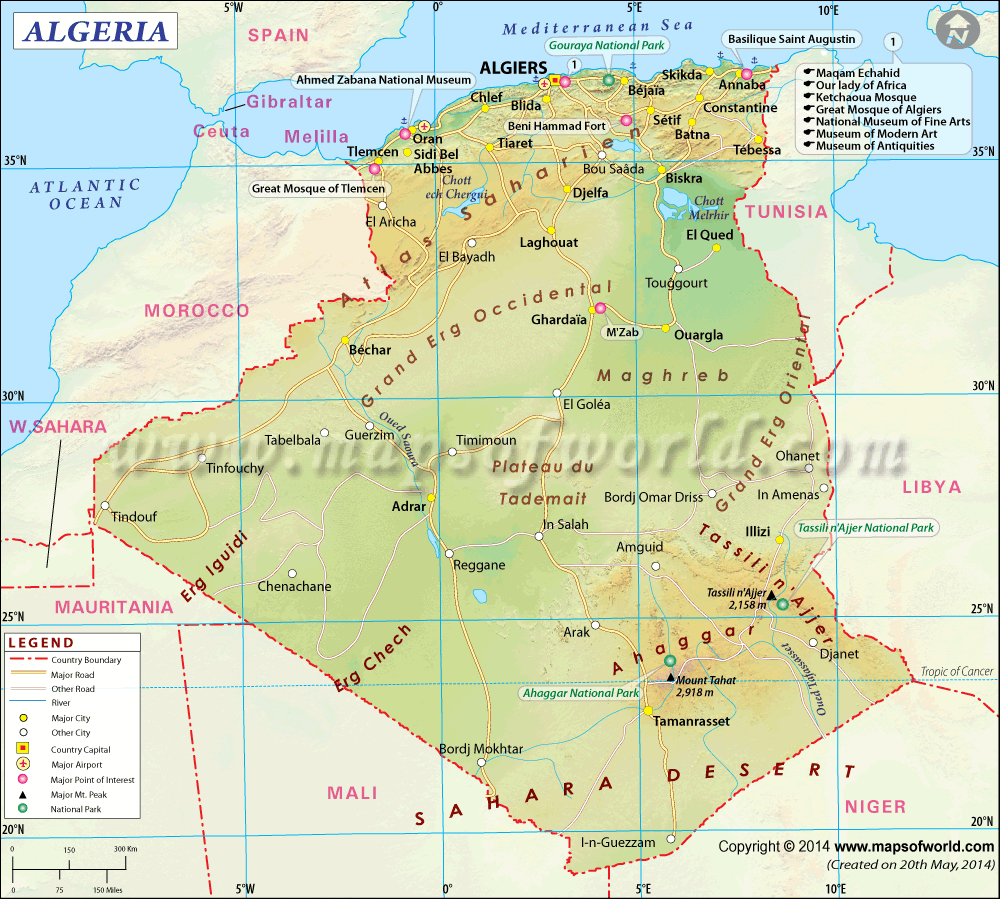
- Neighboring Countries - Libya, Mali, Mauritania, Morocco, Niger, Tunisia, Western Sahara
- Continent And Regions - Africa Map
- Other Algeria Maps - Where is Algeria, Algeria Blank Map, Algeria Road Map, Algeria Rail Map, Algeria River Map, Algeria Cities Map, Algeria Political Map, Algeria Physical Map, Algeria Flag
About Algeria
Explore this Algeria map to learn everything you want to know about this country. Learn about Algeria location on the world map, official symbol, flag, geography, climate, postal/area/zip codes, time zones, etc. Check out Algeria history, significant states, provinces/districts, & cities, most popular travel destinations and attractions, the capital city’s location, facts and trivia, and many more.
| Official Name | The People’s Democratic Republic of Algeria (al-Jumhūriyyah al-Jaza’iriyyah ad-Dimuqratiyyah ash-Sha’biyyah) |
| Capital | Algiers |
| Population | 37,100,000 (2012 estimate) |
| Area | 2,381,741 sq km or 919,595 sq mi |
| Currency | Algerian Dinar (DZD) |
| Country Code | 213 |
| Time Zone | Central European Time GMT/UTC + 1h |
| Literacy | 69.90% |
| Languages | Arabic (official), Berber, Turkish, French, Korandje |
| Major Cities | Algiers, Oran, Tamanrasset, Annaba, Ghardaia, Constantine, Tlemcen , Jijel |
| Climate | Mild Mediterranean in the north, extreme in highlands |
| Major Religions | Islam, Christianity, Judaism |
The People’s Democratic Republic of Algeria is the largest country in north-western Africa spread over an area of 919, 595 sq mi (2,381,741 sq km). It shares land boundaries with Libya, Mali, Mauritania, Tunisia, Niger, Morocco, and the disputed Western Sahara. To the north of the country is the Mediterranean Sea. Algeria has a Mediterranean climate along the coastline with dry summers and mild winters. The plateaus, though, have extreme climatic conditions.
History:
Algeria has been inhabited for over 1.8 million years. This is suggested by the stone tools excavated at Ain Hanech and fossilized Homo erectus at Ternefine. The indigenous people, called Berbers, were pushed away from the coastline towards the plateaus by frequent invasions. Algeria was a prominent Phoenician trade center in 800 BC. Trade relations were combined with territorial expansions which finally suffered because of the defeat at the hands of the Romans in the Punic Wars. Algeria witnessed the advent of Christianity in second century AD.
The country was also a seat of administration for Berber dynasties of the Middle Ages such as the Zirids, the Almoravids, and the Almohads. Islam arrived in Algeria sometime around the eighth century. The region was ruled by the Umayyads, Abbasids, Fatimids and Rustumids successively. This period was followed by a brief Spanish conquest in 1492 which ended with the invasion of Ottoman Turks headed by Barbarossa. Algeria was occupied by the French in 1830. To oust the French colonizers, Abdel Kadir instigated a rebellion which was curbed with a heavy hand in 1848. Oppressions and revolts continued till Algeria gained independence on July 5, 1962 with the National Liberation Front (FLN) emerging as a major political group. It adopted its constitution by popular referendum in 1963. Difficulties, however, continued under the authoritarian regime of Ahmed Ben Bella. Ease was restored in the reign of Houari Boumediene. After a decade long, bloody civil war, the official state of emergency was dissolved on February 24, 2011.
Economy:
Algerian economy largely relies on hydrocarbons found in the Eastern Sahara region. Oil and natural gas contribute 30% to the annual GDP. Crude oil and natural gas are mostly exported to Italy, Germany, Nederland, Spain, United Kingdom, and United States. 97% of the export revenues come in from the hydrocarbon sector alone.
About 14% of the labor is employed in the agricultural sector. It, however, adds only 8.1% to the GDP. The country has utilized only 3.17% of its arable lands for cultivation. The Mediterranean Sea provides ample opportunities for commercial fishing which, however, has not been tapped to its optimum levels. Livestock rearing is practiced by herdsmen in Algeria. The country, owing to its underdeveloped agricultural sector, mostly depends on imports for food.
Industrial diversification is almost unknown in Algeria. Banking, agricultural, and tourism sector are largely neglected. Improvements are, however, underway with Algeria signing the Association Agreement with the European Union for an all round development.
Sports:
Soccer is the national and the favorite sport of Algeria. The national team participated in the Soccer World Cup twice in 1982 and 1986. Algeria has been a notable presence in the African Games. The country is home to Hassiba Boulmerka, the middle distance athlete who became the first Algerian woman to win gold at the 1992 Barcelona Olympics. Another athlete who won gold at the 1996 Atlanta Olympics is Noureddine Morceli. Algeria also has strong national volleyball and handball teams. The women’s volleyball team had qualified for 2008 Summer Olympics in Beijing. The desert regions host horse racing, camel dancing, and camel racing competitions once a year. Water sports are undertaken in resorts developed in cities like Algiers, Oran, and Annaba.
Government:
Algeria is a Presidential Republic with a multi-party system. Numerous political parties exist in Algeria which inevitably coalesce to form the government. The political atmosphere, however, is in constant flux influenced by the military and a group of unelected civilians wielding immense power over all administrative decisions. The Constitution of Algeria was adopted on September 8, 1963 and allows three branches of the government.
- The Executive is led by the President, elected for a term of five years. He is also the head of the Council of Ministers and the High Security Council. The head of the government is the Prime Minister. The current President of Algeria is Abdelaziz Bouteflika, and the Prime Minister is Ahmed Ouyahia.
- The Legislative body comprises both of the government and the Parliament. The Algerian Parliament has 462 seats and two houses – the Upper chamber called the Council of Nation and the Lower known as the People’s National Assembly. On account of shifting regimes, the Parliament is practically powerless. The real power is vested with the President and other power groups called ‘Le Pouvior’. Universal adult suffrage is granted to all individuals above the age of 18.
- The Judiciary is based on French and Sharia laws. The Supreme Judicial Council is the highest law administering body in Algeria. It is headed by the President. The Supreme Court of Algeria is divided into a Private Law Chamber and a Social Division. In addition to it, there are tribunal courts called dairas and provincial courts called wilayas.
Law and Order:
After the failure of the authoritarian socialist regime of Ahmed Ben Bella there has not been a substantial change in the law and order situation of the country. The government has initiated several remedial measures to heal the scars of the decade-long civil war and the subsequent emergency situation. Human rights activists raise concerns from time to time. The milieu is such that many countries have issued advisories against traveling to Algeria citing security reasons. Terrorist incidents are not uncommon, and the Salafist Group for Preaching and Combat which merged with the Al-Qaeda to form Al- Qaeda in the Islamic Maghreb, is known to be active in the country.
Culture and Society:
Life in Algeria has been deeply influenced by shifting regimes starting from Phoenicians to the French. These colonial signs can be read in the handicrafts like ceramics, glassworks, carpets, jewelry, and so on. Algerian cuisine is known for its magical blend of spices and locally available meats and vegetables. It is the land of the sumptuous Merguez Sausage. The rampant poverty has, however, destroyed traditional ways of living notably among the Touaregs and the Berbers. About 99% of the people follow the Sunni sect of Islam.
Arts and Entertainment:
Algeria is the home to noted novelists like Albert Camus, Kateb Yacine and Assia Djebar. Their novels are brilliant representations of the times they lived and worked in. It is also the birthplace of Jacques Derrida and Frantz Fanon. Indigenous cinema was born in 1962 when the Algerian film makers broke away from colonial cinema. Notable films of this period include The Winds of the Aures, To the East, The Battle of Algiers, and so on. Algeria has been the source of inspiration for prominent artists such as Mohamed Racin, Mohamed Khadda and Bachir Yelles. Algeria’s cultural diversity is reflected in its music. Andalusian music is a direct image of Algeria’s Arab ancestry. The life and folk tales of the Berbers and Touaregs are sung in Kabyle themes. Modern Algerian music is noted for artists such as Cheb Mami, Cheb Bilal, Raina Rai, Reda Taliani, and so on.
People, Religion and Ethnic Groups:
The estimated population of Algeria in 2012 is 37,100,000 of which 99% are Muslims and the rest 1% are Christians and Jews. Berbers constitute a sizeable portion of the population followed by the Turks. Other ethnic groups existing in Algeria include the French, Maltese, Italian, Spanish, and Corsicans.
National Holidays and Festivals:
The predominantly Muslim population of Algeria follows the lunar calendar due to which the dates of important festivals vary each year. Eid-al-Fitr, Eid-al- Adha and the Islamic New Year are the major festivals. Mouloud is also observed in February to commemorate the birth of the Prophet. Algeria celebrates Independence Day on July 5. In addition to these, Christmas, New Year’s Day, and Labor Day are official holidays.
