Sulfur is an abundant, yellow-colored multivalent non-metal. It is found as a pure element in nature and also as sulfide and sulfate minerals.
Sulfur had been known and used since a long time in ancient Greece, China, and Egypt. The fumes of the element were used as fumigants. Sulfur was used in medicinal mixtures mostly as balms and anti-parasitics. It was also used to make the best quality of black gunpowder.
Today, most of the elemental sulfur is produced as a by-product from natural gas and petroleum after removing sulfur-containing impurities. The element is most used for commercial purposes; it is basically used in fertilizers, and in the manufacture of sulfuric acid. Sulfur is also used in matches, insecticides and fungicides.
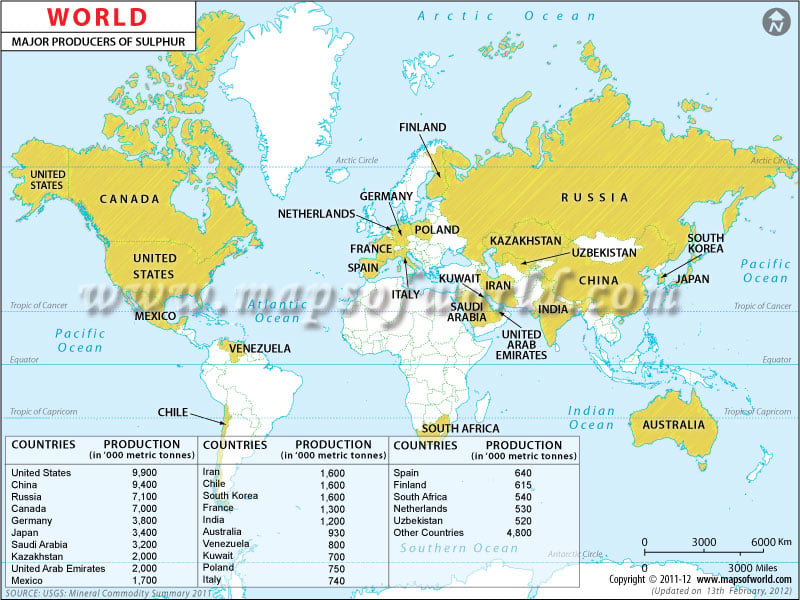
The World Map of Sulfur Producers shows a list of countries that produce large quantities of sulfur. As the data in the map shows, China leads the world in the production of sulfur; in 2010 the country produced an estimated 9.4 million metric tonnes of the non-metal.
The second-largest producer of sulfur is Russia with an annual production of 7.1 million metric tonnes. Canada ranks third followed by Germany, Japan, Saudi Arabia, Kazakhstan, United Arab Emirates, Mexico, Iran, Chile, South Korea, France, India, Australia, Venezuela, Kuwait, Poland, Italy, Spain, Finland, South Africa, Netherlands, and Uzbekistan.
Canada is the largest exporter, followed by Russia and Saudi Arabia.
Sulfur is a vital element for all forms of life, and is widely used in biochemical processes. It is one of the major plant nutrient after nitrogen, phosphorus, and potassium. Sulfur provides a direct nutritive value to the plants hence contributing to an increase in the crop yields.
MAJOR SULPHUR PRODUCERS OF THE WORLD-2010
| COUNTRY | PRODUCTION IN (THOUSAND METRIC TONNES) |
|---|---|
| China | 9400 |
| Russia | 7100 |
| Canada | 7000 |
| Germany | 3800 |
| Japan | 3400 |
| Saudi Arabia | 3200 |
| Kazakhstan | 2000 |
| United Arab Emirates | 2000 |
| Mexico | 1700 |
| Iran | 1600 |
| Chile | 1600 |
| South Korea | 1600 |
| France | 1300 |
| India | 1200 |
| Australia | 930 |
| Venezuela | 800 |
| Kuwait | 700 |
| Poland | 750 |
| Italy | 740 |
| Spain | 640 |
| Finland | 615 |
| South Africa | 540 |
| Netherlands | 530 |
| Uzbekistan | 520 |
| Other Countries | 4800 |
