Paraguay Map
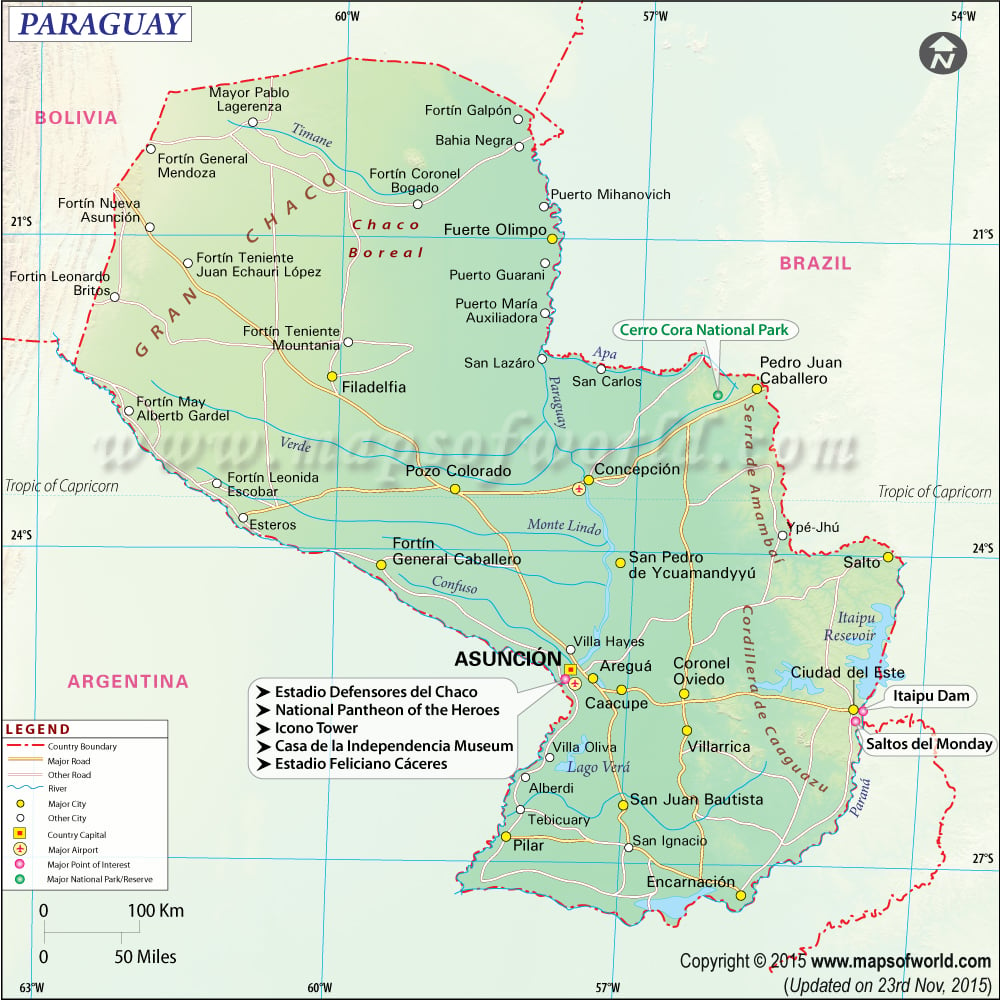
- Paraguay Departments - Alto, Alto Parana, Amambay, Asunción, Boqueron, Caaguazu, Caazapa, Canindeyú, Central, Concepcion, Cordillera, Guaira, Itapua, Misiones, Neembucu, Paraguari, Presidente Hayes, San Pedro
- Paraguay Cities - Asuncion
- Neighboring Countries - Argentina, Uruguay, Bolivia, Brazil
- Continent And Regions - South America, Americas
- Other Paraguay Maps - Where is Paraguay, Paraguay Blank Map, Paraguay Political Map, Paraguay Road Map, Paraguay Railway Map, Paraguay Physical Map, Paraguay Flag
About Paraguay
Explore this Paraguay map to learn everything you want to know about this country. Learn about Paraguay location on the world map, official symbol, flag, geography, climate, postal/area/zip codes, time zones, etc. Check out Paraguay history, significant states, provinces/districts, & cities, most popular travel destinations and attractions, the capital city’s location, facts and trivia, and many more.
| Official Name: | Hellenic Republic |
| Capital: | Athens |
| Population: | 11,305,118 |
| Area: | 131,990 Sq km or 50,961 sq mi |
| Currency: | Euro |
| Religion: | Orthodox faith |
| Literacy: | 97.1% |
| Languages: | Greek |
| Major Cities: | Athens |
| Climate: | Mediterranean Climate |
People of Paraguay : Almost 6,506,464 people reside in the Republic of Paraguay. The ethnic groups of the country are mestizo or people who are Spanish and Amerindian mixed and some other minorities. Spanish and Guarani are two official languages of Paraguay.
Art, Culture and Music of Paraguay :
Art : Embroidery and lace making are two very important sections of art in Paraguay. Poetry is also considered as a very creative form of art. Some of the novelists and poets of Paraguay are Roque Vallejos, Jose Ricardo Maze, Augusto Roa Bastos and so on.
Culture : Paraguay has a mixed culture. The tradition of Paraguay reflects various foreign influences especially European influence.
Music : The music of Paraguay is highly influenced by European music. However the language of the church music is Guarane Choice is performed especially in the religious occasions. Some of the famous music forms are Paraguayan polka, Guarania, zarzuela, the local folk song s and “Paraguayan Songs” etc.
Flag of Paraguay
The flag of Paraguay three horizontal bands, which are same in size. The upper band is colored in red and the band in the bottom is blue. The middle one is white and it bears the coat of arms in the center. It is a strange flag. The two sides of the flag are designed in different manner. The obverse side of the flag features the national coat of arms. However the reverse side of the flag features the treasure seal. The coat of arms depicts a yellow star in its center that is surrounded by the words, “REPUBLICA DEL PARAGUAY”. On the other hand the seal of the treasury depicts a yellow colored lion and a cap that is red. This is a symbol of liberty. Tha words that surround these things are “Paz y Justicia”. It means peace and justice.
Economy of Paraguay : The economy of the republic of Paraguay is stable and highly dependent on its agriculture and export trade. The natural resources of the country are timber, iron ore, hydropower, manganese, limestone etc. Cotton, soybeans, sugarcane, corn, tobacco, wheat, cassava, fruits, vegetables and son are the primary agricultural products. The fast growing industries of the Republic are cement industry, textile industry, sugar industry, beverages, steel industry, metallurgic industry, wood products, electric power etc. The export materials of Paraguay are feed, cotton, soybeans, meat, electricity, wood, edible oils, leather and so on. Uruguay, Brazil, Argentina and Chile are the nations that are involved in the export business with Paraguay.
Paraguay Capital
The capital of Paraguay is Asuncion. Paraguay is located at the Central part of South America. The geographic coordinates of Paraguay are 23º South latitude and 58º West longitude. Asuncion is the Paraguay Capital. The geographic coordinates of the Paraguay Capital Asuncion are 25º 16′ South latitude and 57º 40′ West longitude.
The capital of Paraguay includes the cities of Fernando de la Mora, San Lorenzo, Luque, Lambare, Nemby, and Mariano Rouque Alonso. About 1.8 million people inhabit the capital city of Paraguay. In the capital of Paraguay there is the seat of the government and the chief port. Asuncion is also the most important manufacturing and cultural center of Paraguay.
The local industrialized products of the Paraguay capital city are textiles, footwear and tobacco products. The capital of Paraguay is located on the left side of the river Paraguay.
The city presents gorgeous scenery and spreads out on calm hills in a prototype of rectangular slabs. For the major part of the year the climate of Asuncion remains humid and warm.
The literacy rate in the capital city is recorded to be 95 percent which is the highest in the country. Schools have come up in a large number in the city and the number of the students has also doubled. The important universities in Asuncion are Universidad Americana and Universidad Catolica Nuestra Senora de la Asuncion
Paraguay History
The history of Paraguay dates back to the sixteenth century when the country was inhabited by semi-nomadic tribes. The first European conquest in the region took place in the early sixteenth century by the Spanish while the first settlement was established at Asuncion on August 15, 1537 by a Spanish explorer Juan de Salazar de Espinosa.
From the beginning of the seventeenth century the Jesuit missionaries dominated the lives of the inhabitants of Paraguay. These settlements witnessed religious conversion and various economic activities like agricultural and pastoral production were undertaken.
Between 1721-35, the Spanish land owners declared a war against the Jesuits and broke their monopoly in trade. In 1767, they were expelled by the Spanish forces.
The vice royalty of Rio De La Plata was established in the year of 1776 which made Paraguay dependent on Buenos Aires putting an end to the colonial dominance.
Paraguay got independence from Spain but did not want to be under the leadership of Buenos Aires. Under the leadership of Pedro Juan Cabellero and Fulgencio Yegros, the Paraguayans declared their independence on May 14, 1811 putting an end to the colonial period in Paraguay.
Paraguay Independence is celebrated on the 14th May every year with great pomp and splendor.
In the 1930s and 1940s, the country was stormed by civil war. It was a war fought against the Bolivian regime and is better known as the Chaco War. This period was marked with dictatorships, and extreme political instability. The reins of power fell in the hands of General Alfredo Stroessner from May 1954 and he continued to rule for thirty-five years. The war was waged to claim dominance over the Gran Chaco Region of South America as it was wrongly understood to be the rich in oil.
The discovery of the oil in the foothills of Andes, led them to believe that the land was extremely rich in oil.
Two big large companies Standard Oil supported and backed Bolivia while Shell Oil backed Paraguay. The war started on the orders of Daniel Salamanca, the then president of Bolivia. Paraguay had far lesser population but Bolivia adopted guerilla strategy of fighting. This helped them to win battles as Bolivians adopted formal strategy of war. Paraguay received military assistance from Argentina. Another advantage that Paraguay had over Bolivia was that Paraguay could communicate through radio in Guarani language which was not comprehended by the Bolivian soldiers.
The War of Chaco brought huge losses to both the countries. About 100,000 soldiers were killed. In 1935, three quarters of the Chaco Boreal was given to Paraguay and Bolivia got only a strip of land. After few years, no oil reserve was found in Chaco.
Years later on February 3, 1989, Stroessner was overthrown in a military coup headed by General Andres Rodriguez.
Since then, Paraguay established a democratic system of government. The President is the head of state and the government.
Paraguay Banks
Paraguay banks are mostly found in the Asuncion region and the Villa Morra area. The banks in Paraguay also have ATMs in their respective branches to make money exchange convenient for the people. As per the report of 1995, there were about a total of 35 banks in Paraguay. The banks in Paraguay are open to the public on all the weekdays from 7:30 am to 11 am.
Some of the Paraguay banks include:
- Banco Central de Paraguay
- Cooperativa Universitaria
- Banco Nacional de Fomento
- Interbanco
- Banco Regional
Paraguay Currency
The Paraguay currency is the Guarani. The currency of Paraguaycame into circulation in the middle of the 20th century. The high inflation of the Paraguayan economy have forced the Paraguayan government to de-issue the centimos. 100 centimos made up a Guarani.
The Paraguay currency of Guarani is available in only paper form. The denominations of the Guarani start from 1000 Guaranies. The complete list of denominations are 1000, 5000, 10,000, 20,000, 50,000 and 100,000 Guaranies. The Guarani is a sophisticated banknote containing many special security safeguards. This is done to protect the Paraguayan currency against counterfeiting. The Guarani banknote has a border less under print.
Paraguay Hospitals
Paraguay Hospitals are mainly located in the city of Asuncion. There is lack of Paraguay Hospitals in the rural areas of the country. The hospitals in Paraguay are not very well equipped. The health sector of Paraguay has seen major changes in the early twentieth century. The national constitution, which was adopted in 1992, laid great emphasis on Heath and identified it as the basic right of the people. The National Heath System decided to provide services to people in coordination with private and public sectors.
Post 1990s there were great up gradations in the hospitals of Paraguay. The environment of the hospitals became more hygienic. The health sectors also received great financial and human resources as a result of decentralization in the country. Many hospitals were established in the twentieth century. In 1996, public, private, and semiprivate health sectors consisted of 1,140 establishments which included:
- 47 hospitals
- 25 regional hospitals
- 197 health centers
- 657 health posts or infirmaries
- 214 clinics and sanatoriums
Out of which the majority were administered by the Ministry of Health. According to the estimate taken in 1996, the hospital beds amounted to 1.3 per 1,000 inhabitants. Though the ratio has increased over the years, but there is still scarcity of hospitals in the rural areas. The main hospitals of Paraguay include:
- Centro Medico Bautista/Baptist Medical Center
- Hospital de Clínicas
- Cruz Roja Paraguaya
- H. Barrio Obrero
- Instituto de Prevision Social
- Centro Materno Infantil
- H. Central FF.AA.
- H. Neuropsiquiatrico
- Instituto de Medicina Tropical
Though, majority of hospitals are located at Asuncion, few hospitals are also located at San Lorenzo and Itaugua in Paraguay.
Information on Paraguay
The Republic of Paraguay is situated on the South American continent. The information on Paraguay lists relevant facts like its industry and naturally occurring resources.
The foremost of the information on Paraguay is the country’s languages. Two languages- Spanish and Guarani is in colloquial use. Spanish is the language that is imported from Europe in colonial times. Guarani is the indigenous language that is a result of decades of colonialism. Spanish is spoken in the urban areas. Guarani is spoken in the rural hinterlands. The Paraguayan culture is a mix of the Spanish settler and indigenous South American cultures.
The Republic of Paraguay can be visited all around the year. The country does not fall on the standard tourist trail. This lends a certain frisson of adventure to the activity oriented traveler visiting the country. The principal resources of Paraguay is centered around the natural beauty prevalent in the South American region. The activity of fishing forms the bulwark of the rural Paraguayan economy. The rivers of the country are used for physical transportation from one place to another. The economy of Paraguay is dependent on farm products and its further downstream processing industries. Agricultural products like sugarcane, soybean, wheat, potatoes, and tobacco provide much needed foreign currency through exports.
Paraguay Embassy
Paraguay embassy is positioned in various countries of the world. The Paraguay embassy helps in maintaining the positive relationship between Paraguay and the other countries. From the embassy office of Paraguay information regarding various issues on the country of Paraguay is provided to the foreign tourists.
Some of the countries where the embassies of Paraguay are located are:
- Embassy of Paraguay in Ottawa: in Canada
- Embassy of Paraguay in La Paz: in the country of Bolivia
- Embassy of the Republic of Paraguay in London: in the country of United Kingdom
- Embassy of Paraguay in Tokyo: in the country of Japan
- Embassy Paraguay in Washington DC : in Massachusetts Avenue, New York
All the persons can get information on visa related issues of the country from the Paraguay embassy. The Paraguay Embassy is actually an official mission through which Paraguay usually carry out the foreign affairs.