Uganda Map
 Buy Printed Map
 Buy Digital Map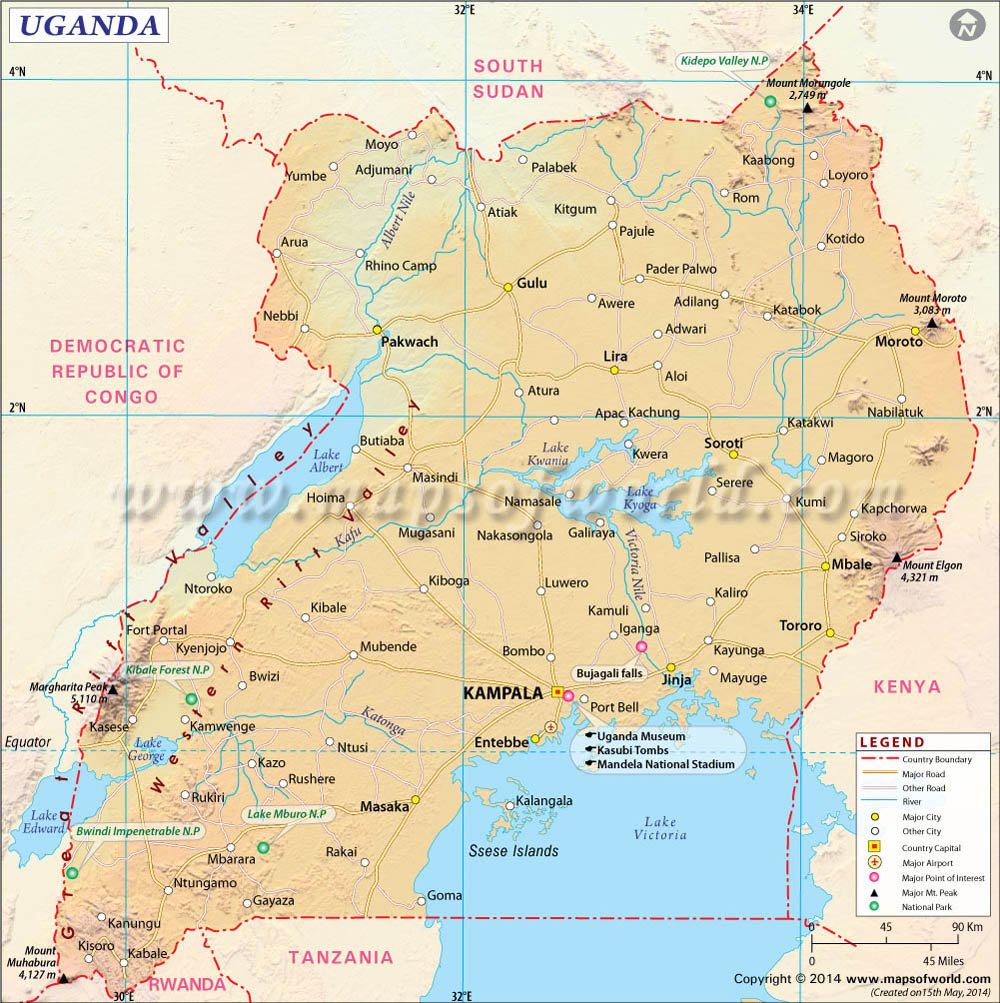
- Neighboring Countries - Rwanda, Kenya, DRC, South Sudan, Burundi, Tanzania
- Continent And Regions - Africa Map
- Other Uganda Maps - Where is Uganda, Uganda Blank Map, Uganda Road Map, Uganda Rail Map, Uganda River Map, Uganda Cities Map, Uganda Political Map, Uganda Physical Map, Uganda Flag
About Uganda
Explore this Uganda map to learn everything you want to know about this country. Learn about Uganda location on the world map, official symbol, flag, geography, climate, postal/area/zip codes, time zones, etc. Check out Uganda history, significant states, provinces/districts, & cities, most popular travel destinations and attractions, the capital city’s location, facts and trivia, and many more.
| Full name: | Republic of Uganda. |
| Capital City: | Kampala |
| Language: | English, Swahili and Ganda. |
| Currency: | Ugandan Shilling. |
| Religion: | Roman Catholic, Protestant, indigenous beliefs and Muslim. |
| National Anthem: | “Oh Uganda, Land of Beauty”. |
| Newspaper: | East African Business Week, The Monitor, The New Vision, Sub-Saharan Informer, The Weekly Observer and The Westniler. |
| Places to Visit: | Bwindi Impenetrable Forest, Jinja, Kampala, Bigodi Wetland Sanctuary, Sipi Falls, Queen Elizabeth National Park, Mgahinga Gorilla National Park and Ngamba Island Chimpanzee Sanctuary |
| Transport: | Airways; Railways; Roadways; Waterways/Ports:- Entebbe, Jinja, Port Bell. |
| Shopping: | hand-made drums, masks, traditional art, paintings, handicrafts, musical instruments, wood carvings, woven goods and pottery. |
A country locked in, Uganda was once a part of the British Colony. The country is famous for being a safari paradise and is also often termed as “Africa’s friendliest country”.
Just as a pearl is encased securely in the heart of an oyster, so is Uganda situated in Africa. It combines the best of all Africa has to offer; and it also boasts of being the country in Africa with the fastest growing economy.
Location of Uganda:
The country of Uganda is located in the eastern region of the continent of Africa Eastern Africa. It is landlocked being surrounded by other African nations on all sides. To its west is Kenya, to its south Tanzania and Rwanda, to its east Congo and to its north Sudan.
Physical Map of Uganda :
The landscape of Uganda is mostly raised land; occurring in the forms of plateaus and mountains. There are plenty of water bodies, the biggest being the Lake Victoria in the south east. The river Nile too flows through the country dunking into the two lakes, Lake Albert and Lake Victoria, which fall in its path. The snow-capped Mountains of Rwenzori fall to the west of the country, while to the south of the same border are the volcanoes and lava plains of Mufumbiro. Forests in Uganda are solely of the rainforest kind.
Flag of Uganda :
The flag of Uganda is rectangular in shape and is dominated by colors that are commonly known as pro-African. The colors in the flag are red, black and yellow. These three colors appear in six horizontal stripes of equal size in the sequence of black-yellow-red (top to bottom). At the centre of the flag is a white disk housing Uganda’s national bird – a red-crest crane – which faces the left.
Climate of Uganda :
To sum it up, the climate of Uganda is primarily tropical. The country experiences two major dry spells through the year which fall in the months of December to January and June to August. Otherwise, Uganda has enough rain to sustain it. Altitude, though, makes a difference to the climatic conditions, with the northeastern regions being slightly dry. The summer months last from December to February. Monsoons come twice a year, occurring once between April and May and again between October and November.
Flora and Fauna of Uganda :
The animal and plant life in Uganda is a diverse lot. The flora of Uganda is divided mainly between dense forests of Mvuli trees and expanses of tall elephant grass. Fauna in Uganda comprises of animals, birds, insects and also fishes. The inventory of animal fauna is almost endless; however, the chief of them are the gorillas, chimpanzees and the black rhinoceros. Some of the other animals that form a part of that list are leopards, elephants, lions, crocodiles, hippopotamuses, buffaloes, giraffes, zebras, various species of antelopes, gazelles and topis. The Uganda kob is a specialty of the country. Birds are equally plenty. A few of the names of the birds available are marabou storks, kingfishers, hornbills, bee-eaters, herons, fish eagles, hoopoes, ibis, lily-trotter and kites.
People of Uganda
The country of Uganda is an exemplary instance of unity in diversity. Once united with the intension that their differences will only breed discontent and discord, the people of Uganda shocked the schemers that they were capable of transcending such petty limitations. A brief list of the tribes and ethnicities that make up Uganda are the Baganda, the Ankole, the Basoga, the Rwanda, the Acholi, the Lugbara, the Bunyoro, the Bagwere, the Karamojong and the Rundi. Among the non-Africans that make up the population are Europeans, Asians and Arabs.
Arts, Culture and Music of Uganda :
Art: hand-made paper products like Cards, photo frames, photo albums and batik works are two of the most famous of the art forms in Uganda.
Culture: The Ugandan culture is an example in diversity as it is influenced by the distinct cultures of several tribes and ethnic races. There are the Bantu, Baganda, Lango, Acholi, Iteso, Karamojong and also Pygmies who go about to make the rich cultural heritage of Uganda.
Music: given that the country of Uganda comprises of several ethnic groups, it is only obvious that each of them should have a different and distinct form of music from the other clans. However, one thing that most of them have in common is the fact that music is viewed as a cultural heritage and so is passed down in hierarchy.
Most of the songs narrate fables and folklore. One of Uganda’s very famous lyricists is Okot p’Bitek. Some of the commonly used instruments that accompany the songs are the Ennanga, Ndigindi, Amadinda, Entongoli, and Lukeme.
Economy of Uganda :
One of the primary revenue earners of Uganda is its agricultural produce. Tea, cotton, coffee and tobacco are the chief agricultural exports. The mining and tourism industry cut a close second while raking in the revenues. Mining of copper, limestone, cobalt and salt is wide spread. Uganda does not stop at that. It goes further into the industry of manufacturing steel, processing sugar, packaging and processing food, brewing, textiles and also cement. No wonder that is has the fastest growing economy in the continent.
Red Paper Uganda
Red paper Uganda is a one of the most popular newspapers of this country. This is actually a tabloid that is published every day. This newspaper has created a reaction that is both favorable and also one of criticism. Red Paper tries to publish news that are not easily taken by the mainstream journalism. They can be said to provide the people of Uganda with news behind news.
Red Paper Uganda is the first tabloid of its own kind. It has created a wave of sensation in the whole nation. This tabloid has published many news that were otherwise claimed to be secret and so has created much reaction among the people of this East African country. It has been publishing news that are otherwise treated as unfit for being published in the mainstream newspaper of this country.
Red Paper is the name of a extremely controversial tabloid in Uganda. This paper is very newly established. It has been published from the year 2002. Since then it has been creating in the world of Uganda media by publishing one after one sensational news. Red Paper published the name of the former foreign minister of Uganda who died of AIDS. It also undertook the project to publish the list of the names of the gay and lesbian people in Uganda that created a mix reactions. This paper really published the names. Moreover, Red Paper is also accused by the Government and many social activists of being very indecent and immoral. But from the point of view of the publisher and editor of this tabloid, they are catering to the tastes of the young generation of Uganda.
Monitor Uganda
Monitor Uganda is one of the major newspapers in Uganda. It is regarded very highly throughout Uganda. The newspaper is an independent newspaper of Uganda that is circulated in Kampala. The publication of the newspaper is in English for the convenience of the people in the country and for the outsiders who visit Uganda. As Monitor Uganda is in English its circulation is restricted to the higher and educated sections of the society.
Monitor is a newspaper that provides a wide range of news that cover politics, international and national news, national issues, economic news, sports, culture, entertainment, business and finance, gender articles, health, kids section, etc.
The different sections of Monitor newspaper Uganda are:
- News Headlines
- Opinions and Editorials
- Monitor Sport
- Business Power
- Health & Living
- Features
- Inside Politics
The newspaper Monitor has daily publication which is called “The Monitor Daily”, a weekly publication called “The Monitor Weekly” and a Sunday publication which is a special edition that comes out only on Sundays and is called “Sunday Monitor”. Apart from the print publications the Monitor also has its own website thus offering its readers an online publication.
The Monitor brings out news on different fields categorized under Frontpage, Letters, Features, Sports, news, Regional special etc. The Sunday edition covers Sunday Home, Sunday life, business, rainbow,Insights and political grapevine.
The Monitor in Uganda therefore is a mixture of news, entertainment and information on various subjects. The newspaper thus blends different aspects of life. It provides news and information and at the same time reflects the culture, society and the entertainment of Uganda. It is one of the most important and sophisticated newspapers of Uganda and upholds the spirit of development of the country.
Uganda Genocide
The people of Uganda have been the victim of serious violations of human rights and peace right from the time of its independence. The regimes of the power hungry Milton Obote, and the “Reign of Terror” of the notorious Idi Amin have been major causes of these happenings. In Uganda, genocide has been largely destructive and has gone on for years and years without proper remedial measures.
The regime of Idi Amin caused much violence and bloodshed. His policy was one of military domination and violence. During his time, many of the tribal people were oppressed, discriminated against, and cruelly treated. Much of the violence was caused on the government’s instruction, and people were forced to take an exile out of Uganda, imprisoned without trial, or slaughtered at the first hint of non alliance.
The Uganda Genocide continued even after the end of the Idi Amin regime, when the Lord’s Resistance Army started to inflict violence on the members of the Acholi tribe. Their favored mode of operation is to abduct Acholi children and turn them into child soldiers. The Acholi people, for fear of losing their children, cannot start an open violent protest, and prefer negotiations with the Army. There has been much hue and cry over this continued genocide in Uganda over a very long period of time, with the media and other international powers entering the fray. The present Uganda government is still trying to contain the violent operations of the Lord’s Resistance Army.
The Uganda Genocide is one of the blackest chapters of human history, and figured among the most destructive genocides ever to happen.