Map of Spain
 Buy Printed Map
 Buy Digital Map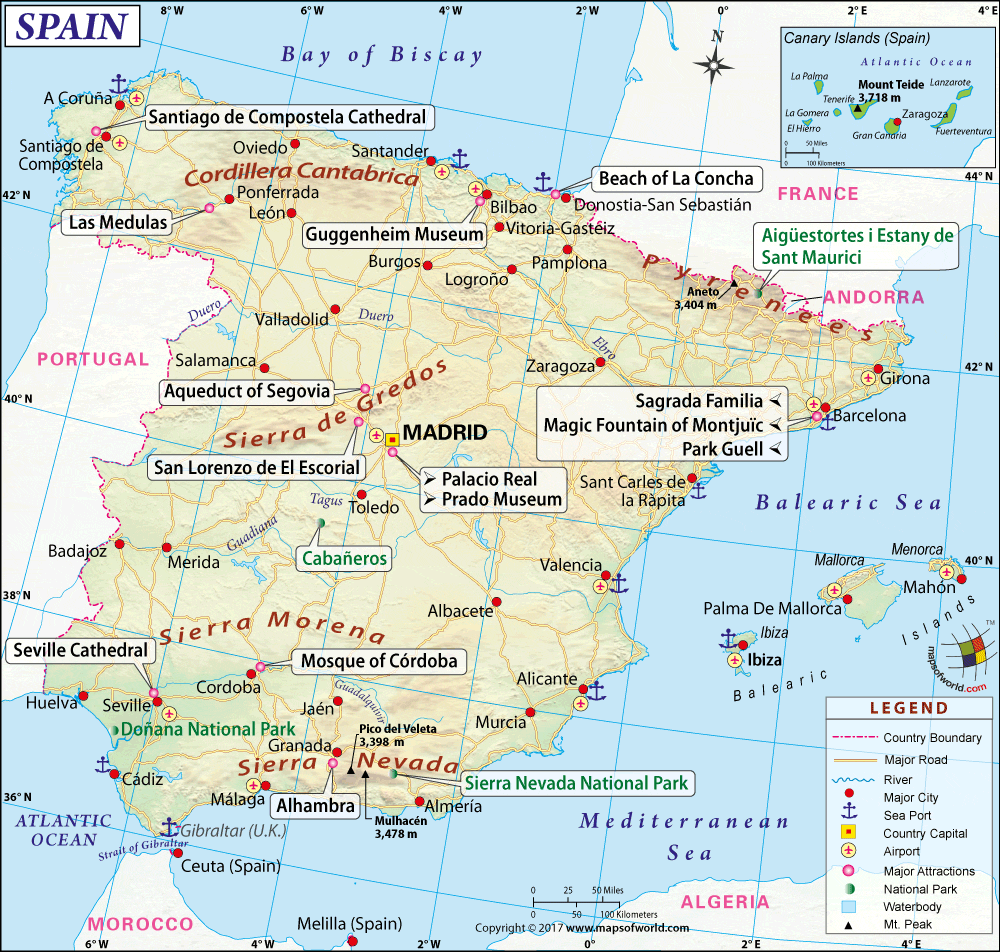
- Spain Cities -Barcelona, Bilbao, Madrid, Murcia, Rota, Seville, Valencia
- Neighboring Countries - Portugal, Morocco, Andorra, France
- Continent And Regions - Europe Map
- Other Spain Maps - Where is Spain, Spain Blank Map, Spain Road Map, Spain Rail Map, Spain River Map, Spain Political Map, Spain Physical Map, Spain Flag
About Spain
Explore this Spain map to learn everything you want to know about this country. Learn about Spain location on the world map, official symbol, flag, geography, climate, postal/area/zip codes, time zones, etc. Check out Spain history, significant states, provinces/districts, & cities, most popular travel destinations and attractions, the capital city’s location, facts and trivia, and many more.
| Full name | Kingdom of Spain (Reino de Espana) |
| Capital | Madrid |
| Language | Spanish, Catalan, Basque, Gallegan and English |
| Currency | Euro |
| Religion | Roman Catholicism, Islam |
| National Anthem | “Marcha Real Granadera” meaning ‘March of the Royal Grenadier’ |
| Area | 195,364 square miles |
| Population | 46,030,109 |
| Places to Visit | Cordoba Mezquita, Toledo, Catalonia |
Officially referred to as the Kingdom of Spain, Spain is a developed country with the twelfth-largest economy in the world. The country has rich cultural heritage among which bullfighting is the most famous and renowned all over the world.
It is considered to be one of the most controversial as well as popular sport in Spain. The Kingdom of Spain is located in south-western Europe on the Iberian Peninsula. Its mainland is bordered to the south and east by the Mediterranean Sea except for a small boundary with the British Overseas Territory of Gibraltar; to the north by France, Andorra, and the Bay of Biscay, and to the north-west and west by the Atlantic Ocean and Portugal. The Balearic Islands in the Mediterranean, the Canary Islands in the Atlantic Ocean and two autonomous cities of Ceuta and Melilla in North Africa are also considered part of the territory of Spain.
Spain covers a total area of 195,364 square miles. The Pyrenees partition the country from Europe-proper and, as a result affiliates it more to the continent of Africa. The other major landscape feature is the plateau that dominates the central region of the country. The Plateau is surrounded by mountains. There are the Cantabrian Mountains to the northwest of the country – near the coast; the Sierra de Gredos Range and Sierra de Guadarrama Range to the west; and the Sierra Morena Range and the Sierra Nevada Range to the south. The optimum elevation in the country is called the Pico de Teide. There are myriads of rivers that snake their course across the country. Some of the major rivers are Douro, Guadalquivir, Guadiana, Ebro and Tagus.
Spain is the twenty-seventh largest country in the world with over forty-six million people. The country has a number of immigrants from several Sub-Saharan and Caribbean countries. There are also sizeable numbers of Asian immigrants, most of whom are of Chinese, Indian, Filipino, Middle Eastern and South Asian origins. Castilian, commonly known as Spanish is the official language of Spain. English and Germany are widely spoken by tourists and foreign residents in the country. Madrid is the capital city of Spain. It is the largest city in Spain with over five million people.
The dominant religion is Roman Catholicism followed by Islam. Over 2.3% of the total Spanish population adhere to Islam.
Literacy rate in Spain is 97.9 %. State education is free and compulsory from the age of 6 to 16.
History of Spain
Before becoming part of the Roman empire after the conquest by Scipio Africanus in 206 BC, Spain was inhabited by Celts, Iberians, and Basques. In the eighth century AD, African Muslims under Tariq entered Spain and conquered the entire country. The Muslims ruled the country for about 800 years. Their rule ended in 1492 when the unified kingdoms of Aragon and Castile overthrew all remnants of Islam in the Peninsula The overthrow of Muslims was important to prevent the expansion of Islam in southern Europe. By the end of the fifteenth century, Roman Catholicism was established as the official state religion. The Spanish Hapsburg monarchy for a time was the most powerful in the world. In 1588, Philip II sent his invincible Armada to invade England, but the conquest did not yield positive results for Spain. The Armada was destroyed and this caused great losses to the Spanish resources. On the other hand, the Spanish defeat paved the way for England’s colonization of America.
Spain then came under the reign of the Hapsburg kings, and saw a major decline in almost all areas. The War of the Spanish Succession (1701-1714) resulted in Spain’s loss of Belgium, Luxembourg, Milan, Sardinia, and Naples. During the eighteenth and nineteenth centuries, the colonial empire of the country in the Americas and the Philippines completely suffered a setback in the various battles and wars fought. The initial years of twentieth century were marked by peace but with the tragic Spanish Civil War starting in 1936, things in Spain again turned tumultous. The end of the war saw the Nationalist Party coming to power under General Franco’s rule. After the death of Franco, a constitutional monarchy was established in Spain in 1978. This gave political autonomy to Spain.
Economy
Spain is the fifth-largest economic power in the European Union. It is one of the leading countries in the world in the production of renewable energy. In 2010 Spain became the leading country in the development and production of solar power surpassing the United States. The country is home to a massive power station plant called La Florida, near Alvarado, Badajoz.
Tourism is a major sector of the economy of Spain and especially since the last four decades, the Spanish tourism industry has grown to become the second biggest in the world. Catalonia is an autonomous community in Spain with a great variety of landscapes. From mountains on the Pyrenees to beaches on the east of the region, Catalonia makes for a perfect holiday destination. Dryland steppes, rocky coastlines, and the majestic mountains in Catalonia have a great variety of bird life. Lammergeier, Pin-tailed Sandgrouse, Black Woodpecker, Little Bustard, Wallcreeper, and Bonelli’s Eagle are the major species.
Barcelona, Girona, Figueres, Lleida, Mataro, and Tarragona are the major Catalonian cities that make for a good vacation.
Politics
Spain is a democracy and functions in the framework of a constitutional monarchy. The head of the state is the monarch, King Juan Carlos 1, who is also the Commander-in-chief of the Spanish Armed Forces. Head of the government is the Prime Minister, Mariano Rajoy.
For administrative purposes, Spain is divided into seventeen autonomous communities that are divided into fifty provinces. Each of the provinces have their own capital city. Generally, though not always, these capital cities carry the same name as their province. The major cities of Spain include: Barcelona, Valencia, Cordoba, A Coruna, Andalusia, Cantabria, Catalonia, Ceuta, Madrid, and Granada.
Flag of Spain
The flag of Spain consists of three horizontal stripes: red, golden, and yellow. The golden yellow stripe is in the middle of the flag, sandwiched between the two red stripes. On the central golden yellow stripe, slightly off center to the left, is superimposed the country’s coat-of-arms which has the royal seal in between the two “Pillars of Hercules”.
Climate of Spain
Spain boasts of a Mediterranean climate. So, the summer months in the region are warm while the winters are chilly. The coastal region in the north-west experiences precipitation almost all year round, it is also relatively cool; winters in these regions are cool and cloudy. In the interiors of the country, on the other hand, the heat is more pronounced.
Flora And Fauna of Spain
Spain’s diverse types of landscapes is home to different types of plants. From deciduous type to evergreen to the steppes, one can find almost all types of trees. Some of the common varieties of plants to be found in the country are oak, elm, beech, chestnut, poplar, pine, ilex and cork oak and juniper; while the flowering variety of plants includes orchids, gentians, lavender and rosemary. Fauna in Spain is comparatively limited due to the spread in human habitat and destruction of natural forests. However, among those few that still remain are ibex, bears, tortoises, bats, deer, snakes, vipers, wolves and lynxes. The avian populace in the country includes such species as the cannery, kite, vulture, eagle, stork, bustard and flamingoes.
Arts, Culture and Music of Spain
Flamenco music and bullfighting is what Spain is most famous for. Nevertheless, Spain has also produced some world famous painters over the years. The most popular ones include Pablo Picaso, Diego Velazquez, Salvador Dali, Francisco Goya, El Greco, and Joan Miro. The art and architecture of Spain show heavy influences from the Christian-European, Moorish and Arabic cultures; and as a result each of the artifacts are stark, bold, unparalleled and, of course, beautiful. The Cordoba, Granada, and Seville are perfect manifestations of the traditional art styles of Spain.
Spain has a rich cultural tradition that results from centuries of divers ethnic conglomerations. Different towns and cities in Spain have different celebratory days. Festivals and fiestas, which are generally religious and have Catholic essence, are a regular feature of Spanish life. Some of the important ones which are also generally celebrated are Christmas, Easter Week, All Saints Day, Carnival, Las Fallas, Semana Santa, Navidad, San Juan and La Candelaria.
Music in Spain is a rich and diverse cultural aspect of the country. The original variety of music in the country was ‘Andalusian’. However, subsequent historical impacts led to the advent of new forms and also the evolution of existing genres. The Renaissance introduced instrumental music to Spain. However, this instrumental variety was different from the one popular in Europe. It mainly carried an Arabian flavor; due to Spain’s proximity to the African Arab nations. There is also a native breed of opera in Spain, dating from the late 16th century and early 17th century, called the “Zarzuela”. However, there are different and distinct folk genres to be found in most of Spain’s regions like Andalusia, Aragon, Asturias, Cantabria and Galicia, Balearic Islands.
Miscellaneous Facts
Spain has been the biggest donor of organs in the world for fifteen consecutive years.
After the United States and Brazil, Spain is the third country that does the maximum operations through plastic surgery. The country boasts of having the most extensive high-speed rail network in Europe. On an average, Spanish high-speed trains are the fastest in the world after Japan. In a drive to save energy, aims to have over one million electric cars on the road by 2014.
