Grenada Map
 Buy Printed Map
 Buy Digital Map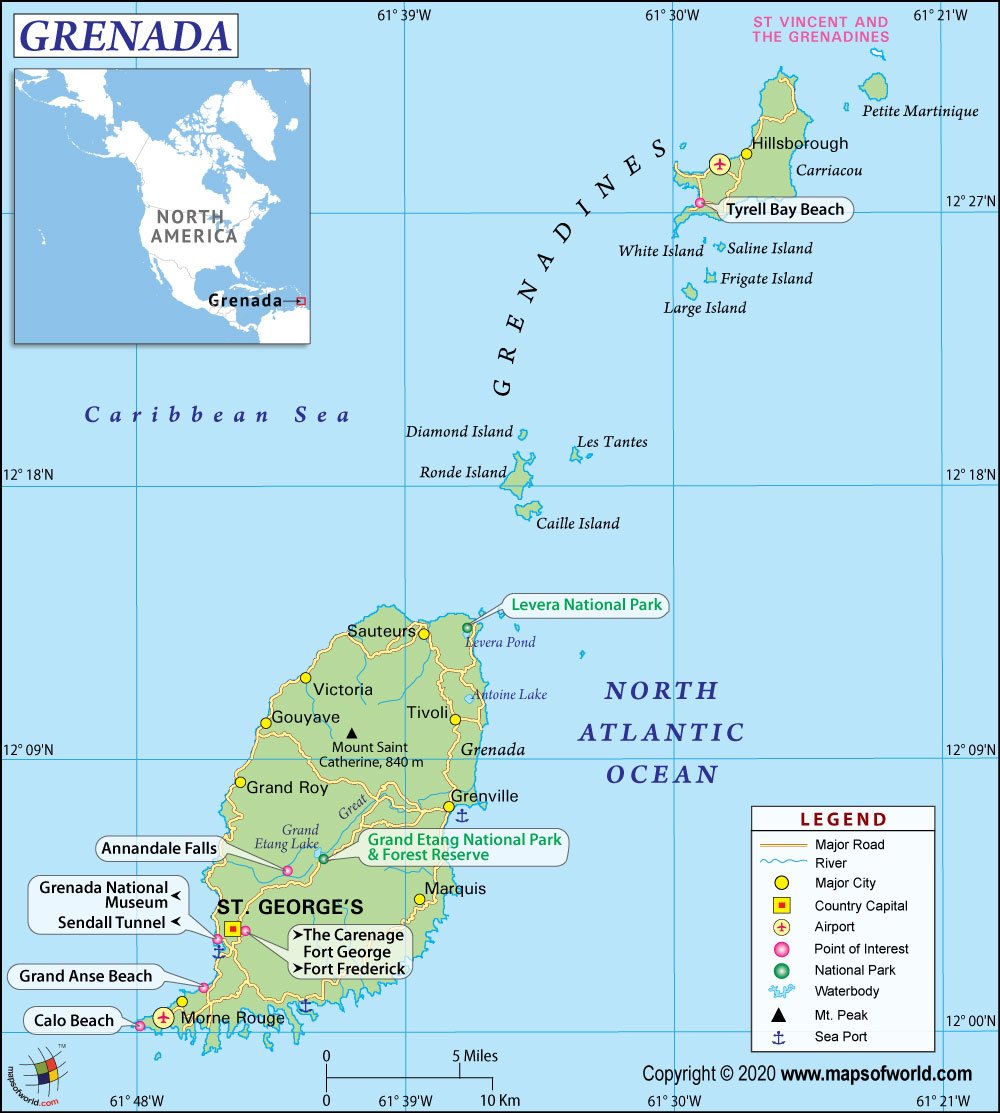
- Neighboring Countries - St Vincent and the Grenadines, Barbados, St Lucia, Dominica, Trinidad and Tobago
- Continent And Regions - North America Map, Americas Map
- Other Grenada Maps - Grenada Blank Map, Grenada Road Map, Grenada River Map, Grenada Cities Map, Grenada Physical Map, Grenada Flag
About Grenada
Explore this Grenada map to learn everything you want to know about this country. Learn about Grenada location on the world map, official symbol, flag, geography, climate, postal/area/zip codes, time zones, etc. Check out Grenada history, significant states, provinces/districts, & cities, most popular travel destinations and attractions, the capital city’s location, facts and trivia, and many more.
People Of Grenada
The population of Grenada is constituted with:
• Black descendants who made its origin from the African slaves.
• Mulattoes
• East Indians groups
• Laborers that came in place of freed slaves.
• The old French and British settlers.
• Immigrants of North America and Europe group.
English is widely spoken is this area, while one may still come across a type of patois language used by the villagers. The thriving religions of the area are:
• Roman Catholics
• Christian denominations like Anglicans, Methodists, and Seventh-day Adventists.
Arts, Culture And Music Of Grenada
Art: Get a cheerful and vibrant art culture in Grenada, which portrays the West Indian people, their vivacity and exuberance, their pets and birds. Fine Arts Gallery offers wide variety of artistic work of several renowned artists like Canute Calliste, Suan Mains, Donald Irvin, Lyndon Bedeau, Richard Buchanan, Christine Matuschek and many others. Camerhogne Art Gallery is famous for exhibiting carvings, sculptures, and wall plaques.
Culture: Participate in the annual drum festival celebrated in the village of Tivoli, which has attracted several visitors. It is only during the months of late July and early August, Grenada and Carriacou, experiences three chief celebrations like:
• The Carriacou Regatta,
• The Rainbow City Festival,
• The Grenada Carnival.
These three festivals harmonize with each other wherein shows, races, competitions, parades, trade fair, pageants, and other exhibits take place. It is during the festival of Play Mas, where one gets to pleasurably interact with the local natives.
Music: The music that is popular in Grenada is calypso and reggae . The Caribbean island of Grenada is known to have shaped quite a number of renowned native musicians like David Emmanuel, the reggae performer and Mighty Sparrow, a calypsonian artist. Carriacou, one of the north islands within the region of Grenada, became prominent for the song statement, which was based on the Big Drum Afro-Caribbean style.
The British and the French greatly influenced the native tunes of Grenada, especially the lullabies and reels, cantique, chanteys and quadrilles.
The population of Carriacou’s Afro-Caribbean carries its own distinct rhythm and cadence like: Big Drum that honors the country’s ancestors like Manding, Chamba, Temne, Moko, Igbo, Banda, Arada, Kongo and Cromanti.
The Big Drum ritual is observed with a song that is sung in the area of Cromanti, the biggest nation of the province. “Cromanti Cudjo” or “Beg Pardon” is pursued along with the tunes of other nations’ song that are short, melodramatic and are chorus in tunes.
Big Drum music is usually played incase a villager expires. The funeral is accompanied with features like music, storytelling and feasting and mainly saraca songs that have its lyrics defined from European and African style. The funeral music that is performed belongs to the folk music. Jazz and Country Music have gained wide acceptance within the region.
The African dances that have evolved here are Heel-and-Toe and Carriacou Big Drum, where famous artist like Willie Redhead, Thelma Phillips, Renalph Gebon and the Beewee Ballet perform.
Flag Of Grenada
The flag of Grenada was officially accepted in the year of 1974. The flag is designed with seven stars that denote the existence of seven parishes within the country. The centrally placed star is bordered by a red colored disk, which signifies the township of Saint George where the capital city of the same name resides.
Grenada is often referred to the “Spice Island,” because of the cultivation of different spices within the region. The clove of the nutmeg, which is settled on the left-hand side of the flag, is the chief crop within the region. The country’s African characteristics are evoked through the color combinations made which comprises of the color red, gold and green. The color Red signifies courage, yellow denotes wisdom and warmth while green the growth of vegetation in the region.
Economy Of Grenada
The economy of Grenada is solely dependant on:
- The cultivation of crops like nutmeg, mace, cocoa, and bananas.
- The tourism industry. (Help in the revenue growth in the country)
The merchandise exports is sustained mainly by the agricultural produce in the country where a major portion of the population resort to employment in this sector.
Grenada’s banana exports noticed a major fall in its production during the year 1996.
The Eastern Caribbean Central Bank is solely responsible for the currency circulation, monetary policies, commercial banking, import and export of which Grenada is a member.
- The industries thriving in the region are food and beverages, textiles, light assembly operations, tourism and construction.
- The goods that are exported are bananas, cocoa, nutmeg, fruit and vegetables, clothing and mace.
- The commodities that are imported here are food, manufactured goods, machinery, chemicals and fuel.
Stay connected at Mapsofworld for all relevant information about the Grenada land.