Ghana Map
 Buy Printed Map
 Buy Digital Map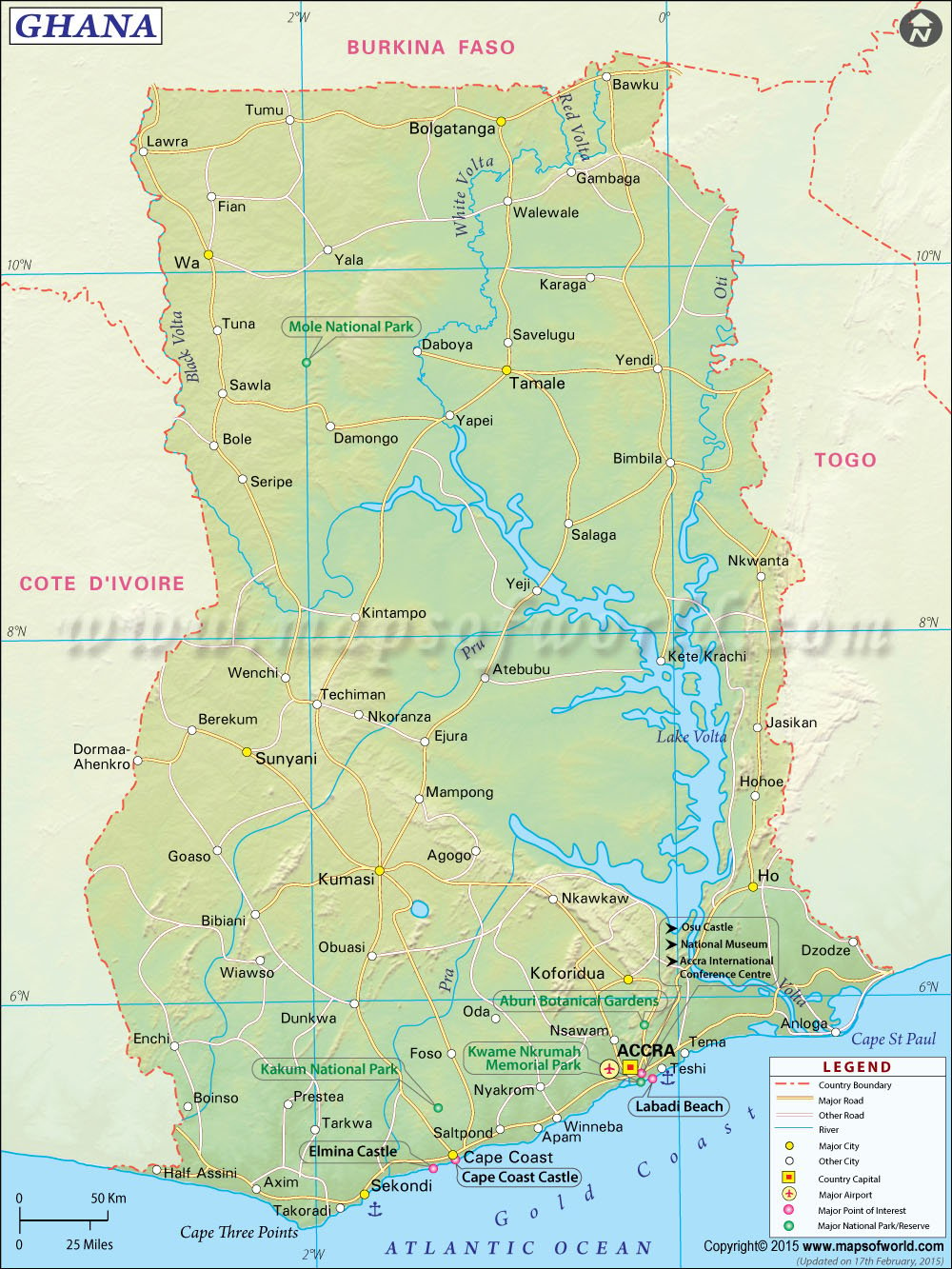
- Neighboring Countries - Cote d'Ivoire, Burkina Faso, Togo
- Continent And Regions - Africa Map
- Other Ghana Maps - Where is Ghana, Ghana Blank Map, Ghana Road Map, Ghana Rail Map, Ghana River Map, Ghana Political Map, Ghana Flag
About Ghana
Explore this Ghana map to learn everything you want to know about this country. Learn about Ghana location on the world map, official symbol, flag, geography, climate, postal/area/zip codes, time zones, etc. Check out Ghana history, significant states, provinces/districts, & cities, most popular travel destinations and attractions, the capital city’s location, facts and trivia, and many more.
| Full name: | Republic of Ghana |
| Capital City: | Accra |
| Language: | English (official), Ewe, Ga, Twi. |
| Currency: | Cedi (C) |
| Religion: | Christian, Muslim, native African religions |
| National Anthem | “Hail the Name of Ghana” |
| Newspaper: | Accra Daily Mail, Daily Graphic, Ghana Classifieds, Ghanaian Newsrunner. |
| Places to Visit: | Accra, Atlantic Coast, Aburi Botanic Gardens, Kakum National Park, Mole National Park and much more. |
| Transport: | Ghana International Airlines fly between Accra and London. One may even avail several African and Western airlines. Opt for ships that link up Tema,which lies in the east of Accra, with several ports in Nigeria, Côte d’Ivoire, Cameroon and South Africa. Buses, taxis, tro-tros ( known as minibuses) and pickup trucks are readily available between Ghana and Burkina Faso. |
| Shopping: | Earthenware pots, leatherwork, woven shirts and Bolgatanga baskets woven,Kente cloth Artefacts from the Ashanti and northern Ghana region, handmade gold and silver, African art & jewelry. |
The lush savannah of the inshore plains, the scorched desert of the Northern region, the spectacular waterfall along the Brong Ahafo and much more attractions bring along several travelers to the land of Ghana. Known as the first black African province this place gained its victory of independence from the colonial tyranny. The distinctive architecture, the historical treasures, the illuminated market place, the fascinating craft bazaar are surely worth a visit while jaunting to this location.
Physical Map Of Ghana
Ghana is well placed near the Gulf of Guinea that is lying just a mile away from the north of Equator. This place can be compared to the Oregon as far as size is concerned. Witness a low coastline along the sandy seashore that is supported by flat plain where innumerable streams bypasses.
Ghana is enshrouded with dense tropical rain forest wherein some of the trees lost its existence due to the presence of wooded hills, which broadens near the north region just a few miles from the shoreline along the Cote d’Ivoire frontier.
Towards the north side of the tropical belt one can witness the savanna grassy plains covering a major portion of the land space. The world’s largest artificial lake, Lake Volta expands from the Akosombo Dam to the Yapei town in southeastern Ghana. This lake has a prospective significance in the area of generating electricity for the state apart from being a source for irrigation and fish farming within the region.Ghana believes in maintaining a constitutional democracy, while Accra been appointed as the country’s capital city. Ghana is constituted with 10 major regions, which is separately alienated into 138 districts.The regions of Ghana are namely:
|
|
Location Of Ghana
The Republic of Ghana is nestled within the region of Western Africa, which is engulfed on all ends by Côte d’Ivoire from the western end, Burkina Faso from the northern end, Togo from the eastern end, and the Atlantic Ocean from the southern end.
Flag Of Ghana
The flag of Ghana was officially accepted during the year of 1957. Designed by Mrs. Theodosia Okoh the flag is adorned with Pan-African colors of Ethiopia. Red, gold, and green are the three-color bands that are horizontally placed while black five-pointed star positions itself in the center along the gold stripe. The color red denote the struggle of independence while the color gold signifies the possessions of valuable minerals within the state while the green represent the richness of natural resources and wealth in the place. The black star corresponds to the guiding star of the freedom the African struggle for freedom.
Climate Of Ghana
As Ghana is set along the northern side of the equator it experiences a frequent change in its climatic condition from wet to dry seasons.
The month of December-February witnesses dry season with about 27-36 C (daytime) and18-26 C (night time).
The month of April to October in northern Ghana and along with April to June and further continuing during the month of September to October in the southern region are affected with rainy season.
The month of March goes through the high temperature while August witnesses low humidity weather condition.
The rest of the year is relatively sultry and dry with about to 38°C rise in temperature.
Harmattan, the dry northeast wind gusts along the region in the months of January to February. The eastern coastal belt is affected with (warm and dry climate); the southwest area is affected with (humid along with down pouring) while the north is (hot and dry).
Flora And Fauna Of Ghana
Ghana is bestowed with scenic natural flora and fauna that thrive within a conducive environment.
The place serves as a cozy habitat for unique wildlife and colorful birds. Mention should be made of the Keta-Angaw lagoon basin, a swampy ground wherein quite a number of migratory birds breed. Hawksbill, Leatherback and Green Turtles some of the native birds of the province breed along the sandbanks of the Volta estuary.
- The Kakum National Park, which is acclaimed as a natural rainforest within the Central Region, is a home to about 40 species of mammals, elephants, birds and butterflies.
- Mole National Park is renowned as the largest national park wherein animals like Duiker, antelopes, kob and hartebeest; leopard, lion, elephant and buffaloes reside peacefully.
- Gbele Game Reserve, are known for preserving hippos, along with elephants and Roan Antelopes.
- The coastline of southern Ghana is festooned with mangroves marshland, and palm fringed gardens.
- The native birds of this region are Bareheaded Rock Fowl, Fire-bellied Woodpecker, Fraser’s Eagle Owl, Narina’s Trogon, Woodland Kingfisher; Orange- cheeked Waybill, Palm-nut Vulture, Barbary Shrike and much more.
- The native animals are Mona Monkey, Diana Monkey, Colobus Monkey, Roan Antelope, Olive Baboon, Hartebeest, Waterbuck and much more.
PEOPLE OF GHANA
The people of Ghana are known for preserving extraordinary sense of self-respect, self-wisdom and determination. The six chief ethnic groups residing in this area are:
|
|
There are about 56 aboriginal vernaculars spoken in Ghana wherein about 31 are specific to the northern region. Twi, Fante, Ga, Hausa, Dagbani, Ewe and Nzema are the regional languages used by diverse group of people in Ghana. Though English is the official language spoken by all. The total number of Christians residing here tentatively amounts to 60 percent of the present population. Muslims and other native African religion can be seen existing in fewer regions.
Arts, Culture And Music Of Ghana
Art: The Ashanti ethnic groups are known for crafting and chipping handmade tools, fertility dolls, kente cloth, weaving, woodcarving, making ceramics, and pottery making and designing. The Adinkra printings are a unique form of art that is used specially during a customary festival or celebration.
Culture: Ceremonies and celebrations is the only of source of entertainment the native people can resort to. It is customary for every person among the village to attend any kind of funeral ceremony. The Ghanaian celebrates Panafest festival where people get to commemorate the rich heritage of the place. Homowo or ‘making fun of hunger is yet another traditional festival of the region that is strictly adhered to.
Music: Ghana is known to preserve three kinds of music. One the conventional music, played in festivals or in funerals; second the highlife music, merged by customary and imported music; and thirdly, the choral music, held in concert halls.
Music is usually accompanied with native musical instruments like Axatse, Gankogui, Kaganu, Kidi, Sogo, Atsimevu, Kpalogo Drum and much more.
Economy Of Ghana
Ghana earns twice as much as any other poor country in West Africa as far as the per capita output is concerned. Ghana is economically reliant on the financial and industrial aid from other international countries. Gold, timber, and cocoa are the chief source of overseas revenue exchange within the district. Agriculture accounts for the country’s GDP growth, wherein about 60 percent of the population is occupied in this profession. Pineapples, cashews, pepper, assava, yams, plantains, maize, rice, peanuts, millet, sorghum are even produced in large amounts. Tourism is yet another revenue generated industry, which attracts thousands tourists from round the world.
- The goods that are imported here are capital equipments, petroleum and foodstuffs.
- Exported goods comprises of gold, cocoa, timber, tuna, bauxite, aluminum, manganese ore, diamonds
- The industries thriving in this region are mining, lumbering, light manufacturing, aluminum smelting, food processing and much more
