 Buy Printed Map
 Buy Digital Map
 Customize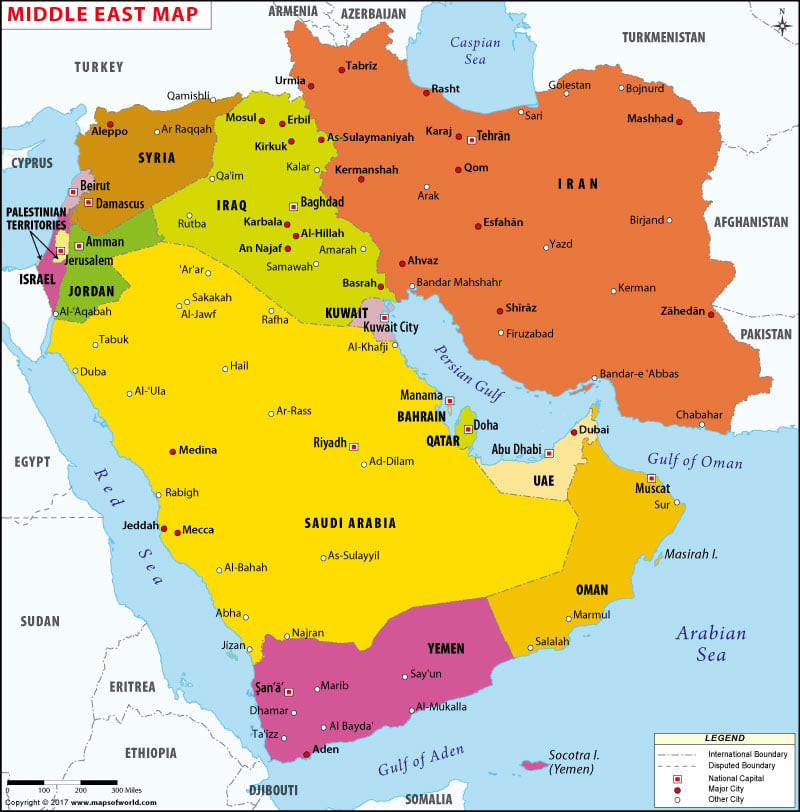
The Middle East is a roughly defined region of Western Asia, which often includes parts of Northern Africa, centering on the Arabian Peninsula.
Introduction about Middle East
Today, the “Middle East” is defined as an area, which extends from the Atlantic Ocean (west) to Afghanistan (east). More specifically, it covers an approximate distance of 5,600 kilometers.
It has an overall population of approximately 300 million people and surrounds the countries of Turkey, Qatar, Algeria, Morocco, Libya, Tunisia, Israel, Egypt, Syria, Lebanon, Saudi Arabia, Jordan, Bahrain, Kuwait, Oman, the United Arab Emirates, Iraq, Yemen, and Iran. The African nations of Sudan and Mauritania are also included in the Middle East. In recent times, one finds that the terms “Middle East” and “Middle Eastern” are considered a complete region, just as the way we would refer Central Asia, Southeast Asia or Europe. The Middle East is home to four distinctive cultural areas, i.e. the Iranian, Turkish, Arab, and the newly introduced Israeli culture.
Territories and regions
Here is a list of countries included in the Middle East that corresponds with Western Asia, with the exclusion of the Greek Cyprus, Caucasus, and after including Egypt:
| Yemen | Palestine | Israel |
| United Arab Emirates | Oman | Iraq |
| Turkey | Northern Cyprus | Iran |
| Syria | Lebanon | Egypt |
| Saudi Arabia | Kuwait | Cyprus |
| Qatar | Jordan | Bahrain |
Relations between the countries
- Iran-Israel : Iran considers Israel nothing beyond a “Zionist regime.” It has always supported alternative militant groups which have their base in the Gaza, West Bank, and southern Lebanon.
- Iran-Egypt : For about three decades there were no formal diplomatic relations between Egypt and Iran.
- Iran-Turkey : It is true that Turkey and Iran share a solid economic relation, but when it comes to regional conflicts they are never on the same side.
- Iran-Saudi : The opposition between Shi’a-led Iran and Sunni-led Saudi Arabia includes differences over oil, political philosophy, and regional influence.
- Iran-Qatar : Iran and Qatar share intimate economic ties, however don’t share similar thoughts when it comes to Syrian conflict.
- Iran-Iraq : Iraq joined hands with Iran in supporting Bashar al-Assad’s government in Syria. However, they did not agree on the armed upheaval of Egyptian President Muhammad Morsi.
- Israel-Egypt : Israel and Egypt have retained strategic relations after having signed the 1978 Camp David Accords.
- Israel-Turkey : Prior to the Prime Minister of Turkey, Recep Tayyip Erdogan’s rule, relations between Israel and Turkey had influential military and economic cooperation. But then, the stress was heightened under Erdogan.
- Israel-Saudi Arabia : Though Saudi Arabia and Israel don’t share a formal diplomatic relation, yet we have seen a number of times that the interests of these countries usually overlap.
- Israel-Qatar : The reduced level of diplomatic relations between Qatar and Israel were cut off by the former in a protest against 2008 Operation Cast Lead of Israel.
- Israel-Syria : Israel is noted for its targeted military installations in Syria. President Bashar al-Assad has warned Israel in case a western coalition offers military help to the rebels of Syria.
- Turkey-Saudi Arabia : Saudi Arabia and Turkey share planned interests, with an inclusion of a rivalry with Iran as well as the support for the rebels of Syria.
- Turkey-Qatar : These two countries share similar interests across the Middle East. Both are in support of the Syrian rebels and have berated the expulsion of Muhammad Morsi, the Islamist leader, from the presidency of Egypt.
- Qatar-Syria : Qatar aids the defeat of Syrian President Bashar al-Assad’s rule. It has offered military and financial help to revolutionaries there.
Dependence on Middle East Economy
The Middle East economy is a diverse one. It consists of Cyprus, Bahrain, Gaza Strip, Iraq, Iran, Iraqi Kurdistan, Egypt, Jordan, Kuwait, Israel, Lebanon, Northern Cyprus, Oman, Syria, Qatar, United Arab Emirates, Saudi Arabia, Turkey, State of Palestine, and Yemen. Moreover, the area carves a niche for the production and export of oil. The oil industry will influence the complete area, both via the wealth, which it generates as well as via the labor movement.
Geography of the Middle East
The Middle East includes the states of Egypt, Oman, Yemen, Qatar, United Arab Emirates, Iran, Bahrain, Syria, Jordan, Turkey, Lebanon, Saudi Arabia, Kuwait, Iraq, and Israel. The Middle East area represents a region of more than five million square miles. The physical geography is too a varied one. One will find vast expanses of deserts, which experience low rainfall. Temperatures in these areas show huge extremes. Along the Mediterranean Sea coast and the Caspian and Black Seas, one finds the water lessening the extreme desert temperatures that results in a more moderate climate, which is same as that of California or southern Italy.
International relations with the Middle East
The recent concentration on Arab-Israeli relations has aided us to believe that Middle East diplomacy will be lowered to a single dimension. More specifically, the foreign strategies of Middle East states are guided by complicated and different motivations. These multiple factors owe as much to geography, history, regional alliances, and western influences as they do to the Israeli conflicts. The essentials of checking rival ambitions, enhancing economic opportunities, and seeking to establish alliances have consistently shaped the local landscape.
List of Middle East Countries listed in Map |
|---|
| Country | Capital | Area | Population |
|---|---|---|---|
| Syria | Damascus | 185,200 km² | 20,820,311 |
| Lebanon | Beirut | 10,450 km² | 4,259,405 |
| Jordan | Amman | 91880 km² | 6,181,000 |
| Israel | Jerusalem | 20,770 km² | 7,765,700 |
| Iran | Tehran | 1,648,000 km² | 74,798,599 |
| Iraq | Baghdad | 438,300 km² | 32,961,959 |
| Kuwait | Kuwait City | 17,820 km² | 2,818,042 |
| Saudi Arabia | Riyadh | 2,150,000 km² | 28,082,541 |
| Bahrain | Manama | 765.3 km2 | 1,323,535 |
| Qatar | Doha | 11,571 km2 | 1,870,041 |
| United Arab Emirates | Abu Dhabi | 83,600 km² | 7,890,924 |
| Oman | Muscat | 309,500 km² | 2,846,145 |
| Yemen | Sana’a | 528,000 km² | 24,799,880 |
