Libya Map
 Buy Printed Map
 Buy Digital Map
 Wall Maps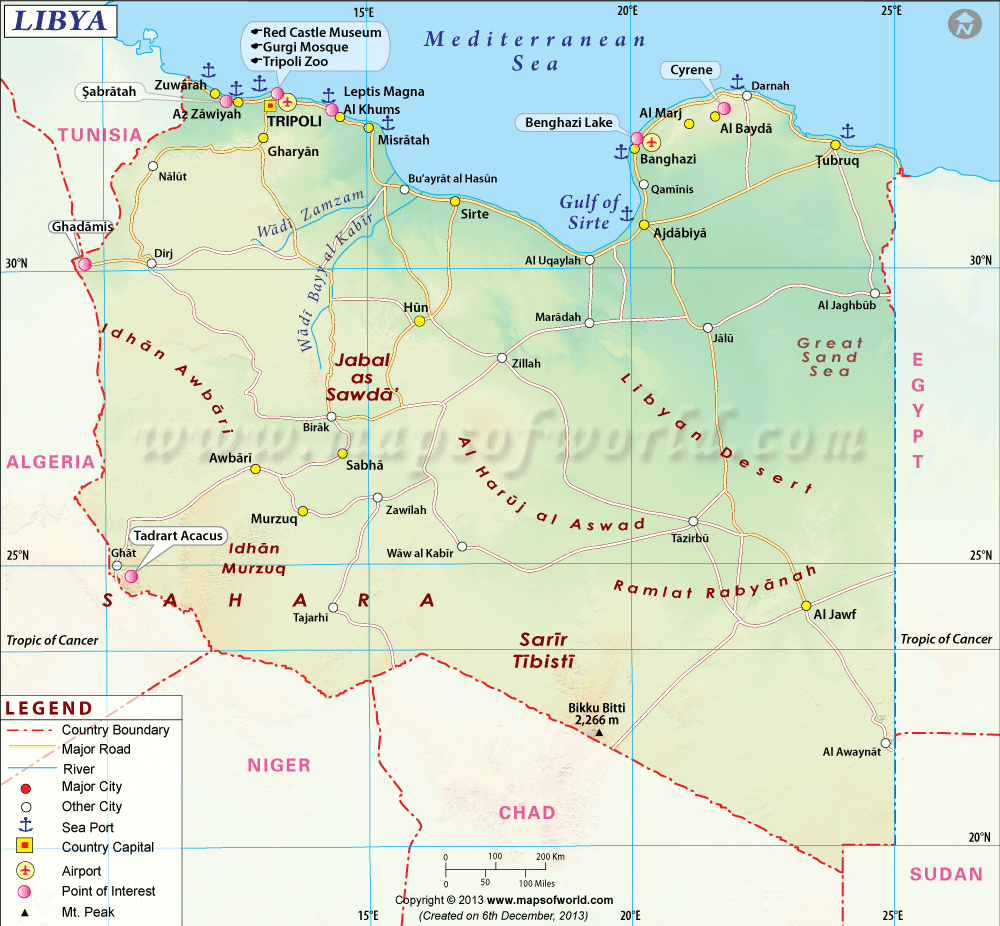
- Neighboring Countries - Tunisia, Algeria, Niger, Chad, Sudan, Egypt
- Continent And Regions - Africa Map
- Other Libya Maps - Where is Libya, Libya Blank Map, Libya Road Map, Libya River Map, Libya Cities Map, Libya Political Map, Libya Physical Map, Libya Flag
About Libya
Explore this Libya map to learn everything you want to know about this country. Learn about Libya location on the world map, official symbol, flag, geography, climate, postal/area/zip codes, time zones, etc. Check out Libya history, significant states, provinces/districts, & cities, most popular travel destinations and attractions, the capital city’s location, facts and trivia, and many more.
| Official Name: | Great Socialist People’s Libyan Arab Jamahiriya |
| Capital: | Tripoli |
| Population: | 6,420,000 |
| Area: | 1.75 million sq.km or 0.67 million sq mi |
| Currency: | Dinar (LYD) |
| Religion: | Islam |
| Literacy: | 82.6% |
| Languages: | Arabic |
| Major Cities: | Tripoli, Benghazi, Misratah, Tarhunah |
| Climate: | dry and hot in summer and cool and dry in winter. |
Libya or the Libyan Arab Jamahiriya is recognized as the fourth largest country within the African continent, and stands in the 17th position as being one of the largest nations in the world.The province is divided into three traditional parts namely Tripolitania, the Fezzan and Cyrenaica. The word “Libya” comes from the Egyptian term “Libu”, which relates to one of the Berber tribes residing in the western region of the Nile.
Arabic is the national dialect spoken in the region. Tamazight is yet another vernacular spoken by the Berber community. The Tuaregs group of people converse with Tamahaq language in the area. Italian and English are even widely accepted within the region.Islam is the sole religion thriving here where most of the natives resort to Sunni Islam, while the rest of the population relate to the Ibadism (a subdivision of Kharijism) religion. Sufism is also followed in several places of the area.
Location Of Libyan Arab Jamahiriya
Libya or Libyan Arab Jamahiriya is nestled within the North Africa, engulfed by the Mediterranean Sea towards the northern end, Egypt towards the eastern end. It is even surrounded by Sudan towards the southeastern end, Chad and Niger towards the southern front, and Algeria and Tunisia to the western direction.
Physical Map Of Libyan Arab Jamahiriya
Libyan Arab Jamahiriya covers a total land space of about 1,759,540 square kilometers that makes it even smaller in size as compared to Indonesia, and is in sync with the size of the US state of Alaska. The eastern part of Libya is covered with deserted lands that are parched and arid in nature. The area is rarely prone to inconsistent rainfall that occurs once in a while within 5- 10 years of span. The western region is marked with oasis dispersed in groups accompanied with depression of which mention can be made of the Kufra group, which includes Tazerbo, Rebiana and Kufra. Catch up with intermittent series of plateaus and massifs along the central point of the Libyan Desert, where Egyptian-Sudanese meet along the Libyan Borders.
The sandstones plateau engulfs the Granite Mountains along the southern area. Eastern Uweinat is known as the highest point within the region, which is an elevated sandstone plateau lying close to the granite region in the western front. The northern end is marked with Uweinat plain, which is featured with volcanic eruptions.
Flag Of Libyan Arab Jamahiriya
The Libya flag was officially accepted in the year of 1977. The country is the only province that carries a flag based on a single color. Green is known as the national color of the country that is carried in its national flag, which denotes the native’s belief and faith in the Islamic religion.
Climate Of Libyan Arab Jamahiriya
The climatic condition of Libya or Libyan Arab Jamahiriya is to a greater extent influenced by the Mediterranean Sea and the deserted region. During the winter months, witness a cool weather that is conditioned with slight showers along the coastal region. It gets dry along the desert areas where temperature descends to about sub-freezing level.
The Sahara experiences dry and scorching condition during the months of summer while it is chill and parched in the winter months.
The best time to jaunt to the Sahara is during the month of October to April, where the day temperature ranges from 15 to 30%deg;C while night being 5 to 20%deg;C.
Watch out for dust-laden sirocco called as gibli along with dust storms and sandstorms that can be witnessed within the region.
Flora And Fauna Of Libyan Arab Jamahiriya
Catch up with floras like the date palms, olive trees and orange trees along with asphodel and wild pistachio near the Jabal Nafusah Plateau. The desert regions are scattered with plants like tamarind, fig tree, acacia arabica and grasses like the alfalfa and esparto. Juniper and mastic trees are quite common in the areas of Jabal al-Akhdar.
Watch out for faunas like the desert rodents, hyena, wildcat, porcupine and gazelle. Bird like the vulture, eagle and hawk are quite frequently sighted within the region.
Arts, Culture And Music
Art: The Rock-art of Wadi al-Ajal captures your sight while traveling to Libyan Arab Jamahiriya, which is found along the southwestern part of Fezzan region.Watch out for paintings and etchings of primitive age that depict the human figures, the wild animals along with the abstract figures that were inscribed here.
Culture: Relish the Libyan delicacy, which has a blend of Arabic and Mediterranean flavors along with the presence of Italian essence. Taste their local dish especially the couscous, which is made of cereals, meat and potatoes. Alcohol consuming is strictly banned within the region as the state abides with the law of Islam.
Libyan Arab Jamahiriya shares a common cultural heritage with its neighboring Arabian continents. The preference of family life comes first for the natives, who frequent visit the country’s scenic beaches. Glance through the important archaeological sites, particularly the Leptis Magna, which is the conserved as the Roman archaeological location of the area.
Music: Assorted range of Arab music thrived within the region, which includes the Andalusi music, which was natively called as the Maluf, Chabi and Arab classical music. The Tuareg community that resides in the southern part of the Saharan region is known for carrying its own folk music. They perform music with a musical instrument that is a one-stringed violin known as anzad, accompanied with drums. The other instruments that are commonly used are zokra, a bagpipe, flute, tambourine, oud, a lute and darbuka, a kind of drum. Huda is the camel driver’s song that is sung by the Bedouin poet-singers, which can be frequently heard within the region.
Economy Of Libyan Arab Jamahiriya
The economy of Libyan Arab Jamahiriya earns its revenue income mainly from the petroleum industry, which supports all its export earnings and adds to the GDP growth within the area. The manufacturing industry along with the construction segment financially supports about 20 percent of the GDP that deals with processing of farming products along with the manufacturing of petrochemicals, iron, steel, and aluminum. Agriculture is the next sector on which the economy largely depends on that supports its export business.
- The goods that are exported to different countries are crude oil, refined petroleum items and natural gas.
- The commodities that are imported include products like machinery, semi-finished goods, food, transport equipment and consumer products.
- The industries thriving within the region are petroleum, iron and steel, food processing, textiles, handicrafts, cement.
