MapsofWorld.com

Your Window to the World

Maps of World.com
OUR CHANNELS :  Finance | Travel
HOME
SITE MAP
NEW ON MAPS OF WORLD
Iraq Map XL
WORLD ATLAS
WORLD MAPS
LOCATION MAPS
WORLD CITY MAPS
WORLD CITY INFO
NORTH AMERICA MAPS
SOUTH AMERICA MAPS
EUROPE MAPS
ASIA MAPS
AUSTRALIA & OCEANIA MAP
AFRICA MAPS
USA MAPS
WORLD OF SPORTS
LANDKARTEN DER WELTLandkartnen der Welt

Home > Iraq > Iraq Tourism

Iraq Tourism

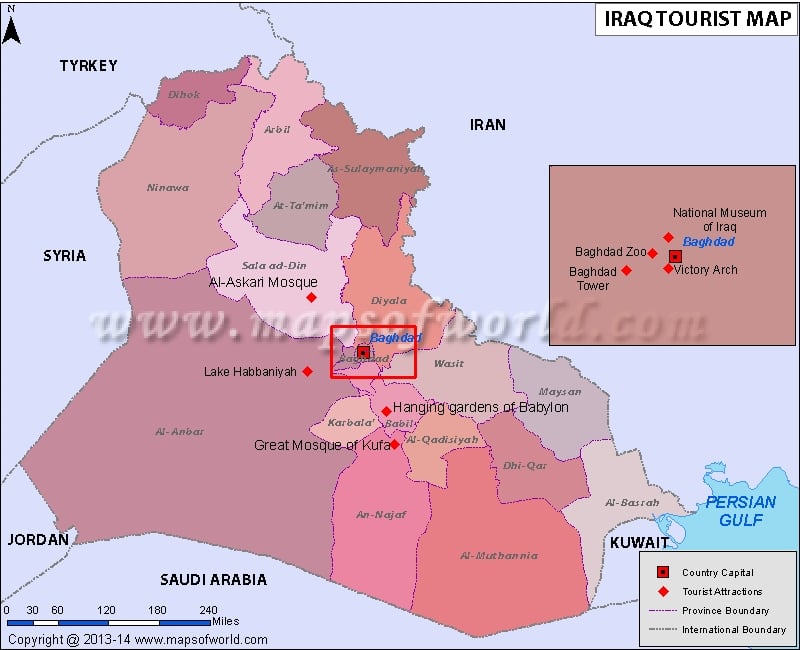
In Iraq the places to visit are Baghdad (capital city), Mosul, Agargoaf, Assur, Babylon, Basra, Borsuppa, Ctesiphon, Eridu, Hatra, Kerbala, Khorsabad,Kish, Najaf, Nimrud, Nineveh,Qurna, Samarra, Ur, Uruk, The Marshes, Ukhaidhir.

Baghdad is the capital city of Iraq. It is said that every road in Iraq leads to Baghdad. It is the City of the Caliphs. It is also the place wherethe legendary character Sindbad was born. Baghdad is located on the river Tigris. The river separates Baghdad into two parts namely Rusafa and Karkh. However, they are well-connected by bridges. In Rusafa one can find the Al-Rashid Street which is the commercial hub of the city.Caliph Street, which lies parallel to this street, is lined with ancient mosques and churches. Cinema halls, travel agencies, premium hotels and airline offices will be found on the Sadoun Street. One can take a lovely soothing drive by the Tigris along the road (lying parallel to Sadoun Street) that stretches from Jumhouriya Bridge to The 14th July Suspended Bridge.

The places to see in Baghdad are old churches and monasteries -Kadhimain Shrine, Church of Meskenta, The Latin Church,Syrian Catholic Church, Latin Church;Walls and Gates-Mu'adham (North) Gate, Dhafariya (Wastani) Gate, Halaba (Talisman) Gate, and Basaliya Gate;The Abbasid Palace.

In Mosul, the second largest city in Iraq,is full of tourist sites like The Umayyad Mosque,The Mujahidi Mosque,The Great ( Nuriddin Mosque), Qara Serai( Black Palace).

Basra is the third greatest city of Iraq. It is called the Venice of the East .Numerous canals running through the city creates an enchanting beauty worth seeing.

Kadhimain Shrine

Al-Kadhimeyya is one of the oldest towns in Iraq. Before the construction of Baghdad, Al-Kadhimeyya was known as Shoneezi, an Arab name meaning the Black Grain. When the Abbasid Caliph Abu Ja'far Al-Mansour started the construction of the Round City of Baghdad in 762 AD (145 AH), he made that area a cemetery named the Qureish cemeteries; containing the bodies of his family.

What to see in Baghdad?

One of the oldest churches in Baghdad, known as Church of Meskenta and as the Church of the Virgin Mary, located in Midan Square off Al-Rashid Street.

It was first built in 1640 AD by the Armenians on a piece of land granted to them by the Ottoman Sultan Murad IV. Then it changed hands to the Nestorian Christians before it eventually went back to the Orthodox Armenians possession.

Old Churches and Monasteries, Baghdad

The Armenian Orthodox Church (Meskenta Church) One of the oldest churches in Baghdad, known as Church of Meskenta and as the Church of the Virgin Mary, located in Midan Square off Al-Rashid Street.

It was first built in 1640 AD by the Armenians on a piece of land granted to them by the Ottoman Sultan Murad IV. Then it changed hands to the Nestorian Christians before it eventually went back to the Orthodox Armenians possession.
Every year, on August 15 special rituals are held in this church for the Assumption of Virgin Mary to heaven. The church is visited all year round by Baghdadis from various sects to present their offerings and gifts.
It is also known to people as the Church of Meskenta (Shirin) after the name of a woman died a martyr in the 5th century. Certain traditions related to local folklore are practiced there such as the Iron chain which some people put round their neck, where if it unlock automatically, prayer acceptance and wishes come true. This church was reconstructed in 1967 and maintenance works and extensions have continued in last few years.

The Latin Church (The Roman Catholic Church)

Built in 1866 near Shorjah in Al-Khulafaa Street. The site was used in 1731 by the Carmelite Fathers to practice their religious rituals in a small church. At that time, it was called the Temple or Monastery of St. Thomas; the apostle. The current church, completed in 1871, is shaped like a cross with towering dome about 32 feet high.

There are many statutes within the church and its walls are decorated with rare paintings. At the present, the church is at the disposal of Orthodox Copts working in Iraq. In the courtyard of this church lies the Iraqi scholar and linguist, father Ansatas Mary the Carmelite who was born in 1866 and died in 1947.

The Chaldean Church

A Chaldean Cathedral and a center of the Chaldean Patriach seat, situated in Ras Al-Grayyeh, near Wathba Square opposite of Shorjah market place, it is one of the largest existing churches in Baghdad. It was built on the grounds of a small church dating back to 1838 AD, and used to be called the Church of Mary Mother of Sorrows.

The Syrian Catholic Church

The first church to be built by the Syrian Catholics in 1841, located in Ras Al-Grayyeh opposite of Shorjah market place between the Latin and the Chaldean Churches. Later on, it was named The Virgin Mary Church and was re-opened in 1863. The interior of the church as well as its altars are decorated with ornaments. Its main door is considered a masterpiece of workman ship and precision in wood engraving.

The Armenian Catholic Church

Situated at Al-Ghazal Souq in Al-Khulafaa Street. Its construction started in 1840 and completed in 1844. At the beginning, it was called Church of Savior's mother, then Church of Assumption. This church was partly reconstructed in 1883 and had its altar and doors renovated.
Walls and Gates, Baghdad
When Abu Ja'far Al-Mansour built Baghdad in 762 AD, it was a round city, with walls and four gates at an angle of 90 degrees for defensive purposes. Main administrative and religious buildings were placed near the center for easy approach. Although the capital was abandoned for Samarra in AD 836, the Abbasids went back to it in AD 892, and the city continued to expand on both sides of the river. Al-Mustarshid Billah (1118 - 1135 AD), was the first Caliph to build a wall on the eastern (Rusafa) side of the city, which remained until late in the 19th century.

Walls and Gates, Baghdad

When Abu Ja'far Al-Mansour built Baghdad in 762 AD, it was a round city, with walls and four gates at an angle of 90 degrees for defensive purposes. Main administrative and religious buildings were placed near the center for easy approach. Although the capital was abandoned for Samarra in AD 836, the Abbasids went back to it in AD 892, and the city continued to expand on both sides of the river. Al-Mustarshid Billah (1118 - 1135 AD), was the first Caliph to build a wall on the eastern (Rusafa) side of the city, which remained until late in the 19th century.

The Eastern Wall was very thick, built from bricks, with several watchtowers and a deep moat connected with the Tigris. The main gates were: Mu'adham (North) Gate, Dhafariya (Wastani) Gate, Halaba (Talisman) Gate, and Basaliya Gate.

The only gate extant today is the Wastani Gate, near the Mausoleum of Omar Al-Sahrawardi - just off Sheikh Omar Street. It is a high cylinder-shaped tower with a ground circumference of 56 meters, 14.5 meters high, crowned with an octagonal dome. On the northwest side it has a portal 3 meters wide with a pointed arch, in front of which is a bridge across the moat. On the southwest side of the tower is a door that leads to an even bigger and higher bridge over the moat.

In the course of the extensive construction works undertaken by the government, workers on the speedy way near South Gate hit upon the remnants of what transpired to have been Halaba (Talisman) Gate, which was destroyed by the Ottomans in 1917. It had been last renewed some 7 centuries earlier in 1221, it has now been preserved with care, to stand as another monument telling a part of the history of Baghdad.

The Abbasid Palace, Baghdad

The only Abbasid palace left in Baghdad located near the North Gate overlooking the Tigris. It is believed to have been built by Caliph Al-Naser Ledinillah (1179 - 1225 AD), in whose reign other notable institutions were built.

It has a central courtyard and two stories of rooms, with beautiful arches and muqarnases in brickwork, and a remarkable ewan with brickwork ceiling and facade. When it was partly reconstructed in recent times another ewan was built to face it.

Because of the palace's resemblance in plan and structure to Al-Mustansereyya School, some scholars believe it is actually the Sharabiya School, a school for Islamic theology built in the 12th century, mentioned by the old Arab historians.

Parts of the building were reconstructed by the State Establishment of Antiquities and Heritage, whereupon a collection of historical remains were exhibited in it representing certain stages of the country's Arab Islamic history
Al-Rasheed Hotel - Baghdad


Ishtar Sheraton Hotel - Baghdad
Category 5 Stars
Number of Rooms & Suites 310 & 12
Nineveh International Hotel - Mosul
Category 5 Stars
Number of Rooms & Suites 262 & 23
Al-Mansour Melia Hotel - Baghdad
Category 5 Stars
Number of Rooms & Suites 292 & 14
Nineveh Obroi - Mosul
Category 5 Stars
Number of Rooms & Suites 189 & 9
Al-Mansour Melia Hotel - Baghdad
Category 5 Stars
Number of Rooms & Suites 292 & 14
Al-Mosul Tourist Hotel - Mosul
Category 4 Stars
Number of Rooms & Suites 147 & 11
Palestine Meridien - Baghdad
Category 5 Stars
Number of Rooms 400
Babel Tourist Hotel - Hilla (Babylon)
Category 4 Stars
Number of Rooms & Suites 47 & 4
Al-Rasheed Hotel - Baghdad
Category 5 Stars
Number of Rooms & Suites 338 & 52
Al-Sadeer Novotel Hotel - Baghdad
Category 4 Stars
Number of Rooms 282
Babylon Hotel - Baghdad
Category 4 Stars
Number of Rooms 300
 

WorldMapStore.com An exclusive online store of maps, globes, atlases, travel guides, and CDs.
 World Maps