Iceland Map
 Buy Printed Map
 Buy Digital Map
 Wall Maps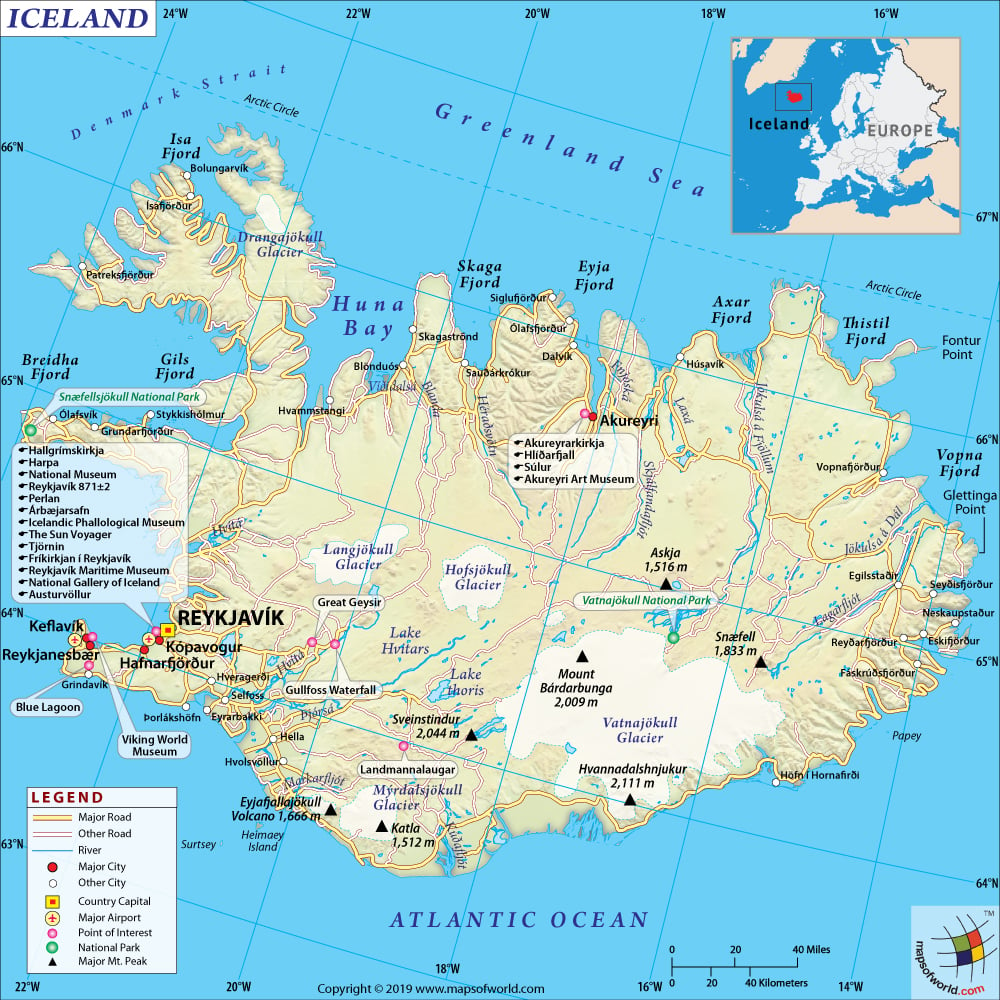
- Neighboring Countries - Greenland
- Continent And Regions - Europe Map
- Other Iceland Maps - Where is Iceland, Iceland Blank Map, Iceland Road Map, Iceland River Map, Iceland Cities Map, Iceland Political Map, Iceland Physical Map, Iceland Flag
About Iceland
Explore this Iceland map to learn everything you want to know about this country. Learn about Iceland location on the world map, official symbol, flag, geography, climate, postal/area/zip codes, time zones, etc. Check out Iceland history, significant states, provinces/districts, & cities, most popular travel destinations and attractions, the capital city’s location, facts and trivia, and many more.
| Full name | Republic of Iceland |
| Capital City | Reykjavik |
| Language | Icelandic (official), English |
| Currency | Icelandic krona (ISK) |
| Religion | Evangelical Lutheran, Protestant designation, Roman Catholic & Asatru followers, Norse religion. |
| National Anthem | Lofsongur (Song of Praise) |
| Newspaper | Baejarins Besta, Iceland News (EN), Hornafjordur, InsideEurope Iceland |
| Places to Visit | Grimsey, Myvatn, Reykjavik, Geysir, Gullfoss, Hallgrimskirkja, Helgafell, Skaftafell National Park |
| Transport | Avail the direct flight of Icelandair, that travel between Europe and USA. One may even opt the Iceland Express, incase one is looking for a low budgeted tour that travels daily from Reykjavik to London and to Copenhagen. One may even undertake a ferry ride, though it is time taking but costs similar to the air fare. The month of May to early September, is usually the time to undertake ferry ride from Hanstholm in northern Denmark. |
| Shopping | Earthern-colored Lopi wool blankets, coats, jackets, earthenware containers, hand knitted hats, pottery, ceramic pieces and many others. |
Indulge in snow mobiling to ice fishing in this land, which has a strong folklore platform.
Physical Map Of Iceland
Iceland is known as the second largest island within the European continent that is placed near the Arctic Circle. The province shares common cultural, economic and linguistic features and is known to be a part of the Scandinavian territory.
It is recognized as the largest island in the world that stands in the 18th position while being the largest island in Europe which positions itself in the 2nd place, right after the Great Britain. Almost 10 percent of the total land area is covered with glaciers of different types starting from the small cirque to the widespread glacier caps. Vatnajokull is the largest glacial cap of the region, which is placed in the southeastern region of Iceland that covers an area of about with an area of 8,300 squares. Other major glaciers of the region are Langjokul, Hofsjokull, Myrdalsjokull, Drangajokull and many others.
The islands lying in the coast region are fairly inhabited. The largest island of the region is Westman Islands towards the south, Hrisey towards the north, and Grimsey along the Arctic Circle.
Iceland is constituted with high raised mountains and elevated plateaus, where Hvannadalshnukur is placed in the oraefajokull glacier within the Southeastern region of Iceland that is considered as the highest point that ascends to a elevation of 2.119 m in height.
Iceland is active with several volcanoes with the presence of 200 postglacial volcanoes, out of which 30 have erupted till now. Among the volcanoes, the fissure eruptions are the common sort.
Hot Springs and Geo-thermal activity seem to predominate the region that typifies the Steam holes, mud pools, and sulphuric rainfall within the region.
The river that passes through this region can be divided into two sectors: glacial and clear-water rivers. The glacial rivers are separated in its diverse tributaries and frequently change their path while crossing the plains underlying the glaciers.
Location Of Iceland
Iceland is an island nation nestled in the northern region of Atlantic Ocean lying in the midst of Greenland, Norway, Scotland, Ireland and the Faroe Island.
The province is placed towards the southern region of the Arctic Circle, thereby passing through the island of Grimsey overlooking the northern coast of the province.
Flag Of Iceland
Several musical instruments like langspil and fiola became quite popular within the area. The place is known for the emergence of the epic alliterative along with the rhyming ballads called rimur that narrated the ancient epic tales that has its roots way back during the Viking era.
The flag of Iceland was officially accepted in the month of June 19, 1915. The flag is designed with a cross, which is a replica from the Danish flag. The flag has a snow-white cross along with a red colored cross is placed within the white cross behind a blue background. The coat of arms symbol is placed towards the edge of the flag whereas the blue background are designed with right-angled squares while the outer rectilinear surfaces are double in size to the interior left hand side ones. The color red signifies the active volcanoes prevalent within the area; the white symbolizes the frost-covered areas in the region, while the color blue stands for the Atlantic Ocean that engulfs the land.
People Of Iceland
It was the former Irish monks that settled along this region but later on Norwegians who settled in the Icelandic territory were responsible for the growth of the occupation and population within the region. It was seen that the traders from the Black Sea and Mediterranean provinces seem to have culturally affected the county. It is observed that the Icelandic culture has quite similarities and relates well with the features of the Scandinavian traditions, especially belonging to the Norway region. The population of Iceland is constituted with descendants from the Nordic and Celtic origin.
The nationalities thriving within the area are:
- Polish
- Danish
- Ex-Yugoslavians
- Filipinos and
- Germans
Icelandic, a North Germanic language is widely accepted language that is spoken by the natives. This language relates well to the Old Norse language that belongs to the Vikings. One may even come across the Faroese language, which is prominently heard in several regions within the territory. Some of the foreign languages accepted here are English, Danish, Scandinavian languages and German.
Arts, Culture And Music Of Iceland
Art: The local native spends most of their leisure hours; crafting several handicrafts like weaving, Silver crafting, and woodcarving. The Icelandic art seems to have influenced from the European and American adopted modernistic approach. Art can be associated well with the thriving religion, especially with the Roman Catholic Church and next with the Lutheran church. The first painter seems to have originated within the area during the 19th century, who painted the village scenario thriving in Iceland along with its cultural heritage. Painting became so popular within the area that the native civilization was blended with the foreign ideas, to bring along a fusion piece of artwork. The province still retains the age-old traditional work done with Silver threading, which was used as a major source of embellishment.
Culture: The local natives indulge in activities like playing soccer, athletics, basketball, golf, tennis, swimming, chess and horseback riding. The native cusines popular within the region which one must not miss out are Hakarl (decomposed shark), gravlax (salmon fish marinated with spices), hangikjot (smoked lamb), and slatur (delicacies made from sheep intestines). One may even try out the Brennivin the local liquor formed out of potatoes and caraway. The people excel in the fields of literature, prose and poetry, which is part and parcel of their cultural life. Do visit the West Nordic Culture House, a famous museum that shows the close link between countries like the West Nordic regions, the Faroe Islands, Greenland and Iceland. This place displays innumerable works of Viking and Inuit artwork, local paintings, carvings, crafting and other masterpieces.
Music: Icelandic music is closely interlinked with the Nordic breed of music, pulsating the native ethnicity with folk and pop music. Several musical bands emerged in this land that were admired which were Sugarcubes, and Sigur Ros. The songs that emerged here were truly religious in nature. Several Protestant hymns came into existence that was written by Hallgrimur Petursson during the 17th century. The composition was later on updated into a modern 19th century music, which was accompanied, by several music instruments like the pipe organ and harmonium.
Economy Of Iceland
Observe a Scandinavian-style of economy that is capitalistic in nature, which looks into far-reaching welfare system, employment opportunities along with the allocation of income evenly distributed within the province. The economy is reliant on the fishing sector that earns 70 percent of the revenue generation through its export while the rest with the workforce associated with it.
The goods that are exported within the region are aluminum, ferro-silicon alloys, machinery, electronic equipment related to the fishing business, software, and woolen goods.
The goods that are imported are machinery and equipment, petroleum products, foodstuffs and textiles. The primary partners being nations like Germany, United States, Norway, and Denmark. The country receives its electricity supplies from the hydropower and geothermal energy.
The prevalent agriculture industry produces crops like potatoes, green vegetables, mutton, dairy products and fish. Relatively 15% of the land is used for agricultural production where hay, potatoes, and turnips, are cultivated while fruits are reared within the greenhouses located here. Sheep rearing, horses and cattle grazing is something the natives even indulge in.
The rest of the country’s revenue is generated from the communications, trade, and service sectors. Tourism is also a growing and booming sector as the place attracts innumerable visitors round the year. The country shares its trade relation with countries like United Kingdom, Germany, Scandinavian countries, and the United States.
Iceland stands in the fifth position as the most productive country in the world as far as purchasing parity is concerned.
The economy is susceptible to the fall in its stocks that is related to the downfall of exports mainly of fish and fish products, aluminium, and ferrosilicon.
The government seems to regulate its policies as far as minimizing the budget along with current account deficits is concerned. The government even has plans for reducing overseas borrowing, inflation, amending agricultural and fishing strategy, expanding the economy, and privatizing the state-owned industries is concerned.
The country has made its advancement in the regions of software fabrication, biotechnology, and financial services.