Namibia Map
 Buy Printed Map
 Buy Digital Map
 Wall Maps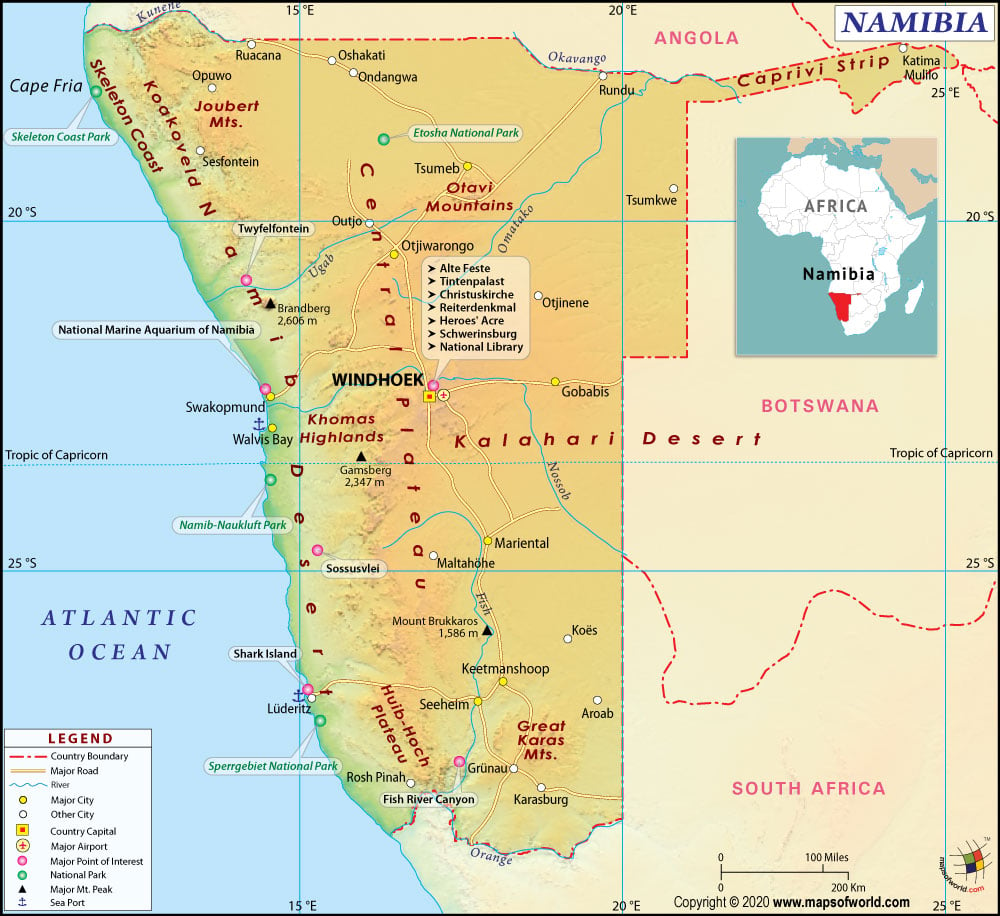
- Neighboring Countries - South Africa, Botswana, Zimbabwe, Zambia, Angola
- Continent And Regions - Africa Map
- Other Namibia Maps - Where is Namibia, Namibia Blank Map, Namibia Road Map, Namibia Rail Map, Namibia River Map, Namibia Cities Map, Namibia Political Map, Namibia Physical Map, Namibia Flag
About Namibia
Explore this Namibia map to learn everything you want to know about this country. Learn about Namibia location on the world map, official symbol, flag, geography, climate, postal/area/zip codes, time zones, etc. Check out Namibia history, significant states, provinces/districts, & cities, most popular travel destinations and attractions, the capital city’s location, facts and trivia, and many more.
| Full name | Republic of Namibia |
| Capital City | Windhoek |
| Language | English, Afrikaans, Herero, German, OshiKwanyama |
| Currency | Namibian Dollar |
| Religion | Christian, Lutheran, native religions |
| National Anthem | “Namibia, Land of the Brave” |
| Newspaper | Namibian, New Era, Plus Weekly, Southern Times, Republikein, Allgemeine Zeitung, Namibia Economist etc. |
| Places to Visit | The Central Plateau, Windhoek, Etosha National Park, Fish River Canyon, Sossusvlei and much more. |
| Transport | Airways: Air Namibia airlines, LTU airllines and South African Airways are available. |
| Shopping | Rock paintings, pottery and some local handicrafts can be found in Namibia ion cheap price. |
In the year 1990, Republic of Namibia regained its independence from the reign of South Africa.
Namibia has enlisted its name as a member of the Southern African Development Community i.e. SADC. It also has membership of the Commonwealth of Nations and the African Union or AU.
Climate Of Namibia
The weather condition of Namibia fluctuates between tropical and subtropical. The weather remains mostly warm and arid throughout the year. However the winter months are relatively cold. Rainfall is very low in the country. However in Kavango and Caprivi, the rainfall is comparatively high. The weather becomes really very hot during the month of December.
Location Of Namibia
Republic of Namibia is situated in the southern region of the African continent. It lies on the coastal region of the Atlantic ocean. The neighboring countries of the Namibia are Angola and Zambia on the northern side, South Africa on the southern region and Botswana on the eastern side.
Physical Map Of Namibia
Throughout the face of Namibia, there are several uplands, lowlands and tablelands. The highlands lie in the center of the country.
Among these highlands that the highest altitude is the Brandberg peak that rises almost 2,606 meters above the sea level. On the other hand the tablelands or the plateaus cover the northern and southern parts of the country.
The Orange River flows to the southern region of Namibia. On the east side of the country, lies the Kalahari Desert.
FLAG OF NAMIBIA
The flag of Republic of Namibia is very colorful and also significant. In the upper corner of the hoist side, a blue triangle is featured. And it also bears a yellow colored sun in left corner. Another triangle of green color is also shown in the bottom corner of the fly side. This one is also of same size as the blue one. The junction part of these triangles is colored in red. This red stripe is again bordered by two narrow white lines.
Flora And Fauna Of Namibia
- Flora: Desert covers a large portion of the country. That is why the flora of Namibia is not so rich and diverse. However unique species of desert plants are found here. These are various species of welwitschia and aloe.
- Fauna: The animal kingdom of Namibia is very rich with various unique species found in the forests. Elephants, rhinoceroses, lions, cheetahs, leopards, ostriches are largely found in this country. Besides these various other species of giraffe, hartebeest, eland, impala, zebra, kudu, springbok, wildebeest, gemsbok etc are also found here. Kori bustard and the Karroo korhaan are two unique species of birds that are found in huge number in this country.
People Of Namibia
Almost 1,800,000 people reside in Namibia. The Ovambo tribe covers the majority of the population of the country. The minorities of Namibia are Kavangos tribe, Herero, Nama, Damara, Bushmen, Baster, Caprivian, Tswana and so on. Although English is the official language of the country, German and some native languages such as Oshivambo, Herero, Nama etc are also spoken widely in various corners of Namibia.Art, Culture And Music Of Namibia
Art: Rock art is a very famous art form in Namibia. Rock art means painting on the rocks. Various animals and other things are engraved in the pieces of rocks. This is a common practice in the various corners of the country. [ptter is also a common art form in Namibia. Practice of theater also exists in the villages of the country.
Culture: Since there are various ethnic groups residing inn this country, the Namibian culture is also diverse and rich. Several rituals and customs of the different races and tribes and also of the religions have been accepted in the Namibian tradition.
Music: The music of Namibia bears a mixed taste of Comorian and Malagasy music forms. Creole and European genres have also left their influences in the music of this country. Various forms such as pop; reggae, jazz, rock, hip-hop etc are popular music forms in Namibia.
Economy Of Namibia
Namibia has been considered as the fourth-largest exporter country of non-fuel minerals in Africa. The economic status of the country mostly depends on its mineral export business. The agricultural products of the country are millet, peanuts, grapes, sorghum and so on. The industries that are growing very fast in this country are meatpacking industry, dairy products industry, fish processing industry, mining industry etc. Mining of several things such as diamonds, lead, silver, tungsten, tin, zinc, uranium, copper etc is very rich here. The materials that are exported are diamonds, copper, lead, uranium gold, zinc etc. South Africa and US are the primary export partners of Namibia.
