The Gambia Map
 Buy Printed Map
 Buy Digital Map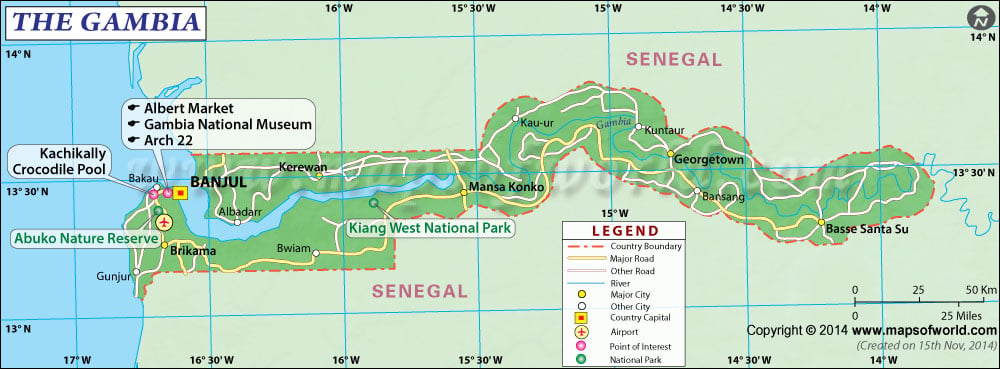
- Neighboring Countries - Senegal
- Continent And Regions - Africa Map
- Other The Gambia Maps - Where is The Gambia, The Gambia Blank Map, The Gambia Road Map, The Gambia River Map, The Gambia Cities Map, The Gambia Political Map, The Gambia Flag
About Gambia
Explore this Gambia map to learn everything you want to know about this country. Learn about Gambia location on the world map, official symbol, flag, geography, climate, postal/area/zip codes, time zones, etc. Check out Gambia history, significant states, provinces/districts, & cities, most popular travel destinations and attractions, the capital city’s location, facts and trivia, and many more.
| Full name: | Republic of The Gambia |
| Capital City: | Banjul |
| Language: | English, Wolof, Fula, Mandingo |
| Currency: | Dalasi (D) |
| Religion: | Muslim, Christian and others |
| National Anthem: | For The Gambia Our Homeland |
| Newspaper: | Daily Observer, The Gambia Daily News, The Point Newspaper |
| Places to Visit: | Banjul, Serekunda, Abuko Nature Reserve, Kartong, Wassu Stone Circles |
| Transport: | One can avail charter flights flying from western Europe and related African states, that has connection with other copuntries. One need to pay the airport tax while leaving Gambia that too in hard currency. Gambia River is also a mode of transportation within this region. |
| Shopping: | Gambishirt, designed with printed and embroidered cotton cloth, Woodcarvings, beaded belts, silver and gold jewelry, West African handicrafts made from straw, beads, leather or metal are found here. |
From viewing the historical burial grounds along the Wassau region to traveling along the prominent trading hubs of the Georgetown.
From taking a breath taking ferry rides from Banjul to Barra to viewing the architectural colonial elegance of the MacCarthy Square.
Experience all these adventures while traveling to Gambia where one can choose to indulge in the exotic greenery of abundant forestlands to the sandy beaches along the Atlantic shores
Location Of Gambia
Gambia is nestled within Western Africa, which is recognized as a smallest country within the African mainland. The place is engulfed by Senegal from the north end, south end and the eastern front with a narrow coastline bordering along the Atlantic Ocean from the western front.
The River Gambia that travel along the country ascend within the Atlantic Ocean.
Physical Map Of Gambia
Gambia is constituted with 5 major divisions along with one city. The divisions are further classified into relatively thirty-seven districts. The names are:
- Lower River
- Central River
- North Bank
- Upper River
- Western River
- Banjul (the sole city)
Gambia is well placed in the Atlantic Coast adjacent to the Bulge of West Africa. It shares a total land area of about 4,000 square miles relatively from the expanses of River Gambia. This plateau region is packed with striking sand cliffs and fringed all over with gorgeous beaches along the Atlantic, which is engulfed by the Republic of Senegal on the lower side.
The Plain is alienated with low flat hills wherein the tributaries of River Gambia travel through. The MacCarthy Island in the Eastern end is known for its volcanic Rocky Hills, while the coastal regions are filled with mangrove swamps and tropical forests. The soil found in the region of Kuntaur District, is clay in nature, which can be characterized, in red, brown and gray sands, scattered with ironstone rocks. One can view the wooded grassland, in the Savannah Region of West Africa of Gambia.
Flag Of Gambia
The Gambia flag was officially accepted during the month of February 18, 1965. The Gambia flag is designed with three horizontal bands equally distributed that are colored in red (top), blue having white edges and green. The color red denotes the abundance of savanna grasslands within the region. The color blue well symbolizes the River Gambia and the green explains the vibrant dense forests within the region.
Climate Of Gambia
Gambia experiences a typical sub tropical kind of climatic condition with equal amount of dry 9 all seven months) and wet season. Gambia is nestled in the midst of the Tropic of Cancer and in the Equator wherein the place gets sufficient amount of sunshine with least amount of rainfall during the month of November to June. Adjacent to the coast wherein Gambia receives a slight change in its weather condition wherein winter converts to summer during the month of July to October. Herein humidity level rises and is monitored with slight amount of down pouring.
August and September witnesses Heavy Rainfall especially during the nighttime.
November to May are known as dry season with about 21-27C temperatures that is usually accompanied with Harmattan wind.
January and April months both during the morning and evening tend to become cooler.
One must carry a hat during the hot season and jackets or pullovers during the winter season.
Flora And Fauna Of Gambia
Travel to Abuko Nature Reserve , which is beautifully placed in the Lamin village adjacent to the Kombo North District. This place is a common habitat for diverse mammals, birds and invertebrates.
The pools along the Northeast end of the reserve attract several Nile crocodiles, usually during the dry season.
Gambian wildlife that can be seen here includes the spotted hyena, bushbuck, and lions. The place is known for breeding species like colobus monkey, dwarf crocodile, Maxwell’s duiker, Gambian sun squirrel and green touraco.
One can even spot the red colobus, the Callithrex monkey, the Patas Monkey and the Senegal bush baby. Among the mammals mention can be made even of Senegal and Blotched Genets, bushbuck, Maxwell’s duiker, Gambian sun squirrel, striped ground squirrel, crested porcupine, bats and much more.
The native floras of the region are the Green Touraco, little Greenbul and the Yellow Breasted Apalis. One can watch attractive birds like the White-Spotted Flufftail to the African Fish Eagles.
Tanji River Bird Reserve is known for fostering assets like the estuarine, the freshwater region, coastal scrub woodland and dry woodland savannah. The place reflects impressive range of earthly flora and fauna.
Catch up with European Migrant birds at the Niumi National Park that possess mammals, which are rarely sighted. Names should be mentioned of the West African Manatee, the African Clawless Otter, Humpbacked Dolphin, Bush Duiker and Kob.
River Gambia National Park is a rehabilitation centre for chimpanzees. The Aardvark, the Ratel, Serval, Genets, African Clawless Otter and West African Manatee, Hippopatamus are also protected here.
People Of Gambia
Gambia is known for its multi ethnicity and edifying humanity. The place has enough space for ethnic groups who believe in preserving their cultural traditions. They are:
- The Mandinka tribe (the largest)
- Fula
- Wolof
- Jola
- Serahule
About 3,500 non-Africans along with European and Lebanese origin reside in this region. Within the existing religion Muslim occupy the majority of the population along with the Christians residing in the region.
Arts, Culture And Music Of Gambia
Art: Gambia are dedicated in their artistic skills which are promoted through their works on batik printing, wood carvings, paintings, drums, weaving, tie dye, basketry, pottery, jewelry, metal work and leather exhibits. The Senegalese people are known for their basketwork whereas major woodcarving can be seen at the village of Brikama.
Music: The music of this West African country can be associated with the neighboring region of Senegal. Griots became quite popular as a native singer who inherited the tradition from the prehistoric Mande Empire. He gained wide acceptance for playing a harp instrument named kora. It was during the year 1960 the hip bands formed by The Super Eagles and Guelewar initialized the tunes of American, British and Cuban music. Listen to the music of djembe, kora, belafon, bongo, sabar, or the special track with kora and accordion that can be tuned into.
Culture: The Gambian National Culture was established in this region to unite the various racial cultures within the society. Instance can be made of the Gambia National Troupe that is constituted with several ethnic groups who deliver musical composition made out of several cultural backgrounds.
Economy Of Gambia
Gambia values the economic structure, which is largely dependant on the production of crops and livestock within the region. Peanuts, fish and hides that are well processed within the region are the major production of the small-scale industry surviving here. Experience the liberal market policy that has a major share of their revenue income from the export of products like peanuts or groundnuts.
The agricultural industry basically thrives on the peanut processing, bakery, brewery, and tannery. The Industries that are flourishing in this region are: Processing peanuts, fish, and hides, tourism, beverages, agricultural machinery assembly, woodworking, metalworking; clothing.
Tourism is yet another aspect that have attracted several tourists within the region. The country earns tremendously through tourism especially during the dry season, of the Northern Hemisphere winter.
- Govt. exports commodities like: peanuts and peanut products, fish, cotton lint, palm kernels.
- The Imported goods are: foodstuffs, machinery, manufactures, fuel, and transport equipment.
