Bahamas Map
 Buy Printed Map
 Buy Digital Map
 Wall Maps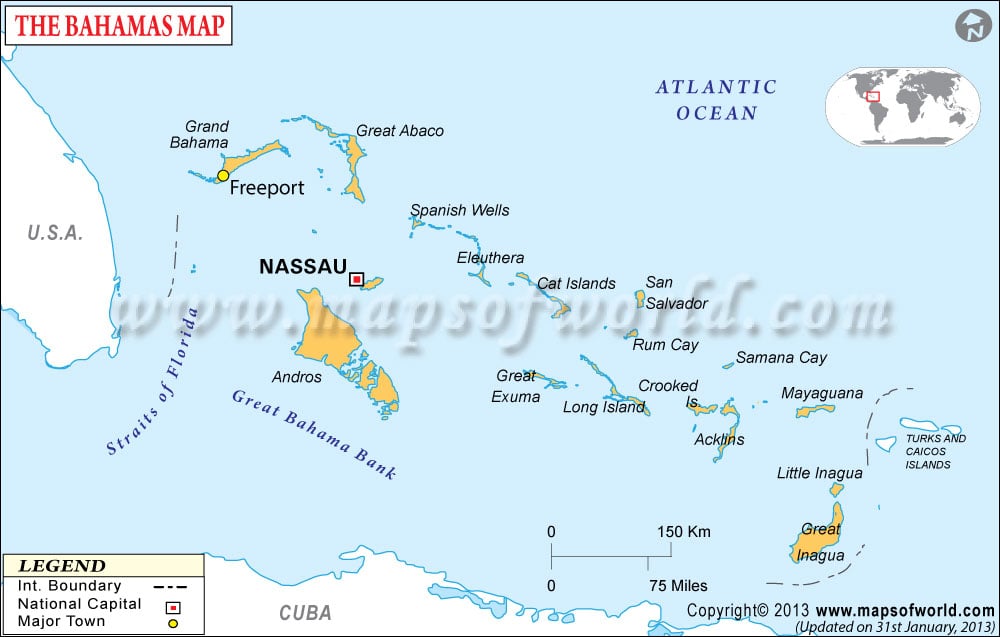
- Neighboring Countries - Cuba, United States, Haiti
- Continent And Regions - North America Map, Americas Map
- Other Bahamas Maps - Where is Bahamas, Bahamas Blank Map, Bahamas Political Map, Bahamas Cities Map, Bahamas Flag
About Bahamas
Explore this Bahamas map to learn everything you want to know about this country. Learn about Bahamas location on the world map, official symbol, flag, geography, climate, postal/area/zip codes, time zones, etc. Check out Bahamas history, significant states, provinces/districts, & cities, most popular travel destinations and attractions, the capital city’s location, facts and trivia, and many more.
| Official Name: | The Independent Commonwealth of Bahamas |
| Capital: | Nassau |
| Population: | 353, 658 (2012 estimate) |
| Area: | 2,381,741 sq km or 919,595 sq mi |
| Currency: | Bahamian Dollar (BSD) |
| Country Code | 242 |
| Time Zone | North American Eastern Time Zone |
| Major Religion: | Christianity, Islam, Jews, Baha’i, Hinduism, Rastafarianism |
| Literacy: | 95.60% |
| Languages: | English (official),Haitian Creole, Spanish, Chinese, Portuguese, Continental French, German, Italian, Hindi, Tagalog |
| Major Cities: | Nassau, Freeport, Marsh Harbour, Clarence Town, Dunmore Town, High Rock |
| Climate: | Tropical wet and dry climate |
About The Bahamas
The Independent Commonwealth of Bahamas is one of the richest countries of the Caribbean. Its geographical coordinates are 24 °15′ N, 76 ° 00′ W. The neighboring states are Cuba, Dominican Republic and Haiti (Hispaniola), and the Turks and Caicos Islands. Situated in the North Atlantic Ocean ,
the Bahamas is a nation made up of about 700 islands, 2400 cays, and 2,387 rocks. It is spread across an area of 5359 sq mi. The country has a typical tropical maritime climate, devoid of extreme temperatures. Frost, sleet, hail are unknown in the country.
History
The Siboney Indians were the first settlers of the Bahamas. They were followed by the Lucayans of Hispaniola and Cuba. Christopher Columbus landed at the San Salvador Island in 1492 when the land was a thriving settlement of the Lucayans. This expedition opened the way for Spanish conquistadors who forcefully captured the Lucayans for slavery. The British settlement of the Bahamas began in late 1640s with the migration of Eleutheran Adventurers under the leadership of William Sayle. They started to live in the Cigateo Island which was later renamed Eleuthera. In 1670, the Bahamas fell into the hands of the Lord Proprietors of Carolina and the infamous history of piracy began. To contain piracy and restore order, the Bahamas passed over to the British Crown in 1718. The Governor-General Woodes Rogers, after a tough struggle, successfully contained piracy. The country was under continuous siege by the American Naval Forces and the Spanish fleet until slave trade was declared illegal in 1807. The Bahamas gained complete independence in 1973.
Economy
With a GDP of $9.093 billion and a real growth rate of 0.95%, the Bahamas is one of richest countries of the Caribbean with 50% of its entire labor force of 175,500 rendering their services to the tourism sector. The unemployment rate of the nation is 7.6% and 9.3% of the population still lives below the poverty line.
Tourism fuels the economy of the Bahamas by contributing to about 60% of its GDP. Financial services sector follows next and constitute 17% of the annual GDP. The financial sector of the Bahamas is largely run by offshore banking. The nation has more than 400 licensed banks and trust companies. The main bank of the nation is The Central Bank of the Bahamas.
Large scale agricultural practices are rare in the Bahamas and about 80% of the food has to be imported every year from the United States, Venezuela, Italy, and Spain. Agriculture and fisheries contribute a mere 5% to the GDP coffers. The major exports include rum, fruit and vegetables, salt, aragonite, and animal products.
The Bahamas does not impose any income tax, corporate tax, capital gains tax, value-added tax (VAT), or wealth tax on the citizens. The contribution of tax revenue to GDP is 18.7%. The national economy reflects an inflation rate of 2.8%.
Sports
Football and basketball are the most popular sports of the Bahamas. Miami Dolphins is considered to be a favorite. Other sports and sporting activities such as baseball, basketball, bowling, cricket, fishing, football, racquetball, rugby, squash, soccer, swimming, tennis, and, volleyball are popular. Regattas are common in the Bahamas with various islands holding sailing competitions at different times a year. The Bahamas is the home to Mark Knowles, who along with Daniel Nestor won the Men’s Doubles Championship at the 2002 Australian Open Tennis Championship. The country won two Gold medals at the 2000 Sydney Olympics. The women’s relay team also returned with a silver medal from the Atlanta Olympics in 1996. In addition to this, visitors can also participate in private piloting, water skiing, scuba diving, swimming, boating, fishing, regatta ,golf, tennis, snorkeling, wind surfing, parasailing, jet skiing, and horse riding.
Government
The Bahamas follows the Westminster system of government headed by Queen Elizabeth II. She is represented by the Governor- General. It is a Parliamentary Democracy headed by the Prime Minister and the cabinet. Individuals above the age of 18 are allowed voting rights by the Parliamentary Registration Department. The Constitution of The Bahamas was adopted in June 20, 1973 and enforced on July 10, 1973. The three branches of government are –
- The Executive is headed by Queen Elizabeth II who is represented in the country by the Governor-General. The leader of the majority party is elected as the Prime Minister. The current Governor-General is Arthur Foulkes and the Premier is Perry Christie.
- The Legislature is bicameral consisting of the Senate (Upper Chamber) and the House of Assembly (Lower House). The former has 16 members duly appointed by the Governor-General in consultation with the Prime Minister and the leader of Opposition. The latter has 38 members elected from various constituencies. The major political parties are Free National Movement, Progressive Liberal Party, and Bahamas Democratic Movement.
- The Judiciary is administers the constitution which is based on the English Common Law. The Supreme Court is the highest Court of Justice in the State. The Justices of the Supreme Court and other magistrates are appointed by the Governor- General.
The Bahamas has 32 local government districts. Elections are held every three years. Department of Lands and Local Government formulate policies to administer the districts.
Law and Order
The Royal Bahamas Police Force is responsible for maintaining law and order in the nation. The Bahamas is a narcotics transit hub owing to its strategic location on the Atlantic. Illegal drugs such as cocaine and marijuana are transported from South America to the United States, Europe and other parts through the Bahamas. Gambling is prohibited except in authorized casinos. Same-sex marriage is legal since 1991. The constitutional rights are, however, strained for such couples.
Culture and Society
The Bahamas is a land of hospitable, amiable, and vibrant people. They express themselves though their indigenous crafts, soulful music, and lively dancing. The famous musical group, the Baha Men belongs to The Bahamas. Junkanoo, the musical style is a ubiquitous phenomenon in the country, depicting the heritage of the nation.
Places to Visit in Bahamas
The Bahamas is renowned for its straw works, easily available in the straw markets of Freeport or Lucaya. The Bahamas is known for its multi-faceted cuisine, local drinks, and cocktails. A local drink of the proud Bahamians is the Kalik Beer. The Protestants constitute the majority of the population, about 67.6%. They are, however, tolerant to all religions and people are free to practice any religion of their choice.
Arts and Entertainment
The Bahamas promotes regional arts through various museums and art galleries like Bethel Galley, Jansu Studio, and National Art Gallery of The Bahamas. It is a home to famed artists like Amos Fergusson, Maxwell Taylor, and Stan Burnside. The Bahamas International Film Festival is a non-profit organization which holds a film festival every year for the tourists and locals showcasing the best of films worldwide. The famous musician Lenny Kravitz has a Bahamian mother. Winston Saunders, the playwright and Gilbert N.M.O. Morris, the economist and author have spent a large part of their lives in the Bahamas.
People, Religion and Ethnic Groups
The estimated population of the Bahamas as of 2012, is 353, 658. Out of this 67.6% are Protestants. The other Christian groups include Baptists, Anglicans, Pentecostals, Roman Catholic, and Methodists. Among the ethnic groups, the Blacks constitute 85% of the population, followed by the Whites, Asians, and Hispanics.
National Holidays and Festivals
he majority of population being Christians, the Bahamas observes all religious festivals such as Good Friday, Easter, White Monday, Christmas, and Boxing Day. New Year’s Day is celebrated with much fanfare. Public holidays include Labor Day, Emancipation Day (August 6), National Day (2nd October), Columbus Day ( October 8), Discovery Day (October 12), and Chung Yeung Festival (October 23)
