Maps of World
We do magic to Maps
World Map / Japan / Earthquake in Japan, 2011

Earthquake in Japan, 2011


Clean up continues one year later


4.6.2012

The nuclear disaster in Japan has affected many things, including the nuclear policy of the nation.

Over a year after the disastrous 9.0 magnitude earthquake in Japan in March 2011, the nation continues to face the aftermath of the quake and ensuing 40 meter tsunami, which took nearly 20,000 lives and threatened many more with concerns over radiation from the damaged Fukushima Nuclear Power Plant.

While the reactors at the Fukushima plant have been reported stable, and the plant has been reinforced to prevent damage in future earthquakes, the evacuation zone continues to displace thousands of residents of the region.

While radioactive debris from the disaster have been collected and fairly contained, the question of what to do with the contaminated debris remains. A reported 90 percent of debris has not yet been removed, though the government has pledged to complete its clean-up by 2014.

The government plans to incinerate debris has been met with protest from those concerned that this method would release more radiation into uncontaminated regions. Debris would be spread across the Japan to disperse and diffuse the effects, and keep them within safe limits. The other option would be containing the affected debris in the contaminated region, which would lead to increased stigma on the affected regions of Japan.

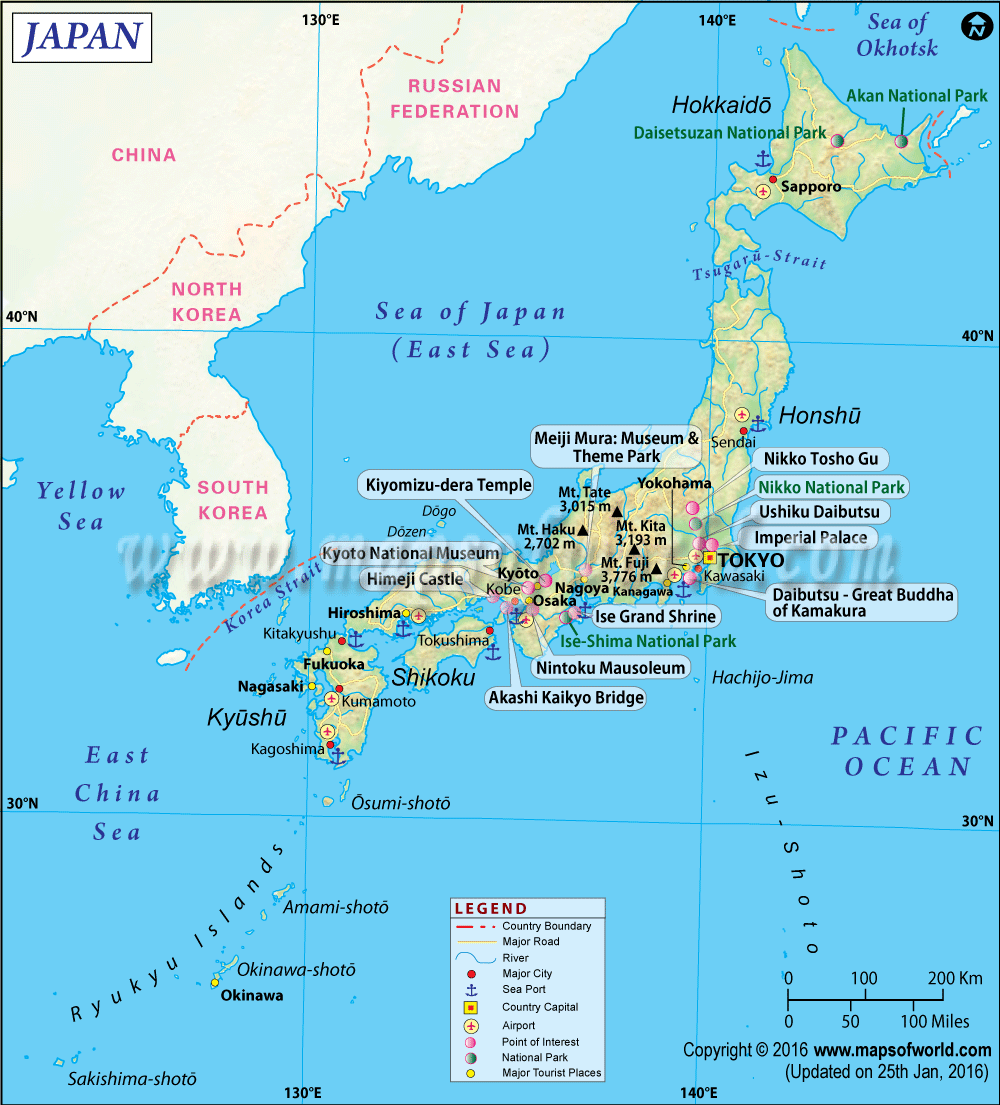
Know the latest happenings in Japan with a mouse hover on map

Disclaimer : All efforts have been made to make this image accurate. However Compare Infobase Limited,its directors and employees do not own any responsibility for the correctness or authenticity of the same.


Pray for Japan


Clean up continues one year later
4.6.2012

Over a year after the disastrous 9.0 magnitude earthquake in Japan in March 2011, the nation continues to face the aftermath of the quake and ensuing 40 meter tsunami, which took nearly 20,000 lives and threatened many more with concerns over radiation from the damaged Fukushima Nuclear Power Plant.

While the reactors at the Fukushima plant have been reported stable, and the plant has been reinforced to prevent damage in future earthquakes, the evacuation zone continues to displace thousands of residents of the region.

While radioactive debris from the disaster have been collected and fairly contained, the question of what to do with the contaminated debris remains. A reported 90 percent of debris has not yet been removed, though the government has pledged to complete its clean-up by 2014.

The government plans to incinerate debris has been met with protest from those concerned that this method would release more radiation into uncontaminated regions. Debris would be spread across the Japan to disperse and diffuse the effects, and keep them within safe limits. The other option would be containing the affected debris in the contaminated region, which would lead to increased stigma on the affected regions of Japan.

Aftermath update: Japan to renew energy policy
11.5.2011

The nuclear disaster in Japan has affected everything about the country, including the nuclear policy of the nation.

With a total of 54 nuclear reactors contributing to 30% of the country's power demand, the energy policy had aimed at constructing 14 more by 2030, taking the energy share to above 50% of the total. However, according to a new development, this plan is about to be scrapped and the whole energy policy might be rewritten from scratch.

This is a setback at a time when nuclear energy was being hailed as the future energy source, but after seeing its perils, the people of Japan are looking for better alternatives.

Massive search operation begins
26.4.2011: Tokyo, Tuesday 2:04 pm (PST: Monday 9:04 pm - GMT: Tuesday 5:04 am)

With panic beginning to subside, the Japanese government has ordered a large-scale search operation to search for people. At least 25,000 troops are being sent to the affected northeastern coast to conduct the search. While the official toll is estimated at about 14,000, at least as many are still missing. Given the impact this earthquake has had on the Japanese infrastructure, some may never be found.

Japan plans plant shutdown
19.4.2011: Tokyo, Tuesday 1:40 pm (PST: Monday 8:40 pm - GMT: Tuesday 4:40 am)

Japanese officials have announced that they are planning a complete cold shutdown of the Fukushima Nuclear Power Plant by the end of 2011. The power plant shows no sign of slowing down, and radiation levels in the nearby sea have risen by more than 1,000 times the legally permissible limit.

Also, the US has said that it would help rebuild the Japanese economy after the disaster. Former U.S. President Bill Clinton visited Tokyo to express his support.

Premier faces flak, asked to resign
15.4.2011: Tokyo: Friday 2:02 pm (PST: Thursday 9:02 pm - GMT: Friday 5:02 am)

The Japanese premier Naoto Kan is facing growing opposition at home, and has been asked to resign. The upset concerns the way the 2011 crisis was handled by the government. However, Kan is adamant about rebuilding the nation and has given a boost to rescue and relief operations. The scale of this crisis is unprecedented, and in the days to come, the many indirect impacts will be better understood.

Japan acknowledges economic blues
13.4.2011: Tokyo, Wednesday 7:37 pm (PST: Wednesday 2:38 am - GMT: Wednesday 10:38 am)

In a statement released today, Japan acknowledged that the earthquake will have a major impact on the Japanese economy. For the first time in six months, the country downgraded its economic estimates, saying that exports, manufacturing, and production have been badly hit. However, the overall impact of the earthquake is expected to be short-lived, as the economy is making slow progress already.

PM thanks world for support
11.4.2011: Tokyo, Monday 2:11 pm (PST: Sunday 9:11 pm - GMT: Monday 5:11 am)

Japanese Prime Minister Naoto Kan has thanked the world leaders for their support during the recent earthquake crisis. The relief operations have picked up pace, and a large segment of the population has moved to temporary housing. There are other hints of good news: analysts say that the earthquake is unlikely to severely affect the nation's financial system.

Huge aftershock causes jitters
8.4.2011: Tokyo, Friday 12:43 pm (PST: Thursday 7:43 pm - GMT: Friday 3:43 am)

A massive aftershock measuring 7.4 on the Richter scale rocked the northeast parts of the Japan. A tsunami warning was subsequently issued. The Fukushima Power Plant reportedly suffered no damage.

Fighting another possible explosion
7.4.2011: Tokyo, Thursday 1:04 pm (PST: Wednesday 08:04 pm - GMT: Thursday 4:04 am)

Even after the radioactive leak was plugged yesterday in the crippled nuclear plant, a new scare is building up. Now that the reactor can begin cooling down, experts say this will cause a steep drop in air pressure and result in a huge explosion. This could easily snowball into the worst nuclear disaster in many years. The power plant officials are in the process of pumping nitrogen gas into the plant to maintain the pressure and avoid a possible explosion.

Radioactive leak finally stopped
6.4.2011: Tokyo, Wednesday 1:22 pm (PST: Tuesday 8:22 pm - GMT: Wednesday 4:22 am)
The radioactive leak at the Fukushima Daiichi power plant has finally been stopped, according to the Japanese officials. The leak was contaminating the ocean water, and carried the risk of a pernicious radiation spread. But Japan's problems are far from over. World over, foods being imported from Japan have been banned, and the US engineers are saying that the Fukushima nuclear plant is still unstable.

High alert in Fukushima schools
5.4.2011: Tokyo, Tuesday 1:19 pm (PST, Monday 8:19 pm - GMT: Tuesday 4:19 am)
An emergency campaign was started by health officials in Fukushima to measure the radiation levels in the region. More than 1,400 schools and nurseries will be tested over the next two days. A 19 mile exclusion zone has also been advised for children. The latest toll stands at above 12,000 at the moment, and almost 15,000 people are not yet accounted for.

More yet to come: Bad economy and low confidence
4.4.2011: Tokyo, Monday 2:21 pm (PST, Sunday 9:30 pm - GMT: Monday 5:30 am)

The Bank of Japan's quarterly Tankan survey has projected that the economic condition will worsen in the next three months. Because of the badly affected production, business confidence is low in Japan and manufacturers remain largely pessimistic.

At the same time, the nuclear crisis refuses to settle down and has sent the Tokyo Electric Power Company into a tailspin. The radioactive leak has still not been stopped, and maintaining the required power levels is very difficult. The repeated aftershocks along with the false tsunami warnings have done nothing to inspire confidence.

Another Tsunami Scare?
28.3.2011: Tokyo, Monday 12:53 (PST, Sunday 19:53 - GMT, Monday 03:53)
Even after the Japanese crisis seems to have settled down, there is still a widespread scare of potential tsunamis. On Monday, a 6.5-magnitude earthquake struck near the previous earthquake's epicenter, and it was feared that it might generate tsunamis in the coastal areas of the Miyagi Prefecture. A tsunami advisory was issued early morning, but was later called off as it became clear that there was no risk of a tsunami.

But such incidents only add to the grief to the Japanese people, who have lost almost everything in this terrible disaster.

Workers back in damaged nuclear power plant
25/3/2011: Tokyo, Friday 13:26 (PST, Thursday 20:26 - GMT, Friday 04:26)
According to the latest reports, smoke has stopped coming out of the damaged nuclear power plant at Fukushima Daiichi and workers have been called in to resume repairs. At the same time, the radiation levels in the area and elsewhere have dropped considerably, and now the risk is lowered. The official death toll has now been declared at 10,035 with over 17,000 people still missing.

After-effects of the earthquake : Chinese auto-industry hit
24/3/2011: Tokyo, Thursday 13:57 (PST, Wednesday 20:57 - GMT, Thursday 04:57)
The aftereffects of the Japanese earthquake are now being felt in the rest of the world. Because Japan has been a major economic force, this effect was inevitable. According to the latest developments, Japanese car makers had to shut down their plants in China because of the supply and process disruption after the quake.

Toyota and Nissan have halted production in the short-term. This will also affect Chinese car makers who are dependent on Japan for import of auto parts.

Food spoiled by radiation
23/3/2011 : Tokyo, Wednesday 12:50 (PST, Tuesday 19:50 - GMT, Wednesday 03:50)
According to the Japanese health ministry, the levels of radiation in vegetables ground in the Fukushima Prefecture tested very high. Another food ban has been enforced, this time on these vegetables. This has repercussions for other countries also - the US has banned some Japanese food imports until the radiation risk settles down.

Tokyo, Tuesday 13:01 (PST, Tuesday 20:07 - GMT, Tuesday 04:07)
Japan's nuclear crisis may have been exaggerated – as of now, work has restarted at the affected Fukushima Power Plant. There were earlier reports of radioactive gasses being leaked into the atmosphere, but this time the scare was not justified. However, it is now feared that the seawater surrounding the power plant is contaminated with nuclear radiation, and it remains to be seen how this will be handled.

Tokyo, Sunday 18:00 (PST, Sunday 00:59 - GMT, Sunday 08:59)
Japan has banned food products from the two provinces around the Fukushima Daiichi Nuclear Power Plant. This restriction comes after high levels of radioactivity were found in milk and spinach produced around the area. Meanwhile, there is some relief at the power plant, as the cooling operations seem to be successful. The authorities have warned that more radioactive gases might need to be released into the air.

Tokyo, Sunday 01:49 (PST, Saturday 08:49 - GMT, Saturday 16:49)
As part of the aftermath to the nuclear crisis, weak traces of radioactive iodine were detected in the tap water in Tokyo. Near the Fukushima area, food products have been found to be contaminated. There might soon be a food ban in the area around the nuclear reactor.

Tokyo, Saturday 17:53 (PST, Saturday 00:53 - GMT, Saturday 08:53)
Dangers of a possible radiation leak seem to have been exaggerated. There has been no serious leak so far, and authorities have been able to restore power to the water pumps of the overheating nuclear reactor. In all probability, the situation will be under control soon.

Tokyo, Saturday 11:15 (PST, Friday 18: 34 - GMT, Saturday 02:34)
The WHO has said that the radiation leak in Japan is localized, and there is no threat to life. World leaders are sending their condolences and aid for the disaster-hit Japan as relief operations continue. It now appears that the process of burying the overheating nuclear reactor will begin soon.

Tokyo, Friday 20:31 (PST, 03:31 - GMT, Friday 11:31)
The Japanese nuclear and industrial safety agency has increased the 2011 crisis's rating to 5, putting it on the same level of severity as the Three Mile Island accident. The level 5 means that there is now a serious threat of a nuclear leak, which would cause even more destruction to life.

Meanwhile, the official death toll has now been confirmed at above 6,500. More than 10,000 people are still missing, and there is no telling how this will play out when this disaster is finally over.

Tokyo, Friday 18:06 (PST, 01:06 - GMT, Friday 09:06)
It seems that all past attempts to contain the nuclear reactor damage have been unsuccessful. The situation remains the same, and as a last resort, the authorities are considering burying the dysfunctional plant. This is reminiscent of the Chernobyl disaster, where burying under sand and concrete was a final option.

This comes after the last two desperate attempts to cool down the plant—dumping water from helicopters and restoring the power cable to the pumps—which appear to have failed to make any difference. However, the radiation levels measured around the reactor do not present any health risk yet.

Tokyo, Friday 13:41 (PST, Thursday 20:41 - GMT, Friday 04:41)
The US has initiated the evacuation process to get its citizens and paramedics out of Japan. The Japanese authorities continue the struggle to contain the potential nuclear disaster, and today they were attempting to restore power to one of the plant's pumps to begin cooling. The spent fuel in the reactors is believed to be a bigger concern than the fuel rods.

Tokyo, Thursday 21:45 (PST, Thursday 04:45 - GMT, Thursday 12:45)
Authorities in Taiwan also detected higher radiation levels on Japanese passengers, although this is not a risk to public health. Meanwhile, heavy snowfall has hampered the relief operations and is the next major worry after the nuclear radiation threat. Japan is also short on food supplies and fuel, which could become far worse if not addressed shortly.

Tokyo, Thursday 19:20 (PST, Thursday 02:21 - GMT, Thursday 10:21)
Radiation fears in Japan have resurfaced. According to a recent story, the South Korean air authorities detected unusually high levels of radiation on three passengers from Japan. Although this poses no health risks to the public, it is a matter of concern.

Meanwhile, the US has asked its citizens to leave Japan immediately, saying that the radiation levels have become alarmingly high. China is also concerned about a possible radiation breakout, and iodine tablets have been distributed as a precaution. The WHO, however, has said that there is no international risk of radiation spread.

Tokyo, Thursday 16:54 (PST, Wednesday 23:54 - GMT, Thursday 07:54)
US troops arrived in Japan to help contain the nuclear crises. However, so far they have not been involved in any active operation. Airlines are continuously monitoring the radiation levels as the risk of a possible radiation wind increases, because of the toxic clouds forming over the damaged reactor buildings.

Japanese authorities are facing the magnitude of this catastrophe; according to their latest statements, more than 13,000 people have died in this disaster.

Tokyo Thursday 13:32 (PST, Wednesday 20:32 - GMT, Thursday 04:32)
Helicopters are being used to dump water on the Fukushima Daiichi nuclear power plant in order to cool it down and contain the potential threat. Officials have said that the radiation levels are now dropping, which is a relief, even if very small, for everyone. Meanwhile, the Japanese stock market Nikkei fell once more as it continues to seesaw.

Tokyo, Wednesday 22:40 (PST, Wednesday 05:31 - GMT, Wednesday 13:31)
The Japanese Red Cross has said that Tokyo is now safe for travel. Police are attempting to cool down the Fukushima Daiichi plant with the help of a water cannon. The official death toll has been revised to upwards of 4,000. Heavy snowfall in the quake-hit areas has made relief operations slow.

Tokyo, Wednesday 21:01 (PST, Wednesday 04:01 - GMT, Wednesday 12:01)
Japan has hinted that it might need the help of US military to help control the nuclear situation, which seems to be spinning out of control. The Fukushima Daiichi plant is still unstable, and the possibility of rainfall has increased the risk of radiation spread. Should this happen, the city of Tokyo would be under considerable threat.

Tokyo, Wednesday 17:56 (PST, Wednesday 00:56 - GMT, Wednesday 08:56)
Japanese Emperor Akihito addressed the nation today and asked the people not to lose hope and to support each other. He termed the earthquake as the worst crisis since World War II, a sentiment echoed in the prime minister's address.

The emperor's address is usually a rare event in Japan, taking place only during the times of war and national crises.

The official death count of this disaster now stands close to 4,000; however, it is likely to cross 10,000.

Tokyo, Wednesday 15:48 (PST, Tuesday 22:48 - GMT, Wednesday 06:48)
Workers at the Fukushima Daiichi nuclear power plant, which was damaged in the Friday earthquake, were asked to evacuate the plant temporarily on Wednesday. The reason for this evacuation was white smoke spotted coming out of the plant. However, once the radiation levels had dropped to safe levels, they were allowed to return to the plant.

Tokyo, Wednesday 13:23 (PST Tuesday 20:24 - GMT Wednesday 04:24)
A new fire started at the Fukushima Daiichi nuclear plant on Wednesday, raising the fears of radiation spread. The Tuesday fire had raised the radiation levels by about 168 times normal levels, but it was back to safe levels once the fire died out. About 150 people around the Daiichi area were examined, of which 23 were decontaminated, according to the International Atomic Energy Association (IAEA). IAEA is helping Japan in damage control and assessment of the nuclear hazards.

Tokyo, Tuesday 12:50 (PST, Monday 19:50 - GMT, Tuesday 03:50)
The Fukushima Daiichi nuclear plant experienced another explosion, resulting in a steep rise of the radiation levels nearby. In an earlier blast in the same plant, 11 workers were injured. Because of this explosion, other reactors in the same plant have also caught fire, which could mean big trouble for disaster-struck Japan.

About 200,000 people have been evacuated from nearby sites.
Tokyo, Monday 19:18 (PST, Monday 11:18 - GMT, Monday 10:19) Japan's crisis has continued to worsen. The official death toll has reached almost 1,700, with news of 2,000 additional bodies found near the Miyagi Prefecture. The radiation threat has also become a scare after the third explosion at the Fukushima Daiichi nuclear plant, even though the authorities say that there has been no major radiation leak as of yet.

The rescue operations continue, and by now more than 15,000 people have been rescued.
Tokyo Sunday 04:42 (GMT Saturday 19:43, PST Saturday 11:43) The nuclear reactor blast continues to worsen. While it originally expected that there was little risk of radiation leak, experts are now reconsidering. Already, three radiation tests done near the reactor have been positive, which is alarming for the masses. People staying within a radius of 3 km of the plant have been ordered to evacuate.

Tokyo, Sunday 02:40 local time (Saturday 17:40 GMT, 09:40 PST) Japan continues to understand the full impact of the earthquake devastation. The earthquake has moved the Japanese coast by a jaw-dropping 8 feet, and previous estimates of casualties continue to rise. There are varying reports, but the number is believed to be about 2,000. However, worse is still feared as thousands of people are still missing.

Meanwhile, the US has sent aid for earthquake relief operations.
Tokyo, Saturday 17:00 (GMT, Saturday 08:00 - PST, Saturday, 00:01)
Relief operations have started in Japan as a nuclear emergency has been declared. However, the official sources that the chances of a radiation leak are very small. Japan has requested relief aid from other countries.

Tokyo, Saturday, 13:30 local time (Friday 20:30 PST, Saturday 04:30 GMT)
At least 398 people are dead and 805 are missing after the massive earthquake in Japan, the Kyodo News Agency reported Saturday. Earlier, the news agency said the death toll from the massive earthquake would likely surpass 1,000.

Tokyo, Saturday, 11:30 local time (Friday 18:30 PST, Saturday 02:30 GMT)
Ecuadorian President Rafael Correa has ordered the evacuation of the Galapagos Islands and of cities along the country's coast Friday.

Potentially dangerous problems cooling radioactive material have appeared at another Tokyo Electric Power Company nuclear plants.

Tokyo, Saturday, 09:11 local time (Friday 16:11 PST, Saturday 00:11 GMT)
A small radiation leak is feared from the nuclear plant in Fukushima about 140 miles from Tokyo. Residents in a 3 km radius of the plant were evacuated. Radioactive material might have leaked from one of its reactors.

Tsunami waves generated by yesterday's 8.9 magnitude earthquake have hit some places on the coasts of Hawaii and California. People have been advised to move to higher ground in Chile, South America. No major loss has been reported from these areas.

Tokyo, Saturday, 05:16 local time (Friday 12:16 PST, 20:16 GMT)
The worst fears on the Pacific Coast have been realized - tsunami waves generated by the massive Japan earthquake have finally arrived. Californian and Hawaiian ports and harbors reportedly suffered some damage. Crescent City, California, was struck with three tsunami waves, one of them reaching a dangerous 8 feet. These waves are gaining height considerably, alarming the coast guards.

Meanwhile, Japan faces complete pandemonium. The death toll has leaped to 1,000 and there are no signs that the increases will slow. The Fukushima Nuclear Power Plant has broken down, and a radiation crisis is feared.

Tokyo local time 3:47 am Saturday (Friday: 10:47 PST, 18:47 GMT)
According to the latest reports, the Japan 2011 earthquake toll will exceed 1,000, and more are expected to follow. Hundreds of missing people have yet to be traced, so this figure continues to rise.

Meanwhile, the projected tsunami appears not to have done much damage on the Hawaiian coast. But the other countries are not taking it lightly – Ecuador has announced national emergency and people are moving to higher regions for safety.

Tokyo local time 00:53, Saturday (Friday: 07:53 PST, 16:53 GMT)
The final assessment of the earthquake losses is yet to come, but latest estimates have surpassed the previous estimates. Now, the death toll could number in the thousands. As missing people are reported and bodies are identified, this toll will continue to rise.

The tsunami has struck the coasts of Hawaii, and is expected to reach Australia and New Zealand shortly.

Tokyo local time 23:55 (06:55 PST, 14:55 GMT)
The death toll in the Japan earthquake has now climbed to a confirmed 93. However, reports of many more missing are pouring in every minute. Currently, it is estimated that the final toll may be up to a few thousands.

Tokyo 22:30 local time (5:30 PST, 13:30 GMT)
The death toll in the devastating Japan earthquake event is now estimated at a minimum of 50. The tsunami warning has become stronger, and has now been extended to as many as 50 countries.

Tokyo 17:05 local time (00:01 PST, 0801 GMT)
Thus far, 32 have been confirmed dead in the devastating earthquake and tsunami that hit Japan today. It is very likely that the toll will rise with time as more casualties are discovered. Local media agencies have said that the total deaths has crossed 50, but an official confirmation is yet to come.

Tokyo 16:01 local time (23:01 Thursday PST, 07:01 GMT)
The recurring earthquakes and the destruction the tsunami in Japan has caused have resulted in a widespread tsunami warning. The countries under possible danger have been identified as: Russia, Taiwan, the Philippines, Indonesia, Papua New Guinea, Australia, New Zealand, Fiji, Mexico, Guatemala, El Salvador, Costa Rica, Nicaragua, Panama, Honduras, Chile, Ecuador, Colombia and Peru. Evacuation process has started in many of these countries.

Tokyo 15:28 local time (22:28 Thursday PST, 06:28 GMT)
Immediately after the biggest earthquake in 140 years, a 10-meter tsunami hit the coast of Japan, causing severe destruction. The tsunami has swept away everything in its path – houses, streets, vehicles, bridges, farms – everything now lies in rubble. Large-scale evacuations have been ordered to avoid loss of life. There has not yet been any confirmation of casualties. This tsunami is expected to be powerful enough that warnings have been issued to Colombia and Peru.

Meanwhile, the aftershocks of the 8.9-magnitude earthquake continue, with smaller earthquakes repeatedly striking the country. There seems to be no relief for Japan – Seismologists say that another big earthquake could strike Japan at any time.

A massive earthquake rocked the northeast of Japan at 1446 local time (0546 GMT), resulting in heavy losses. Measured at 8.9-magnitude, it is one of the most powerful earthquakes to hit Japan in many years. The quake resulted in widespread destruction, with buildings reduced to rubble, bridges shattered, and power outages.

The epicenter of this earthquake was about 240 miles away from Tokyo. After the earthquake, reports came in of a possible tsunami hitting the Japanese coast. The Japanese Meteorological Agency issued tsunami warnings for the entire Pacific coast, directing people to evacuate.

Earlier, more earthquakes of lesser magnitude (7.2 and 6.3) were experienced in the islands of Honshu, but they did not result in such widespread losses.

Earthquake in Japan
At least 250 people in Japan have been injured and one killed by a powerful earthquake which occurred at 10:53:42 AM (01:53:42 GMT) on Sunday, March 20, 2005 in KYUSHU, JAPAN. The earthquake struck west of Kyushu Island, just 9 km (5.5 miles) below the ocean floor.

The earthquake measured a magnitude 7.0 on Richter scale and was centered off the western coast of Japan's island of Kyushu at 33.851°N, 129.975°E, 40 km WNW of Fukuoka, Kyushu, Japan and 915 km W of TOKYO, Japan.

Initial fears that the quake might set off a tsunami were later dispelled by the Meteorological Agency. "We aren't worried about tsunami damage," they said.

The quake damaged buildings and cut utility supplies.

Several strong aftershocks followed.

Most of the injuries came in Fukuoka Prefecture. People were hurt by falling furniture, broken glass, or by hot cooking stoves, a public broadcaster NHK reported.

The hardest hit area appears to be the small island of Genkai, where about 65 homes were destroyed, media reports said. About 500 of the island's 700 residents were evacuated.

The television network NHK reported a 75-year-old woman died after a wall collapsed in her home. Video from the Fukuoka Prefecture, on the west coast of Kyushu, showed a few cracked sidewalks and parking lots, but no widespread damage.

Japan Earthquake Overview
Japan is an earthquake prone country. Earthquakes occur in Japan frequently, causing great damage to public life and national properties. Japanese earthquakes take place mainly because of the country's location. Japan is situated in the 'Ring of Fire' region in the Pacific Ocean, on the edge of tectonic plates. The movements of these tectonic plates cause Japanese earthquakes and other related devastation caused by volcanic eruption and tsunamis.

Japan is situated on two of the major tectonic plates. The North American tectonic plate and Eurasian tectonic plates meet in the Honshu Island which is one of the major islands in Japan. As a result, when these plates move, it causes turbulence leading to Japanese earthquakes. Japanese earthquakes are often accompanied by threatening tsunamis and erupting volcanoes that kill many people in Japan. Many efforts continue to be made learn about the reasons, occurrences, and effects related to Japanese earthquakes.

Earthquakes have occurred in almost every city and region of Japan. Previously, Japanese people believed that Kobe was free from the devastating effects of earthquakes. A terrifying and devastating earthquake that occurred in 1995 showed Japan that not a single place is exempted from the attacks of earthquakes in Japan.

There are records of other major earthquakes in Japan. In 1923 in Tokyo about 1,00,000 people died in a major earthquake. In 1952, Hokkaido experienced an 8.2 magnitude earthquake that killed more than eight thousand people. In 1983, another major earthquake shook the northern part of the Sea of Japan, with a magnitude of 7.7 on the Richter scale. The casualties were however relatively low.

Last Updated on: June 5, 2012
Click on any of the below sections for its Information