Worst Tsunamis in History
What is a Tsunami?
Tsunamis are large, often destructive sea waves, usually caused by earthquakes below the ocean, volcanic eruptions, or underwater landslides.
To the Japanese phrase meaning “harbor wave,” tsunamis can devastate the infrastructure of coastal cities and can be very deadly. Though tsunamis are often misleadingly called tidal waves for their resemblance to a rising tide, tsunamis are unrelated to the tides. Still, they are caused by movements in the earth, usually far below the ocean. Landslides in the ocean have caused some of the most giant tsunamis in history, known as megatsunamis.
Tsunami waves have a much longer wavelength than regular waves, reaching hundreds of kilometers in length. In contrast, the height (amplitude) of the waves remains just above average, slowly building until it reaches the shallow waters along the coast. Before the giant wave hits the coast, the water drastically recedes as a drawback. The giant wall of water then travels at high speeds toward land, crashing and destroying everything in its path. The tsunami then recedes to the ocean, pulling with it much of the debris of the structures it has destroyed. The slow build-up of the waves is one factor that makes tsunamis challenging to predict. Earthquakes, considered the leading cause of tsunamis, are also not absolute predictors of a tsunami because some large earthquakes do not result in a tsunami, and some small earthquakes do. Most tsunamis occur around the Pacific Ocean because of the high level of seismic activity in this Pacific Ring of Fire.
Tsunami Dates
Destructive tsunamis have occurred in all of the world’s oceans and seas. In the second half of the 20th Century, Pacific-wide, destructive tsunamis occurred in 1946, 1952, 1957, 1960, 1964, 2004, 2006, 2007, 2008, 2009, 2011, and 2013.
Many more tsunamis occurred in inland seas around the periphery of the Pacific Ocean, which were extremely destructive locally and claimed thousands of lives. Such localized tsunamis occurred in 1975, 1983, 1985, 1992, 1993, 1995, 1998, 1999 and 2001.
History of Tsunami
Biggest Tsunamis in History |
||||
| Place of Tsunami | Country | Intensity | Year | Affected Countires |
|---|---|---|---|---|
| Grand Banks | Atlantic Ocean off the south coast | 129 km/h (80 mph) | Nov 18, 1929 | Newfoundland, Canada, Saint Pierre and Miquelon |
| Sanriku | Sanriku-kaigan, Japan | 10 meters, height 2 kilometers long | Mar 2, 1933 | Japan, United States |
| Aleutian Islands | Aleutian Islands, Alaska | Apr 1, 1946 | USA, Hawaii, Alaska | |
| Severo-Kurilsk | Pacific Ocean, Kamchatka | 15–18 meters (49–59 ft) | Nov 5, 1952 | Russia |
| Lituya Bay megatsunami | Panhandle near Alaska, USA | 30 metres (100 feet) | Jul 9, 1958 | United States (Lituya Bay) |
| Valdivia | Coast of South Central Chile | 10.7 m (35 ft) waves measuring up to 25 meters high | May 22, 1960 | southern Chile, Hawaii, Japan, the Philippines, eastern New Zealand, southeast Australia, and the Aleutian Islands. |
| Vajont Dam | North of Venice, Italy | 110 kilometres per hour (68 mph) | Oct 9, 1963 | Italy |
| Niigata | Honshu island, Japan (Niigata) | Jun 16, 1964 | Japan, Niigata Prefecture, Sado Island, Awa Island, Oki Islands in Shimane Prefecture. | |
| Alaskan | South-Central Alaska ( USA) | 100 feet (30 m) | Mar 27, 1964 | Alaska, British Columbia, California, coastal Pacific Northwest towns ,New Zealand, Papua New Guinea, Japan, Antarctica. Shoup Bay. |
| Moro Gulf | Moro Gulf in Southern Mindanao( Philippines) | 4 to 5 metres (13 to 16 ft) | August 16, 1976 UTC August 17, 1976 PST | The Philippines -North and South Zamboanga, North and South Lanao, North Cotabato, Magnetization, Sultan Kudarat (Mindanao), Sulu Islands, Pagadian City. |
| Tumaco | Tumaco, Colombia | Three to four waves | Dec 12, 1979 | Ecuador, Colombia, San Juan de la Costa, northeast of Tumaco, east coast of Japan, in Hawaii, Tahiti and Mexico. |
| Sea of Japan | Oga Peninsula (Sea of Japan) | 10 meters (33 ft) | May 26, 1983 | Japan, Aomori Prefecture, Akita Prefecture |
| Nicaragua | West Coasts of Nicaragua and Costa Rica | 9.9 meters high | Sep 2, 1992 | Nicaragua |
| Hokkaidō | Okushiri Island (Sea of Japan) | Maximum run-up of 32 M, 3.5 m at Akita in northern Honshu, up to 4.0 m in southeastern Russia and up to 2.6 m on the coast of South Korea | Jul 12, 1993 | Japan, Hokkaido, southeastern Russia, coast of South Korea, Akita in northern Honshu |
| Java | Coast of Indonesia | 14 m (46 ft) east Java coast and up to 5 m (16 ft) | Jun 3, 1994 | Indonesia : East Java coast, southwestern Bali coast, Lombok, Sumbawa |
| Papua New Guinea | Papua New Guinea | Estimated at being 15 m (59 ft) high with an average height of 10.5 m (34 ft) | Jul 17, 1998 | Papua New Guinea |
| Indian Ocean – Sumatra | Indian Ocean (Indonesia) | 50 M | 26. Dec. 2004 | Sri Lanka, India (mostly in Tamil Nadu),Thailand, Maldives, Somalia |
| Pangandaran | South Coast of Java Island, Indonesia | South Java coast saw runup heights of 5–7 meters (16–23 ft), island of Nusa Kambangan indicated that a peak surge measuring 21 meters (69 ft) | 17. Jul. 2006 | Coast of West and Central Java Island,Pangandaran, Southeast of Jakarta |
| Kuril Islands | Kuril Islands | Estimated tsunami waves to be as tall as 2 metres | 15. Nov. 2006 | Japan, Russia |
| Solomon Islands | Ghizo Island, in Solomon Islands | 12 m (36 feet) | 2. Apr. 2007 | Solomon Islands, Papua New Guinea |
| Samoa | Samoan Islands | 14 metres (46 ft) | 29. Sep. 2009 | Samoa, American Samoa, Tonga, Cook Islands, Fiji, French Polynesia, New Zealand |
| Chile | coast of Chile, Argentina | 2.34 m (7.68 ft) | 27. Feb. 2010 | Chile, Argentina |
| Sumatra | Western Coast of Sumatra,Mentawai Islands (Indonesia) | 3 m (9 ft) | 25. Oct. 2010 | Indonesia, Malaysia |
| Tōhoku | East Coast of Tōhoku (Japan) | 2 m (6.6 ft) | 11. Mar. 2011 | Japan (primary) Pacific Rim (tsunami, secondary) |
| Solomon Islands | Lata, Solomon Islands | 1 metre (3 ft 3 in) | 6. Feb. 2013 | Solomon Islands, New Caledonia, Vanuatu |
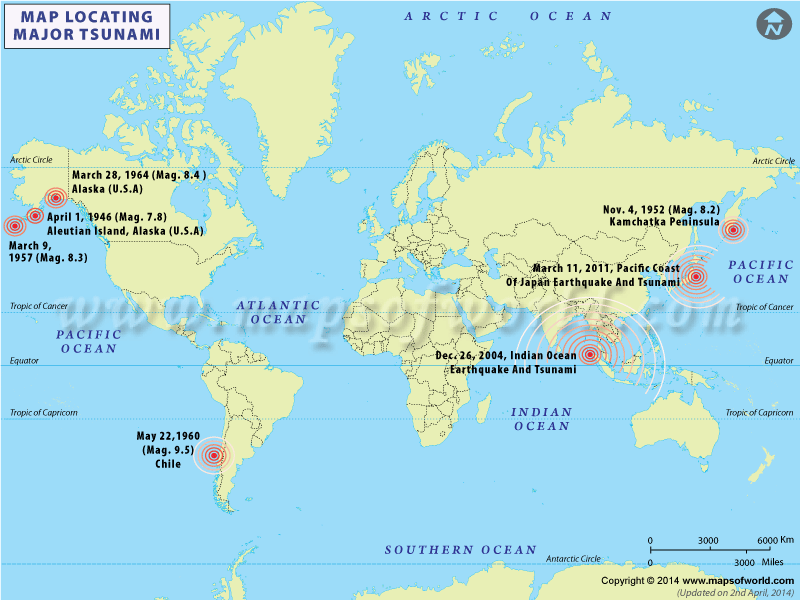
March 11, 2011: Pacific coast of Japan Earthquake and Tsunami
On March 11, 2011, Japan was hit by an earthquake measuring 9 Mw. The most powerful earthquake to have hit the country, the Great East Japan Earthquake, caused untold damage to life, property, and infrastructure. While the Japanese island of Honshu is believed to have shifted about eight feet to the east, the entire planet Earth is estimated to have shifted about four inches on its axis due to the earthquake. Know More
The 2004 Indian Ocean Earthquake and Tsunami
History has recorded the 9.0 magnitude earthquake on 26 December 2004, which rose from the Indian Ocean, as the most destructive and powerful earthquake ever.
The undersea megathrust earthquake occurred at 00:58:53 UTC on 26 December 2004, with the west coast of Sumatra, Indonesia, as the epicenter. Also known as the Sumatra–Andaman Islands Earthquake, it is the third largest earthquake ever recorded at a magnitude ranging between 9.1–9.3, the longest between 8.3 and 10 minutes, and the single-worst tsunami in history.
The earthquake, known to be roughly equivalent to 700 million Hiroshima bombs, accounted for tens of thousands of lives and unsurmountable destruction of land and property. The earthquake triggered the Tsunami within minutes.
According to the U.S. Geological Survey, 227,898 people died, with Indonesia as the worst affected area, with the death toll mounting to 170,000. Other majorly affected areas were Sri Lanka, India, and Thailand. The tsunami and the earthquake affected Southeast Asian countries and beyond, including the Maldives, Somalia, Myanmar, Malaysia, Seychelles, and tourists from Australia and Europe were victims of this tragedy.
The 27 March, 1960 Great Alaska Earthquake and Tsunami
This earthquake is also known as the Good Friday earthquake as it happened on the day of Good Friday at 5:36 P.M. AST (03:36 3/27 UTC), and had a moment magnitude of 9.2 and was 8.4 on the Richter scale. It was the most powerful earthquake ever recorded in the U.S. and North America. The earthquake’s epicenter was 61.05, -147.48, 20 km north of Prince William Sound, 125 km (78 miles) east of Anchorage, and 64 km (40 miles) west of Valdez.
The powerful earthquake caused some parts of Alaska to be liquefied, causing great damage to property and leading to landslides. The earthquake caused areas to be lifted by 15 m (50 feet) in certain areas, while many other areas subsided greatly. In addition to many local tsunamis generated within the Prince William Sound, vertical crustal displacements averaging 1.8 m (6 ft.) over an area of about 300,000 square kilometers (115,000 square miles) extending in the Gulf of Alaska’s continental shelf generated a Pacific-wide tsunami. Its waves were very destructive in southeastern Alaska, in Vancouver Island (British Columbia), and the U.S. States of Washington, California, and Hawaii. The tsunami killed more than 120 people and caused more than $106 million in damages, making it the costliest to strike the Western United States and Canada. Five of Alaska’s seven largest communities were devastated by the combination of earthquake and tsunami wave damage. Alaska’s fishing industry and most seaport facilities were virtually destroyed. Tsunami waves at Kodiak Island washed away 158 houses and buildings within two blocks of the waterfront. Fishing boats were carried hundreds of meters inland. The 1964 tsunami waves also caused extensive damage in Vancouver Island (British Columbia), and the states of Washington, California, and Hawaii, in the U.S. The waves affected the entire California coastline but were particularly high from Crescent City to Monterey ranging from 2.1 – 6.3 meters (7-21 feet). California was hit hardest, where waves reaching as much as 6 meters (20-21 feet) destroyed half of the waterfront business district. At Santa Cruz Harbor, the tsunami waves reached as high as 3.3 meters (11 feet), causing some damage. There was extensive damage in San Francisco Bay, the marinas in Marin County, and at the Noyo, Los Angeles, and Long Beach harbors. Estimated losses in California were between $1,500,000 and $2,375,000 (1964 dollars), while at Crescent City tsunami damage was estimated at $7,414,000.
The 22 May, 1960 Chilean Earthquake and Tsunami
The largest earthquake ( magnitude 9.5 on the moment magnitude scale) of the 20th century occurred on May 22, 1960, off the coast of south-central Chile. It generated a Pacific-wide tsunami, destructive locally in Chile and throughout the Pacific Ocean. The tsunami killed an estimated 2,300 people in Chile. There was a tremendous loss of life and property in the Hawaiian Islands, in Japan, and elsewhere in the Pacific. Destructive waves in Hilo, Hawaii, destroyed the waterfront and killed 61 people. Total damage was estimated at more than $500 million (1960 dollars).
The 9 March 1957, Aleutian Earthquake and Tsunami
On March 9, 1957, and 8.3 magnitude earthquake occurred south of the Andreanof Islands in the Aleutian Islands of Alaska. It happened in the same general area as April 1, 1946, and generated a Pacific-wide tsunami. Although no lives were lost, there was massive destruction of property in the Hawaiian Islands, with damage estimated at approximately $5 million. The waves were exceptionally high on the north shore of the island of Kauai, where they reached a maximum height of 16 meters, flooding the highway and destroying houses and bridges. This was twice the height of the 1946 tsunami. At Hilo, Hawaii, the tsunami run-up reached 3.9 m and damaged numerous buildings along the waterfront. Within Hilo Bay, Coconut Island was covered by 1 m of water, and the bridge connecting it to the shore, as in 1952, was again destroyed.
The 4 November 1952, Kamchatka Earthquake and Tsunami
A strong earthquake (magnitude 8.2) off the coast of Kamchatka Peninsula generated a great destructive Pacific-wide tsunami. Its waves struck the Kamchatka Peninsula, the Kuril Islands, and other areas of Russia’s the Far East, causing considerable damage and loss of life. The tsunami was widely observed and recorded in Japan, but there was no loss of life or damage there. There was considerable damage in the Hawaiian Islands and some in Peru and Chile. The tsunami was recorded or observed throughout the islands of the Pacific. In New Zealand, waves reached the height of 1m, and in Alaska, in the Aleutian Islands, and in California, waves of up to 1.4 meters were observed. The largest waves outside the generating area were observed in the Hawaiian Islands. Fortunately, no human lives were lost in Hawaii from this tsunami, but damages ranged from $800,000 to $1,000,000. In the Hawaiian island chain, the tsunami waves destroyed boats and piers, knocked down telephone lines, and caused extensive beach erosion.
The north shore of the Island of Oahu experienced higher waves of up to 4.5 meters. On the island’s south shore, tsunami waves were powerful enough to throw a cement barge in the Honolulu Harbor into a freighter. The island of Hawaii experienced drag up to 6.1 meters. In Hilo, a small bridge connecting Coconut Island to the shore was destroyed by one of the tsunami waves lifting it off its foundation, then smashing it down. The effects of the tsunami in the generating area in Kamchatka varied significantly. From the Kamchatka Peninsula to Kronotsky Peninsula, the wave heights ranged from 0 to 5 meters. From Kronotsky Peninsula to Cape Shipursky, the heights ranged from 4-13 meters. The highest wave of 13 meters was the third, as observed at Olga Bay, where it caused considerable damage. The travel time of the first tsunami wave to Olga Bay was approximately 42 minutes after the earthquake. From Cape Shipursky to Cape Povorotny, the tsunami waves ranged from 1 to 10 meters and caused considerable loss of life and damage. At Avachinskaia Bay, the tsunami height was 1.2 meters, and its travel time was about 30 minutes. From Cape Povorotny to Cape Lopatkka, the waves ranged from 5 to 15 meters. At Khodutka Bay, a cutter was thrown 500 meters back from the shore. On the West coast of Kamchatka Peninsula, the maximum tsunami run-up at Ozernoe was 5 meters. At Alaid Island of the Kuril Islands group, the run-up was 1.5 meters, while at Shumshu Island, it ranged from 7-9 meters. At Paramushir Island, the waves ranged from 4-18.4 meters. At Severo – Kurilsk on Paramushir Island, the second wave was the highest, reaching a maximum run-up of 15 meters. It destroyed most of the town and caused considerable loss of life. At Onekotan Island tsunami run-up was 9 meters, while at Shiashkoton Island, it was 8 meters, and at Iturup Island 2.5 meters. Waves of up to 2 meters were observed at the Komandorsk Islands and Okhotsk. At Sakhalin – Korsakov a 1-meter tsunami wave was observed.
Where And How Frequently Are Tsunamis Generated
Tsunami waves are generated in large water bodies like oceans and seas, as these waves consist of large volumes of water disturbed by natural or artificial impacts. However, the frequency and location of a tsunami depend on the source cause, as various affecting factors may have varying availabilities depending on the location. Factors like submarine volcanic eruption, landslides, and earthquakes significantly impact generating a tsunami, so these factors also decide the frequency and location of a tsunami. The Pacific Ocean occupies more than one-third of the earth’s surface and is bounded by areas called the “ring of fire,” which includes mountain chains, underwater trenches, and islands. This area is in the highest earthquake-prone zone, which includes the coastal zones of Kamchatka, Japan, the Kuril Islands, and South America. All the regions of the world have different frequencies of tsunami generation with varying intensities of destruction. Destructive tsunamis have occurred in Nicaragua (1992), Indonesia (1992, 1994, 1996), Japan (1993), Philippines (1994), Mexico (1995), Peru (1996, 2001), Papua-New Guinea (1998), Turkey (1999), and Vanuatu (1999) in the last decade. The 2004 Indian Ocean earthquake provoked the world’s deadliest tsunami, which killed about 250000 people.
How Do Volcanic Eruptions Generate Tsunamis
Primarily a tsunami is generated when any natural or artificial force disturbs a large volume of water, particularly or mainly in the vertical direction through the sea floor. These water waves have very high frequency and very small wavelengths in onshore areas, which causes mass destruction. A submarine or offshore volcanic eruption can produce high-magnitude lifts on seafloors, which pushes large water columns upwards to generate tsunamis. Submarine volcanoes can be detected by high rock content and steam above the water’s surface. These submarine volcanoes form high slope pillars over their craters compared to their on-surface counterparts due to the rapid cooling effect of water and buoyancy. In such cases, the process of tsunami generation can be understood through the phreatomagmatic eruption. Such an eruption is an explosive interaction between water and magma, which produces fine-grained tephra with the emission of magmatic gases and steam. Another considerable fact is the failure of a submarine volcano’s slope, resulting in a sudden water disturbance resulting in tsunami waves.
What Are The Factors Of Destruction From Tsunamis
Tsunami causes destruction primarily due to the ultrahigh impacts on structures and other assets. The primary factors of destruction include wave impact, erosion, and inundation. The drag that tsunami waves apply on structures can move or overturn them. The presence of high salt concentration in tsunami waves causes corrosion of metallic bodies, which decreases their life, ultimately leading to failure. As tsunami causes large-scale structural destruction, the floating debris so formed poses a serious threat to other structures or floating vessels. Besides the primary destruction, secondary destruction may include fire hazards and water pollution. Fire hazards may be caused by severed electricity transmission lines, while damaged oil tankers may contribute a severe threat to water quality.
Why Aren’t Tsunamis Seen At Sea Or From The Air
It is well-known that tsunami waves have very low amplitudes and large wavelengths while offshore due to the larger volume of the surrounding water. A typical offshore tsunami wave can have an amplitude A of 1 meter and a wavelength L of 799.9 kilometers. So the energy associated with these offshore tsunami waves is also very low due to such lower frequencies or smaller amplitudes. So these waves are difficult to experience, and it’s virtually impossible to see them at sea or from air.
How Do Earthquakes Generate Tsunamis
Tsunamis can be generated by tectonic earthquakes, which occur due to the earth’s crustal deformation and abrupt dynamics of tectonic plates. A geological theory of plate tectonics has been developed to explain the large-scale dynamics of the Earth’s lithosphere, which sometimes results in tectonic earthquakes. It proposes that Earth’s lithosphere is broken up into seven major and many minor plates, called tectonic plates. Tectonic or lithospheric plates are large, irregularly shaped slabs of solid rock consisting of oceanic and continental lithosphere. Plate boundaries at the edge of tectonic plates undergo large deformations due to interaction between two plates, which causes earthquakes. Large volumes of water above the deformed area get disturbed from its stable equilibrium due to the disturbances caused by these earthquakes. The largely disturbed mass of water strives to gain its original stable equilibrium configuration to minimize the system’s internal energy. This system includes water mass and the earth’s surface beneath it, which attracts water to its minimum potential energy position through gravity. This process creates gigantic and massively destructive water waves known as tsunamis. Tectonic activities and Tectonic motion have been estimated using various space geodetic technologies such as Satellite Laser Ranging (SLR), Very Long Baseline Interferometry (VLBI), and Global Positioning System (GPS).
Why Are Tsunamis So Dangerous
Due to its high speeds, a locally generated tsunami may reach a nearby shore in less than ten minutes. There is insufficient time for the Pacific Tsunami Warning Center or local authorities to issue a warning. For people living near the coast, shaking the ground is the only warning that a tsunami may be imminent.
Tsunami Impacts Near The Origin And At A Distant Shore
Tsunami waves are mechanical waves and thus move through the phenomenon of compression and rarefaction. Their energy and momentum are defined by mass (volume), wavelength, frequency, and amplitude. Near their origin, tsunami waves have very large wavelengths and, thus, more minor frequencies and amplitudes. This makes them less threatening when offshore, and it’s challenging to detect and experience tsunami waves offshore. Tsunami waves reach onshore areas in successive crests and troughs, which take about 10 to 45 minutes. Tsunami waves have lower speeds in shallow water and vice versa, implying that tsunami waves traveling at greater depths reach onshore regions in less time. So the tsunami waves traveling ahead in shallow waters are continually pushed toward the shore by faster tsunami waves generated through the origin. This causes compression of the slower tsunami waves, which decreases their wavelength and increases their amplitude. This increases the height of these tsunami waves from 1 meter in the deep sea to 30-35 meters near the shore. These gigantic tsunami waves onshore are highly destructive with their great smashing force and thus pose a severe threat to life and property.