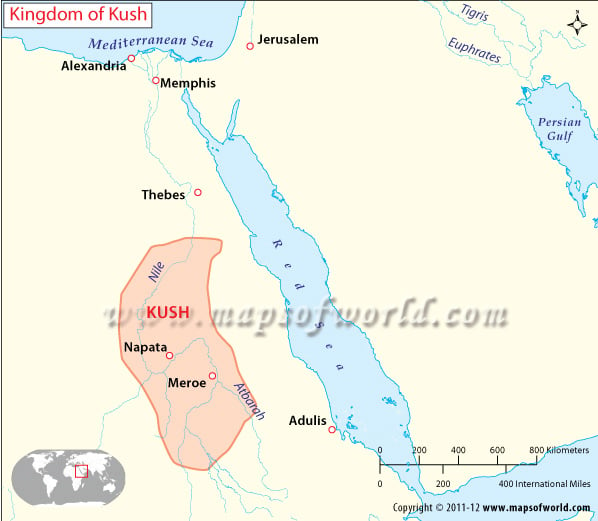
The Nubian province of the New Kingdom of Egypt was governed by a viceroy who promptly declared his independence with the decline of the New Kingdom in about 1070 BC. Therein lay the origins of the Kingdom of Kush, with its early capital at Napata. The kingdom grew and prospered in the fertile valley formed by the confluence of the Nile and the Atbara River.
By the eighth century BC, Kashta, the king of Kush, invaded Egypt and established the twenty-fifth dynasty of Egypt. The manufacture and trade of iron was a significant reason for the economic prosperity of the Kushites. The political and economic influence of the Kingdom of Kush started to decline by the fourth century BC.
In the fourth century BC, military invasions by the Kingdom of Axum, along with natural calamities such as droughts, assailed the kingdom and led to the downfall of the Kingdom of Kush.
Life in Kush
The name, Kush, was probably a derivative of Kash, the Egyptian name for the province. The name Kush also finds reference as Cush in the Bible. The Kushites shared many deities of the Egyptian pantheon including Isis and Amun. Like the Egyptians, the later Kushite kings also built pyramids and tombs to bury the royalty and noblemen. The early Kushite kings were buried in community graves. This led archaeologists to refer to the culture as the Pangrave Culture.
Twenty-fifth Dynasty of Egypt
Kushite King Kashta’s invasion of Upper Egypt marked the establishment of the twenty-fifth dynasty of Egypt and the unification of Egypt. The dynasty reigned over Egypt from about 760 BC to about 656 BC. The reign was largely a peaceful one and Egypt saw a renaissance of indigenous religious practices and pyramid construction under the Kushite kings. Kushite rule in Egypt ended with Psamtik I’s reclamation of the land in 656 BC.
Napata and Meroe
The city of Napata was founded by the Egyptian king Thutmose III when he conquered Nubia. With the Kushites having declared independence, Napata became the capital and administrative hub of the kingdom of Kush. Napata’s location on the banks of the Nile also made it a trading center.
By 591 BC, the capital was moved to Meroe. The move seems to have been a result of the growth of the iron manufacturing industry around Meroe. Meroe, a strategic port on the Red Sea, opened the Kingdom of Kush up to international trade and served as the capital better than Napata had.
Manufacture of Iron and Trade
The most important commodity of manufacture and trade in the Kingdom of Kush was iron. Meroe was rich in iron ore. Dry timber for the furnaces of iron manufacturing units in Kush came from around Meroe. Besides iron, the Kushites exported ceramics, gold jewelry, and ivory. Historians believe that an important reason for the downfall of the Kingdom of Kush was deforestation. The Kushites had indiscriminately cut down trees to fire iron furnaces, and this led to severe drought in the kingdom.