Eritrea Map
 Buy Printed Map
 Buy Digital Map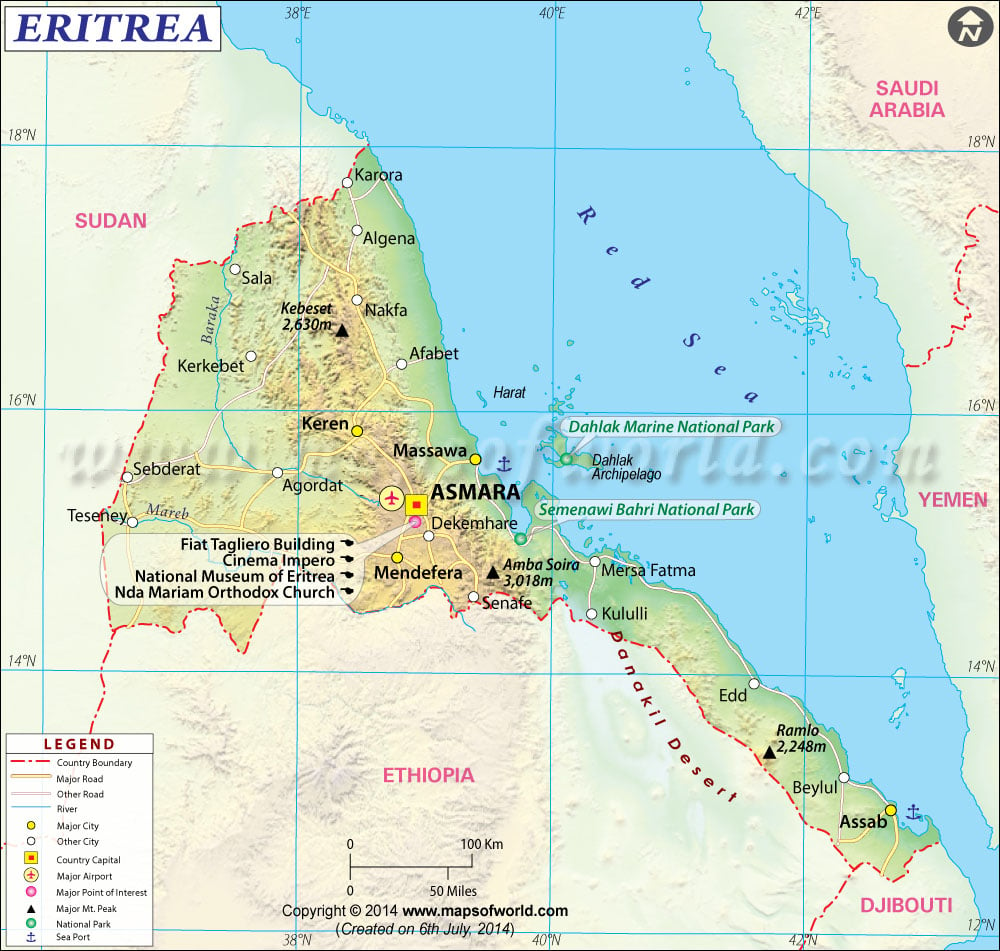
- Neighboring Countries - Djibouti, Ethiopia, Sudan, Somalia, Yemen
- Continent And Regions - Africa Map
- Other Eritrea Maps - Where is Eritrea, Eritrea Blank Map, Eritrea Road Map, Eritrea Rail Map, Eritrea River Map, Eritrea Cities Map, Eritrea Political Map, Eritrea Physical Map, Eritrea Flag
About Eritrea
Explore this Eritrea map to learn everything you want to know about this country. Learn about Eritrea location on the world map, official symbol, flag, geography, climate, postal/area/zip codes, time zones, etc. Check out Eritrea history, significant states, provinces/districts, & cities, most popular travel destinations and attractions, the capital city’s location, facts and trivia, and many more.
| Capital City | Asmara |
| Language | Tigrinya (official), Arabic, English, Tigre, Afar |
| Currency | Nakfa – ERN |
| Religion | Christian, Muslim |
| National Anthem | Ertra, Ertra, Ertra |
| Newspaper | Asmarino, ERINA, Afrik |
| Places to Visit | Qohaito, Asmara, Keren, Dankalia, Massawa Island and many others. |
| Transport | Avail EgyptAir flying from Cairo (Egypt), Lufthansa airline from Germany and Yemenia Airlines from Sanaa to Eritrea destination. One can even opt for shared taxis or chartered bus in this region. |
| Shopping | Gold and silver jewelry, leather items, spears, woodcarvings, drums, carpets and wicker goods. |
Travel to this multicultural land, which is known to have two prevalent religions along with nine nationalities with distinct languages of its own.
Eritrea derives its present name from the Latin word – Mare Erythraeum that stands for the Red Sea. Enthrall your senses that captivate your sight while touring in this land where countless opportunities await you.
Physical Map Of Eritrea
Nestled in the ‘Horn of Africa’ where the region is practically separated into:
|
|
Location Of Eritrea
Eritrea is nestled within the northern region of East Africa. It is surrounded from the western front by Sudan, from the southern front by Ethiopia and from the southeastern front by Djibouti. The coastline boundary along the Red Sea passes through the eastern and northeastern region of the country especially from the location of Saudi Arabia and Yemen.
Eritrea has a parliamentary democracy constituted of six regions but is considered as a functional single party state. The place is formed by Dahlak dry land along the arid coastline while the southern highlands are comparatively cooler. The three tectonic plates in this region are parting with one another near the Afar Triangle or Danakil Depression of Eritrea, which includes the plates of Arabian and the African Plates of Nubian and the Somalian. The highest point in this region is Amba Soira.
The major cities within this place are Asmara (the capital city), Assab (southeast port town), Massawa (east), Keren (north).
Flag Of Eritrea
The flag of Eritrea was accepted officially during the month of December 5, 1995. The flag is designed with a red triangle broadening along the hoist side and corners to the other end of the flag from where two separate triangles in blue and green color initializes to reach the other end. The color green signifies the fertile expanses within the country especially the agricultural division, the blue denote the serene ocean and red represents the martyr who lost their lives during the freedom fighting. A yellow circlet symbol is placed in the corner of red triangle that is comprised of 14 leaves. The triangle shape with shrinking red color signifies the freedom achieved by the nation after the end of hard tyranny.
Climate Of Eritrea
Eritrea is placed at the highest atoll within the African continent. The two major climatic conditions affecting this region are:
The best time to visit this area is during:
|
In the highlands, the sultry month hits the area from May while winter settles during December to February. Minor down pouring happens during March and April and heavy rainfall occurs from June to September. The average temperature of the area lies between 16 degrees centigrade. The lowland areas and the coastal plains are accustomed to sultry and dry condition from June to September. December to February is usually the rainy season with an average temperature level being about 35 degrees centigrade.
Flora and Fauna OF Eritrea
The native animals of this region are greater kudu, Tora hartebeest, vervet monkey, olive baboon, sand fox, bat-eared fox, genet, African wildcat, warthog, Soemmering’s gazelle, Abyssinian hare lion, leopard, zebra, antelope, and elephant. Giraffe and baboon are known to have extinct from this place.
The coastal area is also a habitat to turtle, lobster, and shrimps. Get striking sights of innumerable aquatic life like angelfish, barracudas, butterfly fish, crabs, sea cucumbers and jellyfish.
Native Plant that are found here are acacia, cactus, aloe vera, prickly pear, and olive trees.
Do visit the wildlife preserve of Semenawi Bahri that houses several native birds and floras.
People Of Eritrea
Eritrea population is comprised of Afro-Asiatic people based on different religion and languages. The major ethnic groups within this area are: The Kushitic linguistic, Bilen, Hedareb, Saho, Kunama, Tigre, Tigrinya and many others.
The people are known for their friendly behavior and are proud about their religion. They are hard working in nature, and their technical innovation & spirit needs to be appreciated. Christian and Muslim are the prevalent religion of this place. If by chance you visit a local natives house where you might be offered food to eat. But the local custom would be to decline the eating request at least three times. Once the host utters the word “bezay kelalem”, it is only then one must agree to feast with them.
Arts, Culture And Music Of Eritrea
Art: Visit the National Museum of this region, which displays Adulis excavations, Dahlak Islands tombstones, Sabean material and much more local items.
Culture: The coffee ceremony is widely popular here where guests are offered with brewed coffee. The local incense that is frankincense or gum Arabic is also lighted during this occasion.
Music: Eritrean popular music that has its influences from the Ethiopian music is based on the age-old trumpet style. Its instrumental notes are taken from the American psychedelic rock and Motown soul music. Teklé Tesfa-Ezighe has been traditionally considered as the most renowned Eritrean musician. The music instruments, which are widely used here, are stringed kraar, kebero, lyre, kobar and the wata. Traditional Eritrean dancing is even accompanied with native steps where both men and women participate together.
Economy of Eritrea
The economy of Eritrea depends mainly on the agricultural production. Most of the native people thrive on the farming and herding that sustain major part of the revenue income within the country.
Once the natural disasters, attack by locust plagues, drought and Eritrean-Ethiopian War had a devastating effect and took a heavy toll on the economic growth of the country. Though even after that government made all its efforts to improve the infrastructure condition on transportation along with reviving the port facility. The government initializes the process of improving illiteracy, unemployment, and low skills. Venues have been opened for privatizing the economy for further growth of revenue income within the region.
Stay connected at Mapsofworld for all relevant information about Eritrea.
Eritrea Duty Free Shops
Eritrea Duty Free Shops are retail outlets, which are exempted from paying duties and taxes on some of the goods that they import. The best places to find the duty free shops of Eritrea are the International Airports at Asmara, Massawa and the Assab. Also the seaports and the Eritrea International zones have shops, which do not charge tax on these goods like in other retail chain shops.
In Eritrea, all shops and individual customers can import some specified goods on which customs duty is not charged but there are certain specifications as to the quantity imported. These customs free items are cigarettes, tobacco, cigars and alcoholic beverages. Eritrea Duty Free Items And Quantiy For The Duty Free Items
- Cigarettes: 200 pieces
- Tobacco: 250 gms
- Cigar: 50 pieces
- Alcoholic Beverages: 1 liter
Local customers and travelers can make big profit from the Eritrea duty free shops as taxes and duties are exempted from the above-mentioned items. Eritrea Banks
The first Eritrea banks were established and recognized in Independent Eritrea when the Military forces of Eritrea took the initiative to do so. The two banks that were then nationalized were the Commercial bank of Eritrea and the Central Bank of Eritrea. In the year 1997, the banks were opened for public sector administration by the government. Retail banking in Eritrea is being done by the Central Bank of Eritrea. The Central Banking of Eritrea is well corresponded to other banks as well as the major banks of Ethiopia for the convenience of the people.
The other sectors of banking that are growing gradually are the Housing and Commerce Bank of Eritrea and Agriculture and Industrial Development Bank. The Himbol Financial Services is another name that is gaining importance in the banking sector.
Eritrea Real Estate & Mortgage
In Eritrea, mortgage loans are extended to the needy people by the Housing and Commercial bank of Eritrea in order to help citizens with housing plans at a nominal interest rate. The bank was established a year after Eritrea’s independence in 1994 with a capital of 5,000,000 Nafkas. Three major housing projects comprising of different grades of accommodations have been built for the benefit of the citizens.
Languages of Eritrea Languages of Eritrea give a highlight the complete picture of Eritrea. There are mainly nine ethno-linguistic groups, each of which has their own language. The commonly spoken languages of Eritrea are as follows:
|
|
In Eritrea, Italian, Arabic, English and Tigrinya are languages that are mostly used for formal communication purposes. From 1952 to 1956, Arabic and Tigrinya were considered to be the official languages that continued to be foremost second languages; Arabic among the Muslim people and Tigrinya among the Christians.
Again, in 1956, Amharic got the status of an official language as a result of an override of Eritrea autonomy under the rule of Ethiopia. Presently, the natives of Eritrea, mainly converse through this language.
On the other hand, the mother tongue is used as the medium of instruction in the primary schools and it is extremely popular amongst the foreign tourists. Beside this, Ge’ez is said to be the holy and sacred language of the Eritrean Orthodox Tewahdo Church. Bedawi and Bilen are also some of the living languages of Eritrea.
The key reason behind the diversity of languages in Eritrea is the varied social history that the country underwent for a long time.
National Symbols of Eritrea
National Symbols of Eritrea represent the nation in the worldwide arenas. Basically those symbolic images reflect the spirit of Eritrea and strengthen the bond between the country people. The main symbols that represent Eritrea include the national flag and the coat of arms.
Eritrea Flag has a red isosceles triangle, which divides the emblem into two right angle triangles. Green is the color of the upper triangle, while the lower one is light blue. This flag also features a gold chaplet that circles a golden olive branch. It is placed in the central part of the flag.
Coat of Arms is another very important National Symbol of Eritrea. The symbol of Coat of Arms is used in all the national and international events. It basically showcases a dromedary through natural colors encircling an olive chaplet. There is a band on the bottom with the country name written in three different languages; Tigrinya is on the left, Arabic on the right and English in the middle.