Iran Map
 Buy Printed Map
 Buy Digital Map
 Wall Maps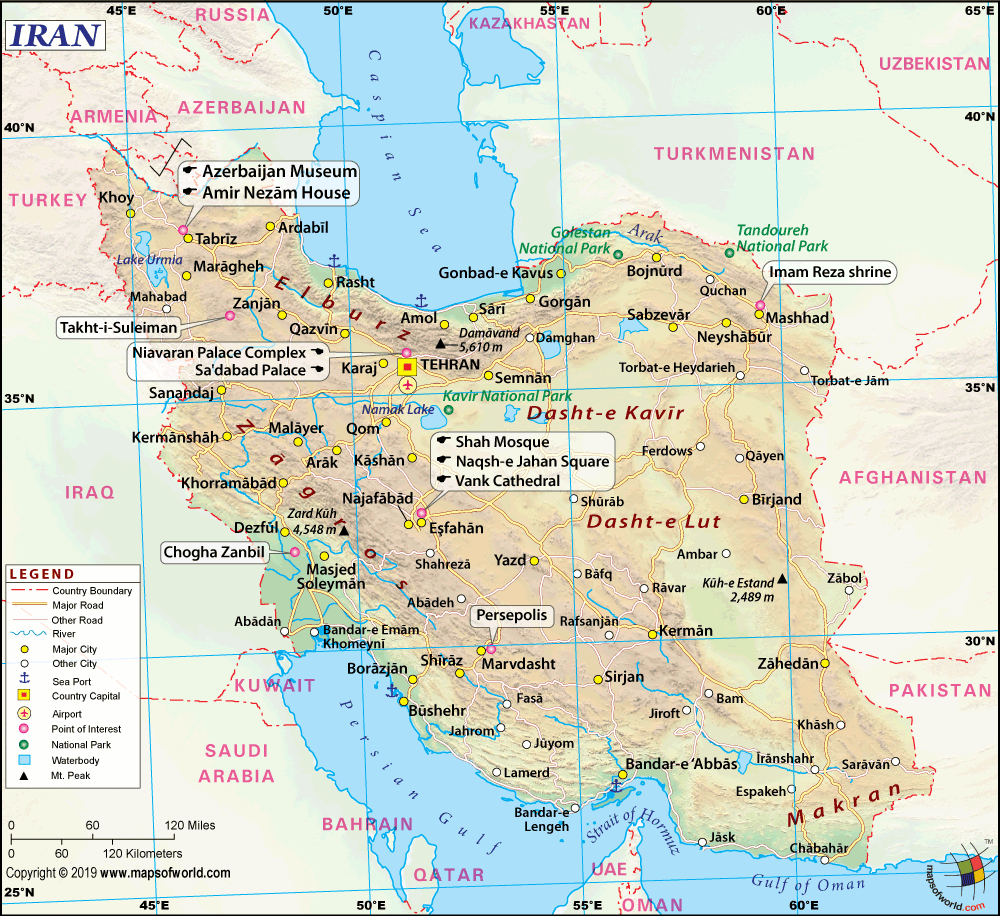
- Iran Cities - Tehran
- Neighboring Countries - Iraq, Afghanistan, Azerbaijan, Turkmenistan, Pakistan
- Continent And Regions - Asia Map
- Other Iran Maps - Where is Iran, Iran Blank Map, Iran Road Map, Iran Rail Map, Iran River Map, Iran Political Map, Iran Physical Map, Iran Flag
Explore this Iran map to learn everything you want to know about this country. Learn about Iran’s location on the world map, official symbol, seal, flag, geography, climate, postal/area/zip codes, time zones, etc. Check out Iran’s significant states, history, provinces/districts, & cities, most famous travel destinations and attractions, the capital city’s location and facts, Top FAQs (Frequently Asked Questions), and many more.
About Iran
Iran, known as the Islamic Republic of Iran, is a country situated in western Asia or Central Eurasia. The country is a regional power with a geopolitically strategic location in the Asian continent. The name of the country Iran is derived from the early Persian word meaning Land of the Aryans. The country is the eighteenth-largest country in the world, with a total area of 1,648,195 sq. km. Iran has a 2240 km long coastline. The country is multicultural, with widely diverse ethnic groups. The largest capital city of Iran is Tehran. Iran is home to one of the world’s oldest civilizations. The country’s government is an Islamic theocracy, including some elements of a presidential system. The country is situated in a seismically active area. Iran’s five central administrative regions are Tehran, Isfahan, Tabriz, Kermanshah, and Marshal. Check key facts about Iran to learn more about the country.
Iran Flag
The present flag of Iran was adopted on July 29, 1980. Also known as the Three-Coloured Flag, the flag’s design consists of equal horizontal green, white, and red bars. The flag has the red national emblem (” Allah”) centered on the white band. The Takbir is written 11 times each in the Kufic script in white at the bottom of the green band and the top of the red band.
The Emblem of Iran features four curves and a sword surmounted by shadda, which is a stylized representation of the word Allah. The emblem consists of five parts symbolic of the Principles of Religion. The national emblem of Iran was designed by Hamid Nadimi and was officially approved by Ayatollah Khomeini on May 9, 1980.
Location of Iran
The Iran Location Map shows the exact location of Iran on the world map. This map exhibits the boundaries of this country, neighboring countries, and oceans. Iran shares its boundary with Pakistan and Afghanistan in the east, Iraq in the west, Turkmenistan in the north, and Armenia, Turkey, and Azerbaijan in the northwest. The country also shares the water boundary with the Caspian Sea north, the Gulf of Oman, and the Persian Gulf south.
The Latitude and Longitude extent of Iran is 24. N and 40. N Latitude and 44. E and 64. E Longitude in western Asia. The Latitude and Longitude Map of Iran are available for more information.
Iran Capital
The capital city of Iran is Tehran. The city is the most populous in the country and western Asia, with a population of around 9 million. Check Tehran Map to know about its location and more. Tehran encompasses the second-largest metropolitan area in the Middle East after Cairo. In 1786, the city of Tehran was first chosen as the capital of Iran by Agha Mohammad Khan because of the city’s proximity to Iran’s territories in the Caucasus. The city is home to many historic locations, with the most popular being the royal complexes of Golestan, Sadabad, and Niavaran. Most of the population of Tehran are Persian and speak the Persian language.
Time Zones in Iran
The country uses only a one-time zone, Iran Standard Time (IRST). Iran has a half-hour offset instead of the usual full hour (UTC+3:30). It means that Iran is 3 hours and 30 minutes ahead of UTC. Daylight Saving Time (DST) or Iran Daylight Time, also known as summer time, starts on 1 Farvardin-the first month in the Solar Hijri Calendar. Iran has abolished DST from September 22, 2022. Check the Time Zone Map of Iran to learn more.
Iran Geography
The physical map of Iran reveals all the details about Iran’s physical features, including mountain peaks, rivers, and lakes. Geographically, the country is located in West Asia and borders the Persian Gulf, the Caspian Sea, and the Gulf of Oman. The terrain of Iran is highly mountainous, thus impacting the country’s economic and political history for several centuries. The topography of the country comprises rugged mountainous rims surrounding high interior basins. The central mountain chain of Iran is the Zagros Mountains. The Zagros mountain chain is a series of parallel ridges interspersed with plains that bisect the country from northwest to southwest. The central part of Iran consists of several closed basins collectively referred to as the Central Plateau. Armenian highlands form the northwestern parts of Iran. The two prominent lowlands of Iran are the Caspian Sea coastal plain in the north and Khuzestan Plain in the southwest.
Iran Climate
The climatic conditions of Iran are generally characterized by long, hot, dry summers and short, cool winters. The climate of the country is divided into four different climatic zones. Iran’s western and southwestern areas can be classified as having a BWh climate with hot desert climatic conditions. A small zone in the mid of Iran between the Persian Gulf and the Turkish Border can be classified as a Bush climate with an annual temperature above 18. C. The eastern and northern areas of the country have a Csa climate ( mild, semi-humid climate). Lastly, the mountainous regions of north Iran have a DSA climate, a cold snow Climate with dry summers and wet winters.
Iran History
The history of Iran dates back to the stone age with prehistoric archaeological evidence from the culture. The country is home to some of the earliest known civilizations. Around 2800 BC, Elam civilization began in Iran and lasted for centuries. Medes, Persian, and Parthians are the ancient people of Iran who arose during the 2nd Millennium BC. In 728 BC, Medians united and formed the Median Empire, which in 550 BC became the Achaemenid empire. In 334 BC, Alexander the Great conquered, and the country was ruled by the Seleucid and Sassanid Empires over the following centuries. The Muslims invaded the country during 7the century. In 1219 Genghis Khan led the Mongols in an invasion of Iran, rolling it for many years.
During World War l and World War Il, Iran was occupied by the British and Soviets. In 1953, during the Cold War, the US and Britain staged a coup to depose Prime Minister Mohammad Mossadegh. In 1978 Iranian Revolution happened, and Mohammad Shah exited the country’s Islamic Republic in 1979. In 1980, war broke out between Iran and Iraq until 1988, when the UN stepped in and called for a ceasefire.
Iran Major Cities
Iran Cities Map reveals valuable details, including the capital city and administrative divisions. Major cities of Iran are:
- Tehran (capital)
- Mashhad
- Isfahan
- Tabriz
- Shiraz
Provinces in Iran
The country is divided into thirty-one provinces ( Ostan in Persian). Each province in the country is governed by the local center, which is usually the most prominent local city. The largest is called that province’s capital (Markaz in Persian). The regions in Iran are headed by a governor-general (Ostandar in Persian). Check the Political map of Iran to locate all the provinces of Iran on the map.
Iran Airports
Iran has about 319 Airports as of 2013. Check Iran Airports Map to learn more. The biggest and the busiest airport in Iran are:
- Mehrabad International Airport
- Mashhad International Airport
- Imam Khomeini International Airport
- Kish International Airport
- Shiraz International Airport
- Ahwaz International Airport
- Isfahan International Airport
Iran Postal Codes
Postal codes in Iran consist of ten digits intended to give an individual code to individual buildings in the country. The first five digits of the Iran Postal codes represent the departure code and the second 5 digits represent the distribution code. The first digit constitutes a forwarding code, the second refers to the zone, the third a district, the fourth part of the district, and the fifth a segment. The last four digits represent the Identification code.
Iran Travel
Travel and tourism options in the country are diverse, ranging from beach holidays by the Persian Gulf and Caspian Sea to hiking and Skiing in Alborz and Zagros mountains. The country is home to 22 Historic Sites. Some of the famous tourist attractions of Iran are:
- Kish Island
- Shapouri House, Shiraz
- Golestan Palace, Tehran
- Pasargadae
- Fin Garden
- Yazd Historical Hotel
Top FAQs on Iran
FAQ #1:When did Persia become Iran?
Ans: In 1935, Persia became Iran and adopted its present name.
Faq #2: Does Iran have nuclear weapons?
Ans: The country is not known to possess weapons of mass destruction currently. Iran has signed treaties repudiating the possession of WMDs, including the Biological Weapons Convention and Non-Proliferation Treaty.
Faq #3 What is the other name Iran is known for?
Ans: Iran is also called Persia.
Faq#4: How big is Iran?
Ans: Iran has an area of 1.648 million km2.
Faq #5: What is the most prominent religion in Iran?
And: The most prominent religion in Islam.