Greece Map
 Buy Printed Map
 Buy Digital Map
 Wall Maps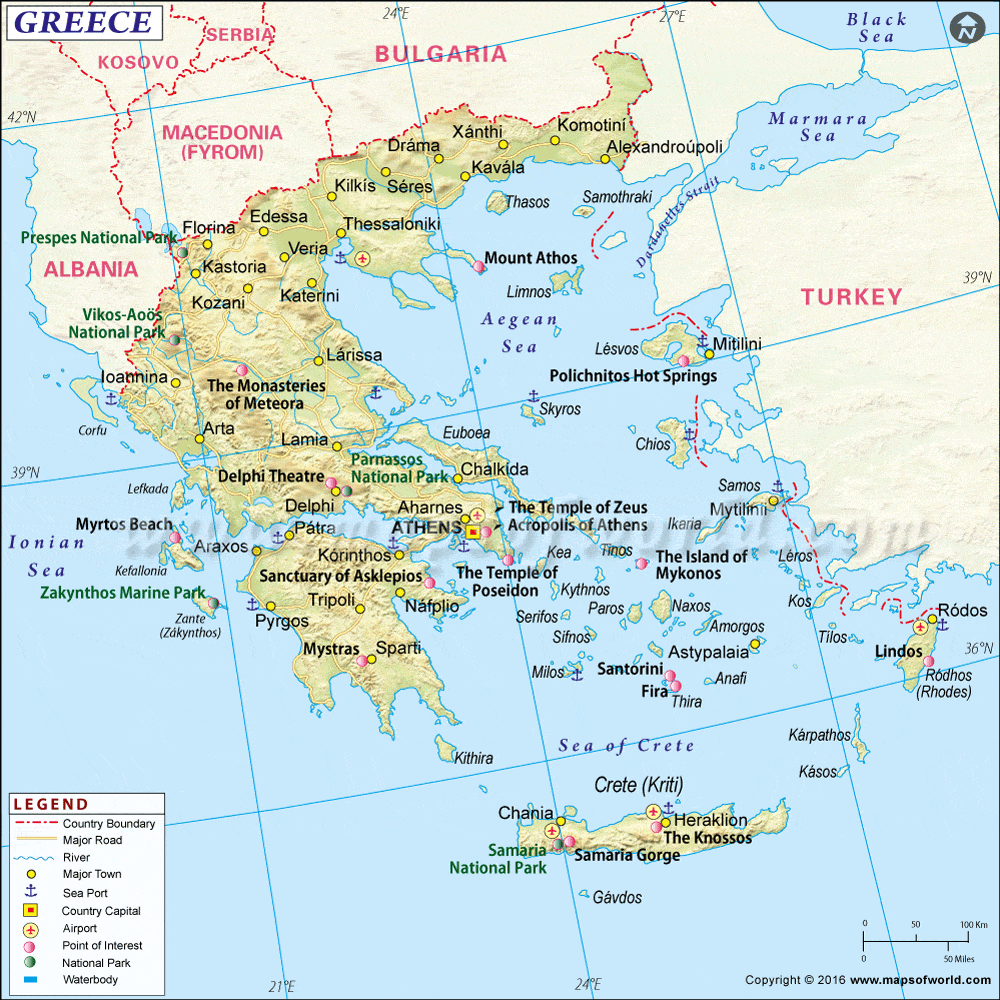
- Greece Cities - Alaxandroupolis, Corinth, Heraklion, Ioannina, Kalamata, Kavala, Patra, Sparta, Thessaloniki, Volos
- Greece Regions - Attica, Central Greece, Crete, East Macedonia and Thrace, Epirus, Ionian Islands, Macedonia Central, Mount Athos, North Aegean, Peloponnese, South Aegean, Thessaly, West Greece, West Macedonia
- Neighboring Countries - Albania, Macedonia, Turkiye, Bulgaria
- Continent And Regions - Europe Map
- Other Greece Maps - Where is Greece, Greece Blank Map, Greece Road Map, Greece Rail Map, Greece River Map, Greece Political Map, Greece Flag
About Greece
Explore this Greece map to learn everything you want to know about this country. Learn about Greece location on the world map, official symbol, flag, geography, climate, postal/area/zip codes, time zones, etc. Check out Greece history, significant states, provinces/districts, & cities, most popular travel destinations and attractions, the capital city’s location, facts and trivia, and many more.
| Capital: | Athens |
| Population: | 11000000 people |
| Area: | 131,940 sq km or 50,942 sq mi |
| Currency: | Euro |
| Religion: | 98% of the Greeks follow the Orthodox Greek Church while 1.3% of the total population follows the Islam religion. The rest 0.7% belong to other religions |
| Languages: | Greek other languages spoken are Turkish, English and French |
| Major Cities | Athens , Thessaloniki , Patra, Iraklio, Volos |
In the 5th century BC, Greece was a hub of development and went on to become undisputed leaders in the areas of art, architecture, science, mathematics, philosophy, drama, literature and democracy. Today, situated in southeastern Europe, Greece is famous for its landscape and natural beauty.
Physical Map of Greece
Greece is made up of the regions of Thrace and Macedonia in the north; Epirus, Thessaly (Thessalia), and Central Greece in the centre; and in the south by the Pelopennisos, a peninsula connected to the rest of the mainland by the Isthmus of Corinth. Though 20 percent of the country is made up of islands, which work out to 2,000 islands, only 170 are inhabited. The Aliokmon, measuring 297 km, is the longest river in Greece. The rivers are not navigable and are usually short and dry up in the summer.
Location of Greece
While islands constitute about one-fifth of the land, Greece is mainly dominated by mountains and seas. The country occupies the southernmost part of the Balkan Peninsula.
The eastern, southern and western borders are made up of the Aegean, Mediterranean, and Ionian seas, thus allowing no part of the country to be more than 100 km away from the water.
Flag of Greece
The flag of Greece consists of horizontal stripes of blue and white placed at equal intervals and they are 9 in number. These 9 strips represent the 9 syllables of the phrase , this phrase means Freedom or Death.
Climate of Greece
The southern and central portions of Greece experience traditional Mediterranean climate with hot, dry summers and mild, wet winters. However, northern Greece has continental climate and experiences colder winters. The rainfall also varies from region to region. While areas towards the west of the Pindus Mountains receive more rain than the east, the average annual rainfall in Athens in central Greece is 400 mm. Mountains are subject to snowfalls.
Flora And Fauna of Greece
The vegetation of Greece varies with the elevation of the land. From sea level to an elevation of 1,500 ft, oranges, olives, dates, pomegranates, figs, cotton, and tobacco are grown. The areas with elevations ranging from 400 to 1,500 ft are home to deciduous and evergreen forests consisting of oak, black pine, chestnut, beech, and sumac. Tulips, hyacinths, and laurels are also characteristic of this elevation. Firs and wild flowers such as anemone and cyclamen are found above 4,000 ft, and mosses and lichens above 5,000 ft.
The wildlife of Greece includes boar, European black bear, lynx, jackal, chamois, deer, fox, badger, and weasel. Among the birds are the hawk, pelican, egret, pheasant, partridge, nightingale, turtledove, and stork. Marine life comprises of squid, octopus, cod, bass, whitebait, and red mullet.
People of Greece
Greece is made up of ethnic Greeks who accounts for more than 95 percent of the population. Besides this, there is a significant Turkish minority in western Thrace. Other minorities include Albanians, Roma (Gypsies), Pomaks (Muslim Slavs), Armenians, Macedonian Slavs, and Vlachs. The first language is Modern Greek, which uses the same alphabet that was used for the Greek language spoken in ancient times.
Arts, Culture and Music of Greece
Greek dances include traditional dances such as the hasapiko, the tsamiko, and the kalamatiano that are usually performed at weddings and other celebrations. The refugees from cities of the Ottoman Empire brought with them songs of the urban working class, which had a considerable influence on the development of contemporary Greek popular music, including bouzouki (a Greek stringed instrument) music. Composers such as Manos Khatzidakis and Mikis Theodorakis have done much to popularize Greek music for a wider international audience.
Economy of Greece
Till the 1950s, Greece’s economy was governed by agriculture but by the beginning of the 20th century, export division of the country began to grow. And in the first half of the 20th century, the country’s income was mainly determined by the exports of agricultural products like tobacco and dried fruit; and by its shipping industry. It is only after the Second World War that the industries began to progress rapidly, aided by foreign investments. Greece became a full member of the European Community (now the European Union, or EU) in 1981. The country engages in free trade with its European partners and also benefits from EU grants and subsidies. Self-employed and by small family-run businesses also contribute to the economy. Besides this, today, the tourism industry also plays a major
role in governing the state of the economy. Greece’s gross domestic product (GDP) in 2001 was $117 billion, which amounted to $11,060 per capita.
Languages of Greece
Among many other languages of Greece, Greek is the main language which is spoken by 10 million inhabitants. Greek is a common language of the Greek diaspora, comprising of the Greeks who have emigrated to countries like USA, Australia, Britain or anywhere in the world.Greek is the official language of Greece spoken by about 99.5% of the population. The number of languages listed in Greece is 16.
Among them 14 languages are living and the 2 are already extinct. The less popular languages of Greece are Turkish, Slavic Macedonian, Vlach a Romanian dialect, Albanian and Pomak which is essentially a Bulgarian dialect.
Modern Greek is the most widely spoken language of Greece. Modern Greek is also known as Demotike.Greek language has categorically developed through Mycenaean period, the Classical period, the Hellenistic period finally the medieval period culminating into the modern era. Mycenaean Greek was the language of Mycenaean civilization. Classical Greek was also known as ancient Greek. The Hellenistic Greek period saw the fusion of various ancient Greek dialects with Attic, the dialect of Athens. This brought in the emergence of Koine Greek. The modern Greek language stems directly from Koine Greek.
Ancient Greek has evolved to modern Greek by incorporating many changes in it. Strong accent has replaced ancient pronunciation with rising and falling tones. The Greek language has been far more resistant to changes than any other language.
Local regions are characterized by specific dialects and accent unique to the particular region. Regional dialects and accents form a major part in the languages of Greece.
English, French and German languages are also sparsely used in Greece. Modern Greek is spoken by about 15-25 million people mainly in Greece, USA and Cyprus. Modern Greek also enjoys the status of a minority language in parts of Turkey, Italy and Albania.
Greece Religion
Ancient Greek religion and mythology are studied the world over and the Greek gods and goddesses have influenced pagan worship the world over. From ancient times to the modern world, paganism has been replaced by Orthodoxy as the dominant religion. Recent studies also confirm a growing trend of atheism across Greece.
Ancient Greek Religion
Religion in ancient Greece comprised of a complex set of beliefs and ritual practices and adherence to of the many cults. Each of the ancient Greek cities or polis worshiped its own patron God or Goddess. The Greek pantheon recognized a number of deities such as Aphrodite, Apollo, Ares, Artemis, Athena, Demeter, Dionysus, Hades, Hera, Hermes, Hestia, Poseidon, and Zeus. Social live evolved around religion and the festivals held in honor of these gods and goddesses became events of great political, social, and philosophical importance.
Social thought in ancient Greece was heavily influenced by the religion of the polis. Ethics and morality were derived from theological and metaphysical beliefs and these in turn influenced the law of the land. Greek mythology is perhaps the most eminent, among the mythologies of the ancient world. Gods controlled the natural elements and human emotions and were also subject to vices. The Iliad and the Odyssey are full of references to divine interference in the wars and fates of human beings.
Greece Science & Technology
The present Greece – Science & Technology is definitely based on the inventions and discoveries made by the old scientists and scholars. Since the foundation of the academy of Athens, a lot has been done in the field of science and technology in Athens. The subjects on applied mathematics, atmospheric physics and climatology have been given stress. Besides the academy of Athens, Greece has five big scientific research institutes. Association of Greek Chemists and Greek Mathematical Society in Athens are the two main specialized scientific research institutes. Nine colleges offer advanced scientific and technical tanning. The Ministry of research and Technology in Greece was established by the Greece government in 1980. The government also spends huge amount on the development of science and technology.
The Greek Research and Technology Network helps in the research and development of the communication and Information technologies throughout Greece. Ministry of Development controls the functioning of the Greek Research and Technology Network. Internet technologies and e-Learning on the national and international levels are supported by GRNET. Research and innovation are the primary keys to the rapid development of science and technology in Greece. Pan-European Grid infrastructure and SEE Federation for EGEE are coordinated by the GRNET.
Greece – Science & Technology has always been the pillar on which the national pride and image of Greece has rested. ThePatras Science and Technology Parkor popularly called PSP is an dynamic organization founded 15 years ago. Presently it houses a noteworthy number of new and strong initiatives that are firmly undertaken by the authorities. The inception of an idea to build a Technology Park in Crete was cherished ever since 1988. The first step towards the building ofScience and Technology Park of Cretewas overtaken by Foundation for Research and Technology-Hellas.