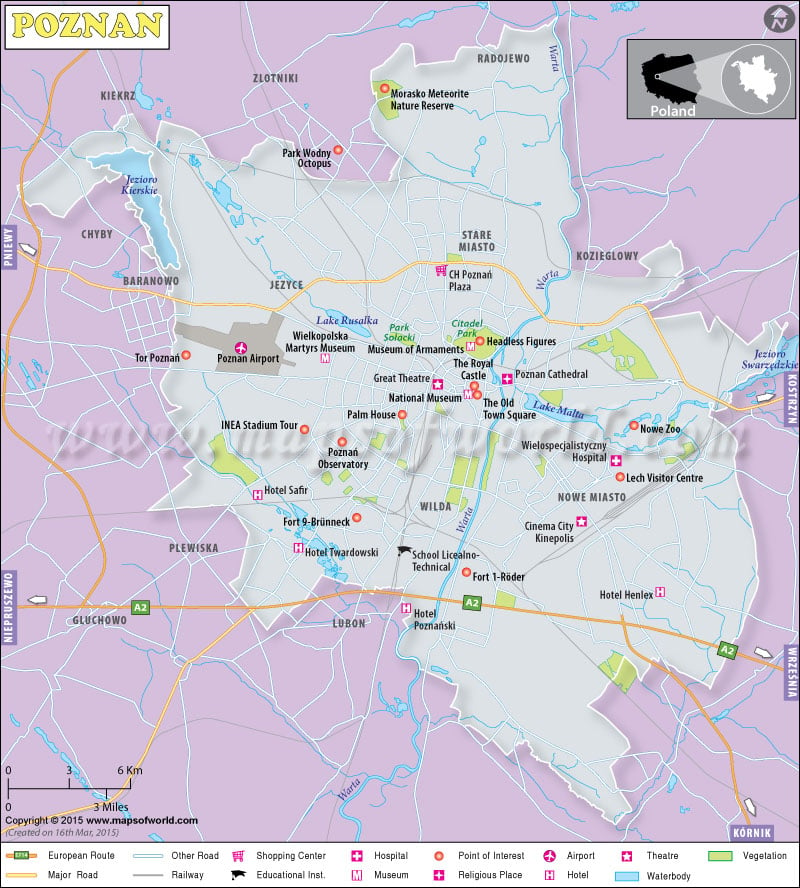
Located in the west-central part of Poland, Poznan overlooks the pictorial shores of River Warta as the oldest Polish city. This fifth largest Polish city is not only identified as an important historical center, but also the abode of commercial, educational and industrial activities of the nation.
The origin of Poznan in Poland dates back to a castle built in the historic days. Once, it was the capital of the Greater Poland region and ruled by Boleslaus the Brave, the son, and successor of Mieszko I in 1025. This was the beginning of imperial rule and the formation of a kingdom on the Polish mainland. Undergoing a series of political invasions and occupations including Prussia and Napoleon the Great, the country rose in revolt after post-World War I in 1918-1919, leading to the birth of a second Republic of Poland. The city of Poznan then became the capital of Poznan Voivodeship, which it still administers.
Poznan in Poland covers a land area of 261,3 km2. Positioned between 16°44’08”E – 17°04’28”E longitudes and 52°17’34”N – 52°30’27”N latitudes, Mt. Morasko is the highest point situated at an elevation of 157 meters above sea level. The Warta River valley is the lowest known point in the region, having a height of 60 meters only.
The local government in Poznan administers the rural towns of Ostrowek, Srodka, Chwaliszewo, Poznan, Ostrow and Lacina, combined into one urban entity later in 1793. This city and the surrounding villages, Gorczyn, Jezyce, Wilda, Winogrady, Grunwald, and Lazarz witnessed fast growth and expansion in 1900. At present, Poznan is segregated into five districts, namely Stare Miasto, Wilda, Nowe Miast, Grunwald and Jezyce.
As a part of the Polish mainland, Poznan has had a significant impact on the socio-cultural life of Europe at large, from the pre-First World War to the Holocaust scenarios. Different types of activities in diverse cultural fields like stage theaters, and musical and instrumental shows are a common parts of the cultural achievements of the land. In fact, the travel and tourism activities in Poznan are adequately encouraged by the annual Malta Theater and classical music festivals, as well as Henryk Wieniawski Violin Competition held every five years. These are certain activities that receive huge participants and audiences across the globe, thereby booming the tourism industry of the land. As an important commercial and educational center in Poland, Poznan has immense contributions to the enrichment of every sphere of national culture and welfare.