Burkina Faso Map
 Buy Printed Map
 Buy Digital Map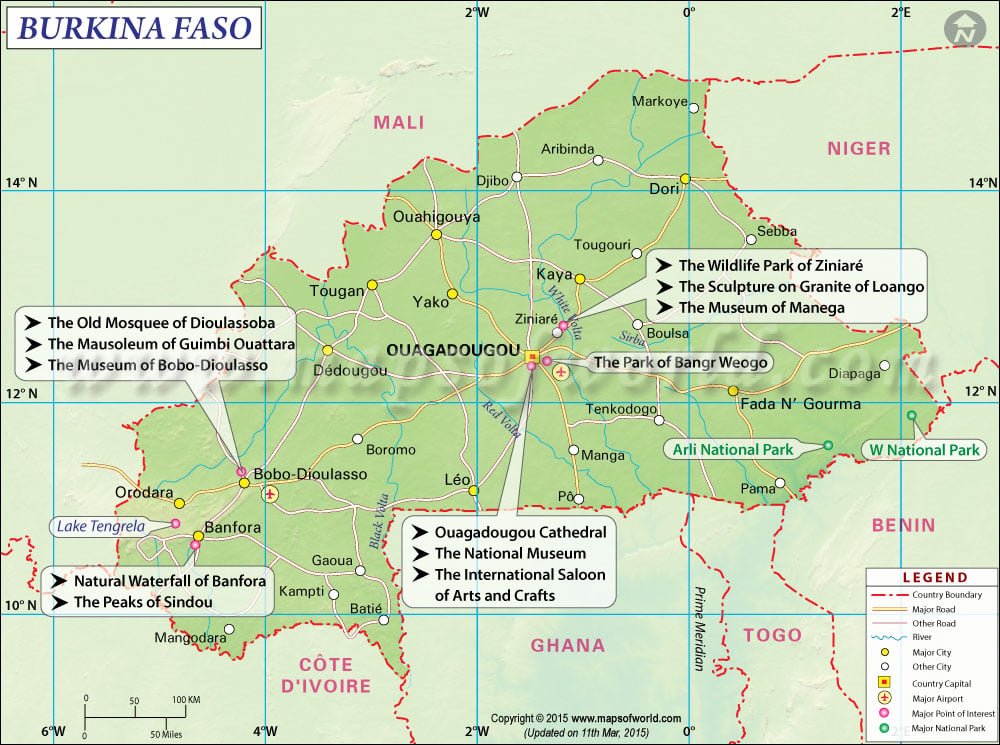
- Neighboring Countries - Mali, Niger, Benin, Togo, Ghana, Cote Divoire
- Continent And Regions - Africa Map
- Other Burkina Faso Maps - Where is Burkina Faso, Burkina Faso Blank Map, Burkina Faso Road Map, Burkina Faso Rail Map, Burkina Faso Cities Map, Burkina Faso Political Map, Burkina Faso Physical Map, Burkina Faso Flag
About Burkina Faso
Explore this Burkina Faso map to learn everything you want to know about this country. Learn about Burkina Faso location on the world map, official symbol, flag, geography, climate, postal/area/zip codes, time zones, etc. Check out Burkina Faso history, significant states, provinces/districts, & cities, most popular travel destinations and attractions, the capital city’s location, facts and trivia, and many more.
| Official Name | Burkina Faso |
| Capital | Ouagadougou |
| Population | 11.9 million |
| Area | 274,200 sq km or 105,869 sq mi |
| Currency | Franc ($1= 724.11) |
| Religion | Islam and tribal beliefs |
| Literacy | 19% |
| Languages | French and Sudanic tribal languages |
| Major Cities | Ouagadougou, Koudougou, Banfora |
| Climate | Mainly hot, wet summers and dry, cool winters |
Formerly a province of French West Africa, Burkina Faso gained independence in 1960. Though agriculture is the main source of income, the country is heavily dependent on foreign aid for its development.
Physical Map of Burkina Faso
Burkina Faso is located on a plateau sloping generally to the south.
The plateau is drained to the south by the Black Volta (Mouhoun), Red Volta (Nazinon), and White Volta (Nakanbe) rivers and to the east by small rivers connecting with the Niger. None of these rivers are navigable.
Location of Burkina Faso
Climate of Burkina Faso
Flag of Burkina Faso
Flora And Fauna of Burkina Faso
Most of the country is covered with grass and small trees. Animals include the elephants, hippopotamuses, buffalo, antelope, and crocodiles.
People of Burkina Faso
The people of Burkina Faso can be divided into two major West African cultural groups – the Voltaic and the Mande. The Voltaic are the majority and include the Mossi, who constitute nearly half the population. Other ethnic groups include the Fulani, Lobi, Bobo, Senufo, Gourounsi, Bissa, and Gourmantche.
Most of the population resides in rural areas. While French is the official language, languages pertaining to the Sudanic family are also spoken by about 90 percent of the population. About 49 percent of the population consists of Muslims and only about 34 percent follow traditional religions. The remaining 16 constitute the Christians, who are mostly Roman Catholic.
Economy of Burkina Faso
Burkina Faso is a landlocked country with a very poor economy.The population is very high and 90% of them are engaged in agriculture. But the country lacks the required natural resources and has fragile soil that is deeply affected by the variations in climatic conditions. Industry remains dominated by government-controlled corporations and has not been generating profits.
Following the African franc currency devaluation in January 1994, the government has updated its development program in collaboration with international agencies, and since then exports and economic growth have increased, but it still has a long way to go.