Afghanistan Map
 Buy Printed Map
 Buy Digital Map
 Wall Maps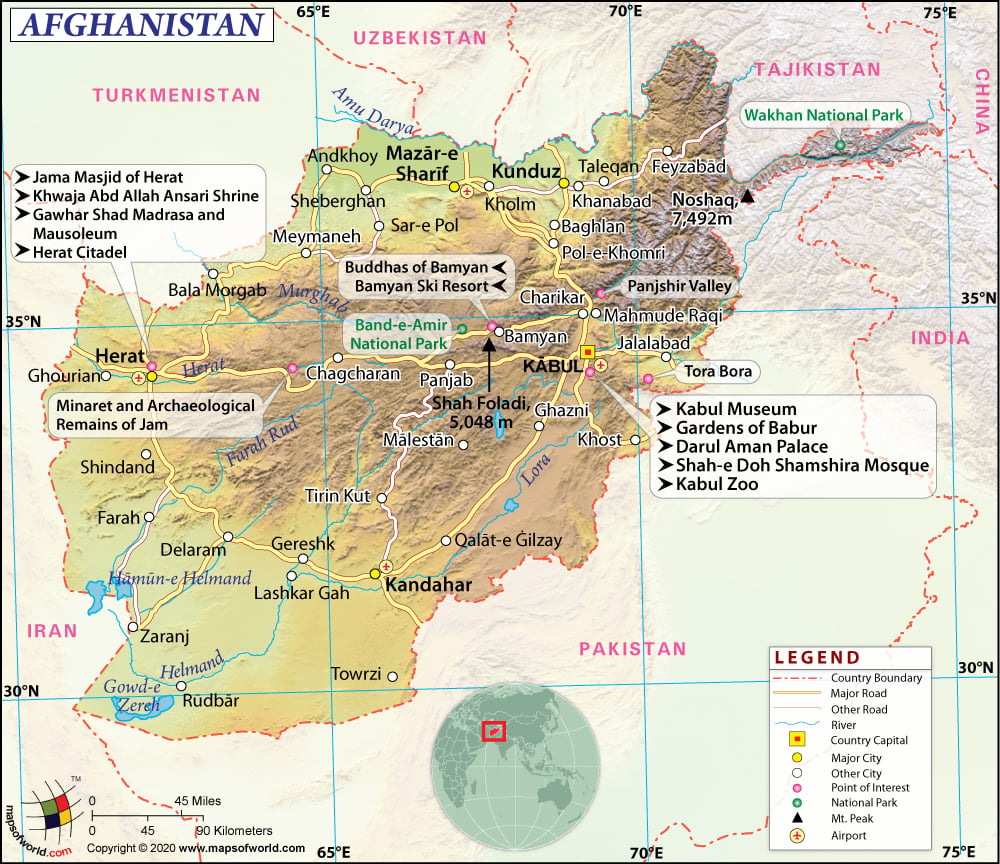
- Afghanistan Provinces - Badakhshan, Badghis, Baghlan, Balkh, Bamyan, Daykundi, Farah, Faryab, Ghazni, Ghor, Herat, Hilmand, Jawzjan, Kabul, Kandahar, Kapisa, Khost, Kunar, Kunduz, Laghman, Logar, Nangarhar, Nimroz, Nuristan, Paktika, Paktiya, Panjshir, Parwan, Samangan, Sar-epol, Takhar, Urozgan, Wardak, Zabul
- Neighboring Countries - Pakistan, Iran, Tajikistan, Turkmenistan, Uzbekistan
- Continent And Regions - Asia Map
- Other Afghanistan Maps - Where is Afghanistan, Afghanistan Blank Map, Afghanistan Road Map, Afghanistan River Map, Afghanistan Cities Map, Afghanistan Political Map, Afghanistan Physical Map, Afghanistan Flag
Explore this Afghanistan map to learn everything you want to know about this country. Learn about Afghanistan’s location on the world map, official symbol, seal, flag, geography, climate, postal/area/zip codes, time zones, etc. Check out Afghanistan’s history, significant states, provinces/districts, & cities, most popular travel destinations and attractions, the capital city’s location, facts and trivia, Top FAQs (Frequently Asked Questions), and many more.
Key Facts of Afghanistan
Afghanistan is a country located in south and central Asia. Afghanistan, officially known as the Islamic Emirate of Afghanistan, is also sometimes referred to as the heart of Asia. The country has a long history and a vibrant culture. The country covers a total area of about 652,864 square kilometers (252,073 sq mi). Afghanistan is predominantly mountainous, with plains in the north and the southwest. The modern state of Afghanistan was said to be founded by Ahmad Shah Durrani. Buzkashi is a traditional sport of Afghanistan, which is played on horseback and involves players trying to drag a goat or calf carcass towards a goal.
Afghanistan Flag
Afghanistan has had more flags since the early 20th century than any other country in this period. The Internationally recognized flag of the Islamic Republic of Afghanistan is the tricolor flag having vertical black and green stripes. The flag has the national emblem in white at the center. The resistance movements against the Taliban in Afghanistan have used the flag. The present-day flag of Afghanistan was adopted on 15 August 2021 with the victory of the Taliban in 2001-2021. The current Afghanistan flag consists of a white field with a black Shahada.
Afghanistan Location
Afghanistan Location Map shows the exact location of Afghanistan on the world map. This location map shows the boundaries of this country, neighboring countries, and oceans. It is a landlocked country located at the crossroads of Central Asia and South Asia. The country shares its boundary with Iran to the west, Pakistan to the east and south, Turkmenistan to the northwest, Uzbekistan to the north, China to the northeast and east, and Tajikistan to the northeast.
Afghanistan’s Latitude and Longitude extent are 33.N Latitude and 64.E Longitude in Asia. One can check this Latitude and Longitude Map of Afghanistan for more information.
Afghanistan Capital
The capital city of Afghanistan is Kabul, situated in Kabul Province. The capital City is located in a narrow valley between the Hindu Kush along the Kabul River in the east-central part of Afghanistan. It is one of the most mined cities in the world. Kabul is one of the world’s highest capital cities, with an elevation of 1,790 meters (5,873 ft). Kabul city is the largest in Afghanistan and is the economic and cultural center of the country as well. The town is strategically located at a crossroads in Asia along Central and South Asia trade routes. Kabul was once a key destination on the ancient Silk Road.
Afghanistan Time Zones
The country uses only a one-time zone, Afghanistan Time (AFT). Afghanistan has a half-hour offset instead of the usual full hour, unlike most countries (UTC+4:30). It means that Afghanistan is 4 hours and 30 minutes ahead of UTC. Daylight Saving Time (DST) has never been used in the country.
Afghanistan Geography
The physical map of Afghanistan reveals all the details of the country’s physical features. It is a landlocked mountainous country located at the South and Central Asia crossroads. Afghanistan contains most of the Hindu Kush mountain range. The highest peak in Afghanistan is at Noshaq, 24,580 ft (7,492 m). The other ranges extending southwestward from the Hindu Kush include the Foladi peak (Shah Foladi) of the Baba mountain range and the Safed Koh range, which consists of the Tora Bora area, and dominates the border area southeast of Kabul. The Afghanistan natural drainage system is landlocked. There are four major rivers in Afghanistan: the Amu Darya, the Kabul River, the Hari River, and the Helmand River.
Afghanistan Climate
The country has an arid continental climate with temperature and precipitation variations between seasons. Temperatures throughout Afghanistan greatly vary by altitude, with mountainous regions experiencing temperatures below zero on an annual basis contrary to southern arid regions regularly experiencing temperatures over 35.C. Precipitation in the also country varies with topography, with the northeastern mountain range experiencing more than 1000 mm and arid southwestern region typically experiencing less than 150 millimeters (mm) of precipitation each year. Climatic conditions in the country are also affected by climate phenomena, specifically, El Nino Southern Oscillation (ENSO) and the Indian Ocean Dipole, which is responsible for drought conditions in the country.
Afghanistan History
The history of Afghanistan dates back to about 50,000 years ago. Achaemenid, Macedonian, and Mauryan Empires are some of the earliest known civilizations in the country. By the 6th century BC, the Achaemenid Empire had taken control of the region that includes modern Afghanistan. In 330 BC, the area was conquered and occupied by Alexander the great, and in 305 BC, it became part of the Maurya Empire. Due to the strategic location of Afghanistan within Asia, various empires successively took control of the region, including the Parthians, Kushans, and Sassanids. Afghanistan, then known as ”Khorasan’s,” in the 4th century CE, became an important center for Islam.
Between the 16th to 18th centuries, three kingdoms ruled the region, including the Khanate of Bukhara, the Mughals, and the Safavids. Mir Wais Hotak, in 1709 led a revolution against the Persian Safavids and declared Afghanistan independent. From the 1840s to 1870s, there was British intrusion in Anglo-Afghan Wars, while the British controlled some areas until Afghanistan was proclaimed independent under the Treaty of Rawalpindi in 1919.
In 1978, the Saur Revolution happened, the People’s Democratic Party arose to take control of the government, and a civil war broke out. In 1979, the Soviet Union invaded Afghanistan, which resulted in massive death and destruction until the Soviets finally withdrew in 1989. In 1996 Afghanistan saw the rise of the Taliban. Hamid Karzai was sworn in as head of an interim power-sharing government in December 2001.
Afghanistan Provinces
The country is divided into 34 provinces. Each province of Afghanistan usually encompasses several districts or over 1000 villages. Check this Political Map of Afghanistan for locating all the provinces on the map. The areas are the primary administrative divisions of Afghanistan. Below are the maps of all provinces of Afghanistan:
- Badakhshan Map
- Badghis Map
- Baghlan Map
- Balkh Map
- Bamyan Map
- Daykundi Map
- Farah Map
- Faryab Map
- Ghazni Map
- Ghor Map
- Hilmand Map
- Herat Map
- Jowzjan Map
- Kabul Map
- Kandahar Map
- Kapisa Map
- Khost Map
- Kunar Map
- Kunduz Map
- Laghman Map
- Logar Map
- Nangarhar Map
- Nimroz Map
- Nuristan Map
- Paktiya Map
- Paktika Map
- Panjshir Map
- Parwan Map
- Samangam Map
- Sar-e Pol Map
- Takhar Map
- Urozgan Map
- Wardak Map
- Zabul Map
Afghanistan Major Cities
Major cities of Afghanistan are:
- Kabul (capital)
- Bamiyan
- Kunduz
- Balkh
Afghanistan Airports
Afghanistan has a total of about 50 airports/airfields located across the country. There are four international airports in Afghanistan. Check this Afghanistan Airports Map to know more. The Biggest and busiest airports in Afghanistan are:
- Kandahar International Airport
- Hamid Karzai International Airport in Kabul
- Herat Airport
- Mazar-I-sharif Airport
- Fayzabad Airport
- Khost Airport
Afghanistan Postal Codes
The postal codes of Afghanistan are four digits (NNNN). The country introduced Postal Codes/ZIP codes in 2011 at a press conference in Kabul. Postal codes in Afghanistan are managed by Afghan Post, the national public postal service under the direction of the Afghan Ministry of Communications and Information Technology. The first two digits of the Postal code (ranging from 10-43) correspond to the province, while the last two correspond to either the city/delivery zone or the district/delivery zone.
Afghanistan Travel
The country has more than six thousand years of history with many historical sights and attractions. Some of the most famous tourist attractions of Afghanistan are:
- Babur Tomb
- Qargha Lake
- National Museum of Afghanistan
- Kabul Museum
- Darul Aman palace
- Handle-Amir National Park
Top FAQs on Afghanistan
FAQ #1: Is Afghanistan in the Middle East?
Ans: Afghanistan is not in the middle east.
Faq #2: When did Afghanistan become Islamic?
Ans: In September 1996, the Taliban captured Kabul and established the Islamic Emirate of Afghanistan.
Faq #3: Why did the US leave Afghanistan?
Ans: The U.S and NATO formally ended their combat mission in Afghanistan in Afghanistan on December 28, 2014, and ultimately withdrew the United States Armed Forces on 30 August 2021. It marked the end of the 2001-2021 war.
Faq #4:What language is spoken in Afghanistan?
Ans: The official language of Afghanistan are Dari (Persian) and Pashto.
Faq #5: Does Afghanistan have nuclear weapons?
And: Afghanistan does not have nuclear weapons.
FAQ#6: Does Afghanistan have oil?
Ans: The country had 1.8 billion barrels of oil between Balkh and Jawzjan Province in the north of the country in 2010
Faq #7: How big is Afghanistan?
Ans: Afghanistan covers approximately 652,865 square kilometers (252,072 sq mi) of land.
FAQ #8 Who started the Afghanistan war?
Ans: Afghanistan war began when an international military coalition led by the United States launched an invasion of Afghanistan in 2001.
Faq #9: Why did Russia invade Afghanistan?
Ans: The internal fighting in the country and coups within the government between the people’s and Banner factions prompted Russia to invade Afghanistan.
FAQ #10: When did the Taliban take over Afghanistan?
Ans: On 15 August 2021, the Taliban took over Afghanistan.