Guinea Map
 Buy Printed Map
 Buy Digital Map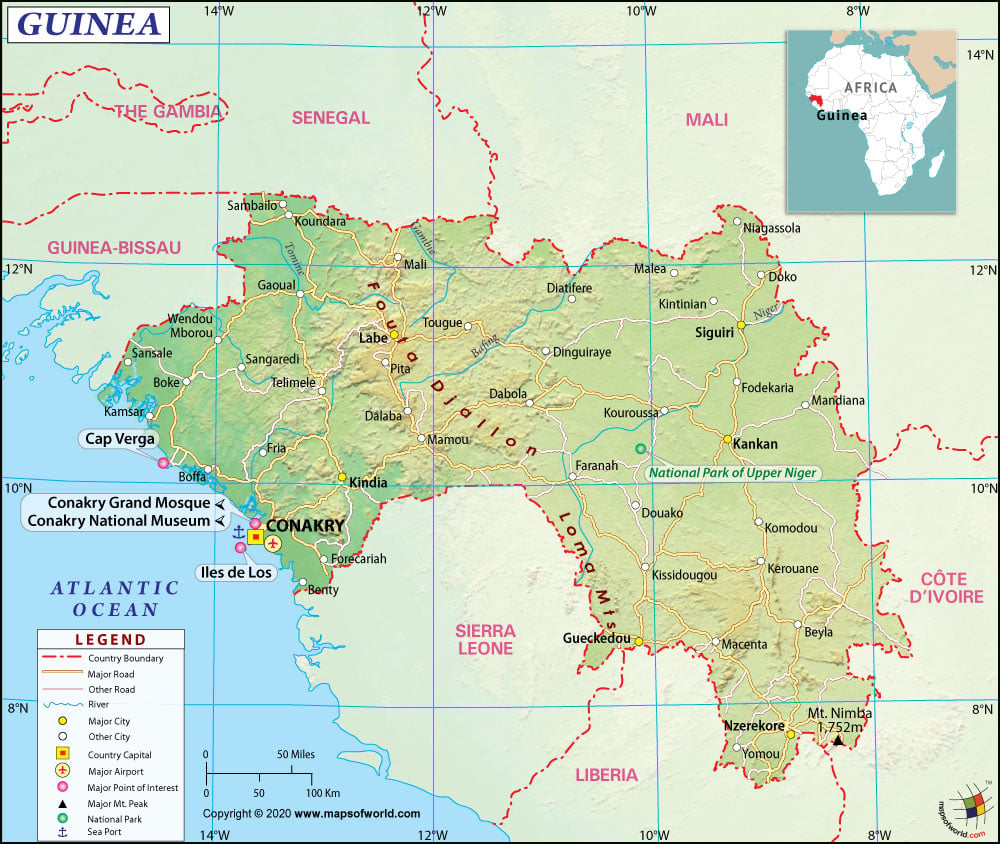
- Neighboring Countries - Sierra-Leone, Liberia, Cote d'Ivoire, Mali, Senegal, Guinea Bissau
- Continent And Regions - Africa Map
- Other Guinea Maps - Where is Guinea, Guinea Blank Map, Guinea Road Map, Guinea Rail Map, Guinea River Map, Guinea Cities Map, Guinea Political Map, Guinea Flag
About Guinea
Explore this Guinea map to learn everything you want to know about this country. Learn about Guinea location on the world map, official symbol, flag, geography, climate, postal/area/zip codes, time zones, etc. Check out Guinea history, significant states, provinces/districts, & cities, most popular travel destinations and attractions, the capital city’s location, facts and trivia, and many more.
| Full name: | Republic of Guinea |
| Capital City: | Conakry |
| Language: | French (official), Fula, Susu |
| Currency: | Syli or Guinean Franc (GFr) |
| Religion: | Muslim |
| National Anthem: | Liberté |
| Newspaper: | La Nouvelle Tribune, La Lance, Le Populaire, La Nouvelle Tribune |
| Places to Visit: | Conakry, Fouta Djalon, Bossou, Cape Verga, Mt Nimba and much more. |
| Transport: | Air France and SN Brussels Airlines are some of the direct flights flying straight to Guinea. Air Ivoire and Air Senegal International also fly to Europe from the airport hub. No direct flights traverse to USA but one may even avail Bush taxi, bus and minibuses that connect to different parts of the city. |
| Shopping: | Native Guinean clothes, woodcarvings, leather rugs designed in black-and-white patterns, skins, records, calabashes and jewelry. Purchase local goodies at the famous market of Gueckedou. |
The untainted countryside speaks about innumerable destination and choices for an inquisitive traveler to venture. From the Savannahs that stretch along from the Tinkisso River to the Mali border, to the historical town that speaks of bygone era within the eastern region of the province, from the cascading waterfall along the Kinkon Falls to the Nimba Range that broadens to the Côte d’Ivoire district, this place has enough to provide you with. Travel to this land where innumerable opportunities awaits you, that would leave behind valuable moments to cherish.
Location Of Guinea
Guinea is nestled in the region of West Africa, which was previously called as the French Guinea. The province is engulfed by Guinea-Bissau and Senegal on the northern front , Mali on the north and north-eastern front , the Côte d’Ivoire on the south-eastern front, Liberia on the southern area, and Sierra Leone on the western region.
Physical Map Of Guinea
The present name, Guinea initiated from the Berber that was soon denoted as the land of the blacks. The name Guinea was usually designated to most of western coastal area of Africa and to the southern region of the Sahara desert along with the northern region of the Gulf of Guinea. The province is even referred to as Guinea-Conakry to distinct it from its neighboring place which is called as Guinea-Bissau.
The territory of Guinea is covered with a coastline overlooking the Atlantic Ocean, being a main source of water for the Niger, Senegal, and Gambia regions. The highest summit within Guinea is Mont Nimba, which boldly stands at a height of 5,748 feet. Covering a total land area of about 94,919 square miles the province is roughly similar to the United Kingdom but comparatively smaller to the US state of Michigan.
The province is administratively separated into seven main regions, which is further subdivided into thirty-three prefectures. These regions being:
|
|
Flag Of Guinea
The official flag of Guinea was accepted during the month of 10 November 1958. The flag is designed with three bands of colors that is red, yellow and green, which is known as the national color of the province. These bands lie vertically in equal size and shape that can be compared to the flag of Ghana that lie horizontally with these basic colors. The flag denotes a basic significance of the uninterrupted struggle for human emancipation and liberation.
The color red denotes the basic color of blood. The flag carries the message of progress and work within the region. It denoted the anti-colonialist martyrs who gave away their blood and sweat for the country.
The color yellow signifies the golden color that emit from the African sun. It carries the message of Justice that needs to be prevalent within the country. It believes in equality and fairness, liberality and generosity along with energy and power.
The color green relates to the agricultural production within the region that carries along the message of prosperity and wealth. It believes in solidarity and commonality among the native folks.
Climate Of Guinea
Travel to the land of Guinea during the month of November to March, which is the best time of the year to tour, where you may observe mild daytime and cozy cooler nights. The climatic condition of Guinea is tropical in nature and can be divided into two rotating seasons which is:
|
It is due to the onset of drifting intertropical convergence zone (ITCZ) especially in the month of June that brings along with it heavy rainfall during the wet season. Once the ITCZ moves further southward during the month of November, the harmattan wind propels from the northeastern part of the Sahara thereby making the climate, hot and dry.
July-August witness’s heavy down pouring when most of the roads are blocked. Comparatively the month of May-June and September-October are trivially affected.
Mountain temperatures can ascend to about 5 C. So do carry along your sweater incase you visit the mountain ranges of the area or take along the umbrella, and water-resistant shoes during the rain affected months. The Upper regions of Guinea, particularly the Futa Jallon, is affected with least amount of rainfall with an average temperature reaching to about 14°C thereby ascending during the dry season.
Flora And Fauna Of Guinea
Guinea is surrounded with dense mangrove forests that are embedded along the river mouth. The Lower Guinea is dominated with wooded trees of parinari, with several branches of climbers and bushes attached to it.
Gum copal has its common plantation along the streamline of the area. The Futa Jallon was subjected to massive destruction by burning, whereas the lower slopes are filled with afforested plants like sedge (catagyna pilosa), and laterite.
The higher plateau area and the mountain peaks are marked with rarely sighted dense plantation. The Upper Guinea are covered with Savanna forests that is marked with distinct tall grasses in major portion of the province. The native trees that are found here are shea nut, tamarind, and locust bean. Guinea shares common rain forest with the Liberia borders.
The native animal of the region are elephant, hippopotamus, buffalo, lion, leopard, antelope, monkey, crocodiles along with dangerous venomous snakes.
People Of Guinea
The Population of Guinea is mainly constituted with foreign refugees, Liberians and Ivoiriens. The ethnic group of people residing here are: Peuhl, Malinke, Soussou and others. The Religions that are thriving here are Muslim that constitutes about 85% of the population and the rest with Christian that belongs to 8% of the inhabitants residing here.
French is the official languages spoken here. Apart from this dialect the other local vernaculars that one may come across are:
The Fula languages seem to flourish here and are spoken by the Fula natives who reside from the area of Senegal to Cameroon till the expanses of Sudan. It is a part of the Niger-Congo language family placed near the Atlantic branch.
The Maninka language is yet another dialect thriving within the region and is interlinked within the southeastern Manding subgroup along the Mande branch. It remains as the mother tongue of the Malinké people
Susu popularly known as or Soussou or Sosokui, is the local vernacular of the Susu natives residing in Guinea, West Africa that belongs to the Mande group of family. This language was used for trade purpose with other tribal groups nestled within the region.
Arts, Culture And Music Of Guinea
Art: With the development of manufactured goods the Handicrafts gained a major setback during the colonial era. It was due to the downfall in the tourism and the marketing industry, just after the independence, the crafts fabrication within the area was severely affected. But still works like leatherwork, woodcarving, and jewelry can be sighted presently, that holds the market till date.
Culture: The family comprising within Guinea stay in groups within the same compound area that consists of a man having many several wives along with members like aunts, uncles, grandparents, cousins and many brothers and sisters. The staple food of the area is rice and meat and maize (corn). A conventional recipe is rice that is seasoned with native guinea hens, topped over with cayenne and paprika, along with a stew made of tomatoes, sweet potatoes, and bananas.
Music: The music of Mande have gained quite popularity in the local area and even in the international market, beyond the boundaries of West Africa and the Mande of Mali. This genre of music belongs to the Maninka vernacular folks that carry a swift, soft and graceful melancholy. The djelis are well known as the traveling praise-singers who carried out their music for affluent dignified clientele.
Guitar is the most common instrument that accompany with the native music of the region. Ngoni, a type of banjo along with balafon, are the accepted melodious instrument of the region. The Susu natives are seen playing with the balafon instrument that looks just similar to a xylophone. The kora, unified by the designs of a harp and a lute, is also seen quite recurrent within the location.
The popular music emerged with the formation of the dance band called as Bembeya Jazz. These bands were backed up by the government wherein several major groups had joined in like Keletigui et ses Tambourins Lanaya Jazz and Super Boiro.
Economy Of Guinea
The economy of Guinea is dependant on the agricultural produce that supports about 75 percent of the labor force, thereby contributing to 20 percent of the overall country’s income. About one third of the annual food provisions are imported to different parts of the country. Paddy rice, cassavas, sweet potatoes, yams, and corn (maize) are known as the chief crops within the region. The native harvests of this place, being crops like bananas, coffee, pineapples, oil palms, peanuts (groundnuts), and citrus fruits, on which the domestic needs are served. Cattle rearing, along with nurturing of sheep’s and goats is what the households of the Guinea thrive on. Timber functions as an important source in the generation of fuel within the country. The huge mineral deposits of excellent bauxite, iron ore, and diamonds can be found within the region where Bauxite is extracted from the region of Fria, from where the raw ore is transformed to aluminum thereby sent to Kamsar for final refinement and distillation.
Endeavor a trip to the local mine deposits of iron ore within the Kaloum peninsula, along the Conakry and Mount Nimba from where the minerals seem to emerge for development.
It is due to the presence of the fertile land, clear water, and favorable climatic conditions that encourages the irrigated cultivation and agro industry within the province. With residents residing and working abroad along with the export of coffee, the county maintains a consistent foreign exchange from other part of the world.
Fishing industry has even made an upscale in the fiscal generation where most of the fishing harbor faces the Boulbinet section of the area of Conakry.
- The Exported goods from the region are bauxite, alumina, gold, diamonds, coffee, fish, and agricultural products.
- The commodities Imported within the place are petroleum products, metals, machinery, transport equipment, textiles, grain and variety of foodstuffs.
- The Industries thriving within the region are bauxite, gold, diamonds; alumina refining; light manufacturing and agricultural processing industries.