Colombia Map
 Buy Printed Map
 Buy Digital Map
 Wall Maps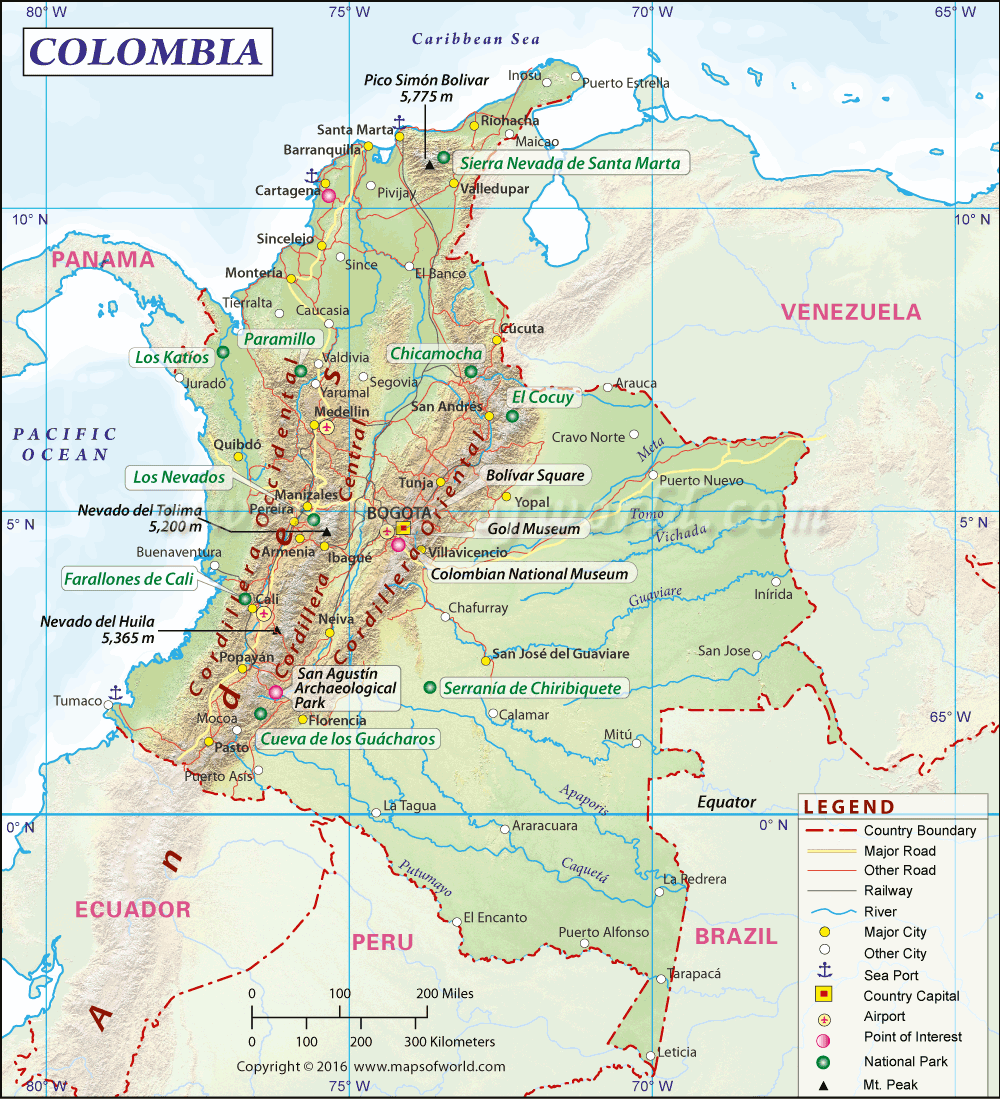
- Colombia Departments - Amazonas, Antioquia, Arauca, Atlantico, Bolivar, Boyaca, Caldas, Caqueta, Casanare, Cauca, Cesar, Choco, Cordoba, Cundinamarca, Distrito Capital, Guainia, Guaviare, Huila, La Guajira, Magdalena, Meta, Narino, Norte de Santander, Putumayo, Quindio, Risaralda, San Andres y Providencia, Santander, Sucre, Tolima, Valle del Cauca, Vaupes, Vichada
- Neighboring Countries - Venezuela, Ecuador, Peru, Brazil
- Continent And Regions - South America, Americas
- Other Colombia Maps - Where is Colombia, Colombia Blank Map, Colombia Political Map, Colombia Railway Map, Colombia Road Map, Colombia River Map, Colombia Physical Map, Colombia Flag
About Colombia
Explore this Colombia map to learn everything you want to know about this country. Learn about Colombia location on the world map, official symbol, flag, geography, climate, postal/area/zip codes, time zones, etc. Check out Colombia history, significant states, provinces/districts, & cities, most popular travel destinations and attractions, the capital city’s location, facts and trivia, and many more.
| Official Name: | (Republic of Colombia) Republica de Colombia |
| Capital: | Bogota |
| Population: | 42.8 million |
| Area: | 1.13 million sq km or 0.43 million sq mi |
| Currency: | Peso ($1=2,343) |
| Religion: | Christianity |
| Literacy: | 91% |
| Languages: | Spanish |
| Major Cities: | Bogota, Medellin, Cartagena |
| Climate: | Varied climate |
Named after Christopher Colombus, Colombia was discovered by Alonso de Ojeda in 1499. Today, Colombia, is the largest producer and exporter of mild coffee.
Map of Colombia
The central and western parts of the country are mainly dominated by the Andes mountains. Towards the west, two-fifths of the country lie in the highlands of the Andes, characterized by towering mountain ranges which are separated by high plateaus and fertile valleys.
These valleys have the main rivers of the country passing through them. East of the Andes, three-fifths of the country consists of portions of the llanos (grasslands) and selva (rain forest). Along the shore of the Caribbean Sea lies a strip of lowland.
Physical Map of Colombia
The principal river of Colombia, the Magdalena, flows north between the Cordillera Oriental and the Cordillera Central.
Location of Colombia
Colombia is situated in the northwest of South America and has coasts on both the Caribbean Sea and the Pacific Ocean. The country is bound on the east by Venezuela and Brazil; on the south by Ecuador and Peru; and to the northwest by Panama.
Climate of Colombia
The climate of Colombia varies with elevation. The low regions along the coast and the deep Pata and Magdalena river valleys are hot, with average annual temperatures fluctuating between 24° to 27°C. From about 1,500 to 7,500 ft, the climate is subtropical, and from 7,500 to 10,000 ft, the climate is temperate. Above 10,000 ft, the climate is cold where the temperatures ranges from -18° to 13°C.
Flora And Fauna of Colombia
Colombia is home to one of the world’s greatest varieties of birds, as well as hundreds of different kinds of mammals and thousands of types of insects and plants. The flora of the country consists of mangroves and coconut palms, which grow along the Caribbean coast. The forests cover about one-half of the country and include commercially useful trees such as mahogany, lignum vitae, oak, walnut, cedar, pine, and several varieties of balsam. Tropical plants also yield rubber, chicle, cinchona, vanilla, sarsaparilla, ginger, gum copal, ipecac, tonka beans, and castor beans.
The wildlife is made up of jaguars, pumas, tapirs, peccaries, anteaters, sloths, armadillos, and several species of monkey and red deer. Alligators, once numerous along the principal rivers, have become scarce due to intensive hunting. Many varieties of snakes inhabit the tropical regions of Colombia. Birds include condors, vultures, toucans, parrots, cockatoos, cranes, storks, and hummingbirds.
People of Colombia
Colombia is made up of people from different races. Around 58 per cent is made up of mestizos, a mixture of European and Native American race, 14 per cent is made up of mulatto, a mixture of black and European race and 20 per cent consists of unmixed European race. The remaining is made up of 4 per cent of Blacks, 3 per cent of mixed black-Native Americans and 1 per cent of unmixed Native Americans. The country is urbanized as over 76 per cent of the population lives in towns and cities.
Arts, Culture and Music of Colombia
The art and culture of Colombia touched the peak around the 16th century, which is even before the Spanish settlers came in. The folk music and dance of the country reveals African or Native American influences. Bambuco, the national dance is quite famous but Salsa is also equally popular. The music loved by most people in Colombia is called murga, which is played by groups of wandering street musicians using stringed instruments. The country also excels in art and craft work. The temples, statues, potteries that are made here are the examples of the fine artwork of Colombians. The culture of Colombia has traces of Native Americans, which the Spanish settlers incorporated during the colonial period.
Flag of Colombia
The flag of Colombia has three horizontal bands – yellow on the top, which is double-width, blue in the middle and red at the bottom.
Economy of Colombia
The economy of Colombia is mainly dependent on agriculture and coffee used to be a principal cash crop in the past. But later, when the coffee prices declined in the international market, Colombia successfully diversified its economy. Economic reforms were planned and implemented in the direction of oil and coal, which helped the economy grow. However, by the end of the 20 th century, Colombia suffered recession due to a combination of low world oil prices, reduced export demand, and diminished investment flow. To worsen things, the domestic growth and foreign investment were also hindered by widespread violence stemming from drug trafficking and guerrilla insurgencies. The gross domestic product (GDP) in 2001 was $82.4 billion, or about $1,910 per capita.