Bhutan Map
 Buy Printed Map
 Buy Digital Map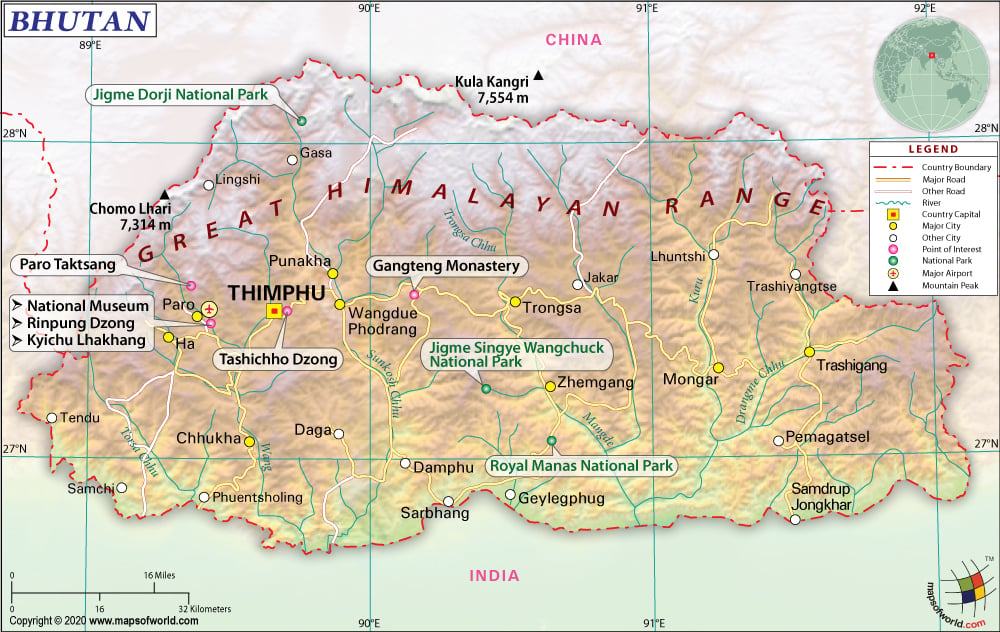
- Neighboring Countries - Bangladesh, Nepal, Myanmar, India, China
- Continent And Regions - Asia Map
- Other Bhutan Maps - Where is Bhutan, Bhutan Blank Map, Bhutan Road Map, Bhutan River Map, Bhutan Cities Map, Bhutan Political Map, Bhutan Physical Map, Bhutan Flag
About Bhutan
Explore this Bhutan map to learn everything you want to know about this country. Learn about Bhutan location on the world map, official symbol, flag, geography, climate, postal/area/zip codes, time zones, etc. Check out Bhutan history, significant states, provinces/districts, & cities, most popular travel destinations and attractions, the capital city’s location, facts and trivia, and many more.
| Name | Kingdom of Bhutan |
| Dzongkha | Druk Yul |
| Continent | Asia |
| Capital | Thimphu |
| Area | 14,824 sq miles |
| Population | 708,427 (2011 estimate) |
| Districts ( dzongkhags) | 20 |
| Major Languages | Dzonkha, Tshangla, Nepali |
| Major Religions | Buddhism and Hinduism |
| Major Ethnic Groups | Sharchops, Ngalops and Lhotshampa |
| Form Of Government | Unitary Parliamentary Constitutional Monarchy |
| Country Code | 972 |
| Currency | Ngultrum |
| GDP (PPP) | $ 4.287 billion (2011 estimate) |
| Time Zone | Bhutan Time (UTC + 6:00) |
| Literacy | 47% |
| Climate | Varied climate |
Visit the blessed land of Bhutan nestled within Himalayas, which is an abode of spiritual gods and immortal deities where one can retreat to in search of worldly connotations of wisdom, inspiration and solitude.
The place carries along the spirits of religious divinity and cultural legacy as one come across high mountain slopes flagged with religious symbols or dance accompanied with religious festive masks, that speaks about the prevalent ethos of the area. The word Bhutan is inferred from the Sanskrit word ‘Bhu-Uttan’ which refers to highlands. The place is even recognised as The Last Shangri-La, that beholds pristine landscape countryside which is the smallest non Arab nation left within the mainland Asia. The mothertongue of this region is Dzongkha. This place is filled with semi tropical forests, savannah grasslands, bamaboo jangles and alpine cultivated uplands that surely captures your glance.
About Bhutan
The kingdom of Bhutan is a landlocked country located to the east of the Himalayas in South Asia. Bhutan shares political boundaries with the People’s Republic of China to its north and India to its east, west, and south. It is a small country, about half the size of Indiana with a population of about 708,427 according to 2011 estimates. Bhutan has three distinct climatic zones – the tropical zone (south Bhutan), temperate zone (central Bhutan), and sub-alpine zone (north Bhutan). This Himalayan kingdom known for its natural beauty was rated the happiest country in Asia in 2006 by Business Week.
History
Archeological evidence points to human inhabitation of Bhutan as early as 2000 B.C though there is no recorded history of the time. In the 7th century Guru Rinpoche or Padmasambhava introduced Buddhism to Bhutan and Buddhism still remains the dominant religion of the country. The history of Bhutan is recorded since the 17th century when the region was unified by Shabdrung Ngawang Namgyal. He established a dual system of government and also codified the Tsa Yig, the monastic constitution. After his death in 1651, Bhutan fell into chaos and was attacked by Tibet in 1714. Bhutan’s first brush with the British took place when Cooch Bihar sought the British assistance to end Bhutanese occupation of their kingdom. In the 19th century, to end the differences which arose over the Duars of Bengal, the Treaty of Sinchulu was signed between the British and Bhutan. The treaty accorded Bhutan an annual subsidy in exchange of British control over the Duar region. In 1907, the Wangchuk dynasty came to power in Bhutan and in 1910 the Treaty of Punakha was signed between Bhutan and British India. This treaty gave British India a dominant voice in matters of Bhutanese foreign affairs. This was the starting point of strong bilateral relations between India and Bhutan which continues till date.
Bhutan’s path towards democratization can be said to have started as early as 1953 when King Jigme Dorji Wangchuck established the National Legislature. In was in 2008 that the first general elections were held and Bhutan officially became a constitutional monarchy.
Location Map Of Bhutan
Located on the eastern Himalayas, with Tibet lying towards the north, with Indian Territory of Assam and West Bengal lying to the south and east, and Sikkim towards the west.
This South Asian nation is landlocked and is covered all over by the mountains enclosed with Tibetan plateau that extend to reach the fertile valleys of lesser Himalayas.
Physical Map Of Bhutan
The Great Himalayan range of Bhutan which lies about 7,500 meters above sea level stretches along the Bhutan-China boundary with Kula Kangri being the highest point in the region. Watch out for glaciated mountain peaks in the northern front that carries along an artic ambience at its highest altitude. With lesser Himalayas to the south end, the capital city of Thimpu lies in the western front. The native river experiences its tributaries meandering into the Brahmaputra river of India.
FLAG OF BHUTAN
The Bhutan flag carries the design of a white dragon lying on a orange and yellow colored backdrop. Divided into two triangles with upper portion carrying the yellow color and the lower carrying the orange. It is the dragon that lies in the center facing away from the side from where it is hoisted. This dragon that clutches jewels in its claws bring along the significance of wealth through the Thunder Dragon popularaly known as Druk. The color yellow stands for the existing secular monarchy and the orange stands for the religious faith of Buddhism.
Government
Bhutan is a unitary parliamentary constitutional monarchy. The Bhutanese constitution advocates separation of powers and the government has three branches – the executive, the legislature, and the judiciary.
- The King is the head of the state while the Council Of Ministers exercises the executive power.
- The Parliament consist of the upper house (National Council) and lower house (National Assembly)
- The legal system is based on traditional codes established by Shabdrung Ngawang Namgyal and the Anglo-Indian legal system
- Besides the three branches of government, there is another body Dratshang Lhentshog – the Commission for Monastic Affairs.
Climate Of Bhutan
The climatic condition in Bhutan drastically changes as per the location, which experiences cold winters to humid summers throughout the year. The place is exposed to tropical condition in the Southside, temperate condition in the center of the location and cold towards the northern side. Watch out the snow clad mountains especially the Thrumsing La, the snow covered mountain pass that can be dangerous during winter season. Bhutan is hit by monsoon winds during the months of late May to early October.
Flora And Fauna Of Bhutan
A tour to Bhutan’s botanist paradise takes you to the dense conifer forests with variety of species thriving like the Fir forests, blue pine conifer forest, Chirpine upland, hardwood forest, lowland hardwood and tropical lowland forests.
Bhutan was once recognized as the Southern Valley of Medicinal Herbs, which covers plants like Rhododendrons, junipers, magnolias, carnivorous plants, rare orchids, blue poppy, edelweiss, gentian, medicinal plants, daphne, giant rhubarb and many others.
Bhutan boasts of aboriginal faunas like the golden langur, red pandas, black-necked crane, snow leopard, takin, musk deer, Himalayan brown bear, Himalayan marten, tiger, hornbills, pheasants, mountain goats and timid blue sheep and many others.
The place records for about 770 varieties of bird species and to name some are Black necked crane, green backed tit, plumbeous water redstart, oriental turtledove.
PEOPLE OF BHUTAN
Bhutanese people are friendly in nature where the local residents honor guests in a traditional Bhutanese hospitality of greeting. The traditional attire worn by Bhutanese women is popularly known as Kira whereas the men’s customary clothing is a knee length overcoat known as Gho.
There are three major ethnic groups that constitute the Bhutanese population, which includes the Sharchops well known as Eastern Bhutanese, the Ngalungs identified as Western Bhutanese and the Southern Bhutanese recognized as the Lhotshampas.
Law and Order
Bhutan is by and large a peaceful country. But there have been allegations of human rights violation as far as the treatment of the Nepali refugees living in southern Bhutan are concerned.
People, Religion and Ethnic Groups
The main groups of Bhutan are the Sharchops, Ngalops and Lhotshampas. The Sarchops dwell in the eastern part of the country and is the largest ethnic group. The Ngalops live in western Bhutan and due to their proximity to Tibet, their culture is similar to Tibetan culture. Lhotshampas refer to the heterogeneous group of Nepali population who inhabit the southern part of the country. The dominant religion in Bhutan is the Vajrayana form of Buddhism. Hinduism is another major religion of the country.
Culture and Society
The culture of Bhutan is deeply influenced by the traditions of Buddhism and Hinduism. Due to its remoteness and isolation, it has managed to preserve its unique culture and so is referred to as the last Shangri-la.
The traditional dress of Bhutanese men is called gho while women wear the kira. The color, texture, and design of these dresses are decided by the social standing of the wearer. Traditional cuisine of Bhutan mainly consists of rice, wheat maize and animal protein.Dairy product and beverages like tea and beer are also popular.
Bhutanese architecture is simple with traditional houses made of rammed earth dominating the landscape. But, the stonework and woodwork in the windows and rooftop is exquisite. The most famous symbol of Bhutanese architecture is the dzong, a kind of massive fortress. Music is the lifeblood of Bhutanese life and both traditional and modern genres are enjoyed by the people. Mask dances and dance dramas which are accompanied by traditional music are also quite a favorite, particularly during festivals.
In Bhutan, inheritance passes through female line. Arranged marriage is still preferred though love marriages are gaining popularity in urban area.
Art and Entertainment
The main orders of Bhutanese art are Nyingma and Drukpa Kagyu. Bhutanese art is quite similar to Tibetan art and both are inspired by Vajrayana Buddhism. Be it painting or sculpture, the religious influence is unmistakable. Besides these, Bhutan is also known for its wood cravings, bamboo craft, and embroidery.
Music is an integral part of life in Bhutan. Both traditional and modern music are popular in the country. Some important folk genres are boedra and zhungdra. Like music, Bhutanese are also very fond of dance and masked dances are performed during festivals. Many of these dances have religious significance. The most famous is perhaps the Cham dance that is performed during the festival of Tsechu.
Sports
The national game of Bhutan is archery. Traditional archery events are held in every village and are highly competitive. Another popular traditional game is Digor which bears similarity to both shot-put and horseshoe throwing. Football and cricket too are gaining popularity.
National Holidays and Festivals
Bhutan has a long list of national holidays. Many of these holidays mark significant events related to Buddhism like the birth anniversary of Guru Rinpoche or the first sermon of the Buddha. Bhutanese also observe the birthday and the day of coronation of the king as national holidays. Some other important public holidays are National Day (December 11), Winter Solstice (January 2) and Zhabdrung Kuchoe (April 23)
Tsechu, held on the tenth day of a month in the Tibetan Lunar calendar is the most popular festival of Bhutan. It is held in honor of Guru Rinpoche or Padmasambhava who introduced Buddhism to Bhutan. Every district of the country celebrates its own Tsechu of which the Paro and Thimphu tsechu are the most significant. The famous masked dance of Bhutan, the Cham dance, is an essential part of this festival.
Economy Of Bhutan
Bhutan is an underdeveloped and predominantly agricultural country with 85% of its population engaged in agriculture and allied activities. Industrialization is at a nascent state due to Bhutan’s late entry into industrialization as well the government’s cautious approach. Some industries like cement, steel, and ferroalloy, have been established. The infrastructure is underdeveloped, mainly because the mountainous topography makes it difficult to construct roads and other infrastructure facilities. Bhutan has great potential in hydropower and currently electricity constitutes a major part of its exports. Its other exports include timber, handicrafts, and gypsum while the principal items of import are fuel, rice, grain, lubricants and machinery.