- Neighboring Countries - St Vincent and the Grenadines, Barbados, St Lucia, Dominica, Trinidad and Tobago
- Continent And Regions - North America Map, Americas Map
- Other Grenada Maps - Grenada Map, Grenada Blank Map, Grenada Road Map, Grenada River Map, Grenada Cities Map, Grenada Physical Map
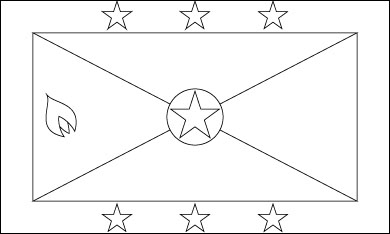
Download Picture of Blank Grenada Flag For Kids to Color
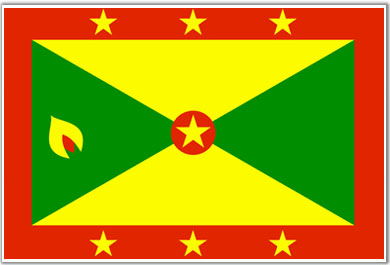
Grenada Flag Description
The flag of Grenada is divided diagonally into four triangles.
The top and bottom triangles are golden, and the triangles on the hoist and fly side are green. At the point where the four triangles meet in the center, a large gold star is positioned over a red circle. Centered along the hoist side is a symbol representing a nutmeg in gold and red over the green triangle. The triangles are surrounded by a red border, with three gold stars along the top and another three along the bottom.
The colors of the flag of Grenada are typical pan-African colors, reflecting the country’s ties with Africa and its African identity. The red is symbolic of the courage and vitality of the people of Grenada, and their quest for freedom. The red border represents the preservation of their unity. The gold represents the sunshine and warmth of the people and symbolizes wisdom. Green traditionally represents fertile lands. There is one star for each of the six parishes and a large star for the capital of Grenada. The nutmeg is a symbol of Grenada, as it was formerly called the Isle of Spice for its many nutmeg trees, and today it supplies about 40 percent of the world’s annual nutmeg supply.
Grenada Flag History
The flag of Grenada was designed by Anthony C. George and officially adopted on February 7, 1974, a few days after achieving independence from Britain. Prior to this, Grenada had been a British colony and had used a colonial flag, which featured the British Union Jack and an ensign of Grenada. Grenada became a British associated state in 1967 when it adopted a tricolor flag with horizontal stripes of blue, yellow, and green from top to bottom. In the center was the emblem of the nutmeg. This flag was replaced with the current flag upon independence.
| National symbol(s): | Grenada dove, Bougainvillea flower |
| National colors: | red, yellow, green |
| National anthem: | |
| Name: | “Hail Grenada” |
| Lyrics/Music: | Irva Merle BAPTISTE/Louis Arnold MASANTO |
Fact about the Grenada flag |
| Country | Grenada |
|---|---|
| Designed by | Anthony C. George |
| Adopted | February 7, 1974 |
| Revision | NA |
| Design and Colors | A rectangle is divided diagonally into two triangles of yellow (top and bottom) and green (hoist side and fly side) with a large red border around the field; there are seven yellow five-pointed stars with three centered on the top border, three centered on the bottom border and one on a red disk superimposed at the center; there is also a symbolic nutmeg pod on the hoist-side of a triangle. |
| Size Ratio | 3:5 |