Nigeria Map
 Buy Printed Map
 Buy Digital Map
 Wall Maps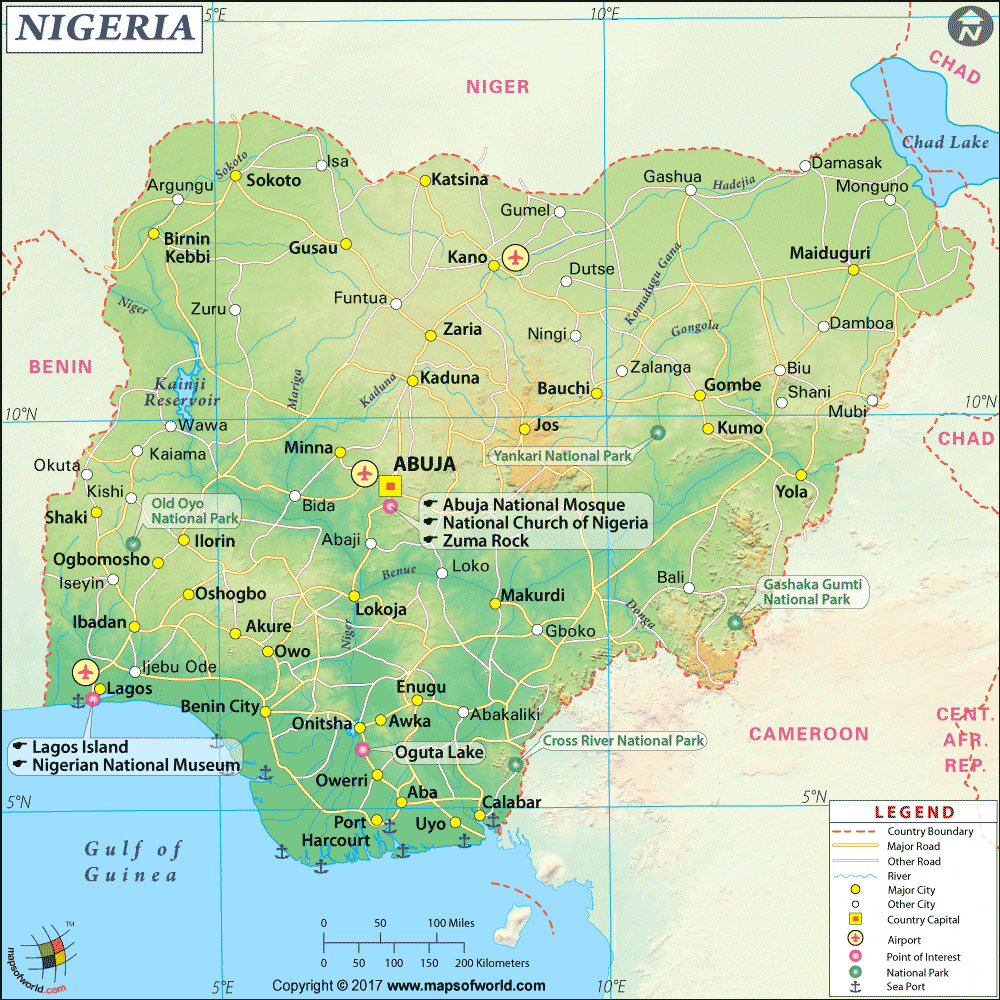
- Neighboring Countries - Niger, Cameroon, Chad, Benin
- Continent And Regions - Africa Map
- Other Nigeria Maps - Where is Nigeria, Nigeria Blank Map, Nigeria Road Map, Nigeria Rail Map, Nigeria River Map, Nigeria Cities Map, Nigeria Political Map, Nigeria Physical Map, Nigeria Flag
About Nigeria
Explore this Nigeria map to learn everything you want to know about this country. Learn about Nigeria location on the world map, official symbol, flag, geography, climate, postal/area/zip codes, time zones, etc. Check out Nigeria history, significant states, provinces/districts, & cities, most popular travel destinations and attractions, the capital city’s location, facts and trivia, and many more.
The Federation of Nigeria on the south coast of West Africa is one of Africa’s most populous nations and comprises of 250 tribal groups.
Economy of Nigeria
The oil-rich Nigerian economy, long caught in political instability, corruption, and poor macroeconomic management, is undergoing substantial reform under the new civilian administration.
Nigeria has seen seven coups in 32 years, during which the military rulers had failed to diversify the economy away from over dependence on the capital-intensive oil sector, which provides 20% of GDP, 95% of foreign exchange earnings, and about 65% of budgetary revenues.
The largely subsistence agricultural sector has failed to keep up with rapid population growth, and Nigeria, once a large net exporter of food, now must import food. Nonetheless, increases in foreign oil investment and oil production had kept the economic growth at 3% in 2002.
Location of Nigeria
Nigeria is bound by Cameroon to the east, Chad to the northeast, Niger to the north, Benin to the west, and the Atlantic Ocean to the south.
Flora And Fauna of Nigeria
In the low-lying coastal regions, mangroves are found while swamp forest are found where the water is fresh. Farther inland, this vegetation gives way to tropical forest, with its many species of tropical hardwoods, including mahogany, iroko, and obeche.
The fauna of Nigeria includes elephants, buffaloes, lions, leopards, smaller animals such as antelope, monkeys, jackals, and hyenas, which are found in abundance. Hippopotamuses and crocodiles are still common in the largest rivers. Birds, including species that migrate seasonally between Africa and Europe, are also abundant in Nigeria.
Physical Map of Nigeria
The ecology of the country varies from tropical forest in the south to dry savanna in the far north, yielding a diverse mix of plant and animal life. About two-thirds of Nigeria lies in the watershed of the Niger River, which empties in to the Atlantic at the Niger Delta, and its major tributaries: the Benue in the northeast, the Kaduna in the west, the Sokoto in the northwest, and the Anambra in the southeast.
Flag of Nigeria
The flag of Nigeria has three equal vertical bands of green towards the hoist side, white in the middle and green at the bottom.
Climate of Nigeria
The climate of Nigeria is tropical in nature, which is occasionally subjected to variations, depending on the rainfall. During summers, major portion of the country comes under the influence of moisture-laden tropical maritime air. Temperatures are high throughout the year, averaging from 25° to 28°C. In the higher elevations of the Jos Plateau, temperature is at an average of 22°C. Northern Nigeria experiences greater temperature extremes than the south. Rainfall varies widely over short distances from year to year.
People of Nigeria
Nigeria is made up of three large ethnic groups – the Hausa-Fulani, Yoruba, and Igbo- who represent 70 percent of the population. Another 10 percent comprises of several other groups numbering more than 1 million members each, including the Kanuri, Tiv, and Ibibio. More than 300 smaller ethnic groups account for the remaining 20 percent of the population. However, these groups are similar in nature, thus melting all the boundaries to become a huge group. Most Nigerians speak more than one language. The country’s official language, English, is widely spoken, especially among educated people. Apart from English, 400 native Nigerian languages are also spoken, out of which some are being threatened with extinction.