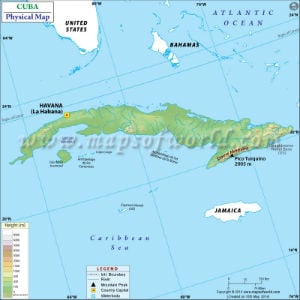
Geographical Location of Cuba
Cuba, which is the largest Caribbean island, is located between the Bahamas and Jamaica. It lies at a distance of 90 miles from Florida. The total land area of Cuba is estimated to be 110,860 km2 which is approximately equivalent to that of Pennsylvania. To the north of Cuba lies the Starlit of Florida and the North Atlantic Ocean and to its northwest is the Gulf of Mexico. The Yucatan Channel lies in the western part of the island while it is bounded by the Caribbean Sea in the south.
Topography of Cuba
The topography of Cuba is an important element of the overall Geography of Cuba. Cuba is characterized by huge mountains which cover more than one-third of the total land area. The remaining portion of the island consists of flat plain lands. There are 200 bays and 289 beaches in Cuba. Cuba is also characterized by a large number of water bodies. Most of the rivers of Cuba are shallow.
Type of Vegetation in Cuba
Many parts of the island are forested which consists of trees such as cedar, ebony, oaks, pine, mahogany, and mangroves. Mariposa is the national flower of Cuba. Begonias, Bougainvillea, and hibiscus are some of the other commonly found flowers on this island.
The geography of Cuba provides important information about this beautiful Caribbean island.
Flora and Fauna Cuba
The Flora and Fauna of Cuba are rich, vibrant, and classified into uncountable species. Flora and Fauna Cuba form a fascinating treat for the eyes.
Flora in Cuba
There are nearly 7000 species of plants, that are found in Cuba, out of which some 50% are native to the island. The flora is varied, out of which orchids assume a high position. The orchids have outstanding colors, and flawless shapes and exist in more than 300 species. The national flower of Cuba is butterfly jasmine, which is a tiny orchid with white petals. The national tree is the Royal Palm.
Other Plants of Cuba
Among the rich vegetation of Cuba, the other known varieties are:
- Cactus
- Cork’s palm
- Coconut palm
- Dinner palm
- Mango
- Guava
- Pomegranate
- Soursop
- Avocado
- Banana
Fauna in Cuba
The Fauna in Cuba is characterized by rich wildlife and plentiful birds.
Birds in Cuba
There are many native birds on this island. Some common species are:
- Cuban woodpecker
- Emerald Hummingbird
- Greater Antillean Oriole
- Belted Kingfisher
- Blackbird
Cuban Wildlife
The forests and hilly areas of Cuba are the home of diverse species of wildlife. The important ones are:
- White-tail deer
- Jutia, (a rodent). It is also known as “Banana Rat”.
- Snakes like the Boa Constrictor.
- Different kinds of fish.
The Flora and Fauna Cuba forms an exuberant and striking picture of the landscapes of Cuba. It can be said, that the Flora and Fauna of Cuba are one of the primary attractions of this Caribbean Isle.