Sudan Map
 Buy Printed Map
 Buy Digital Map
 Wall Maps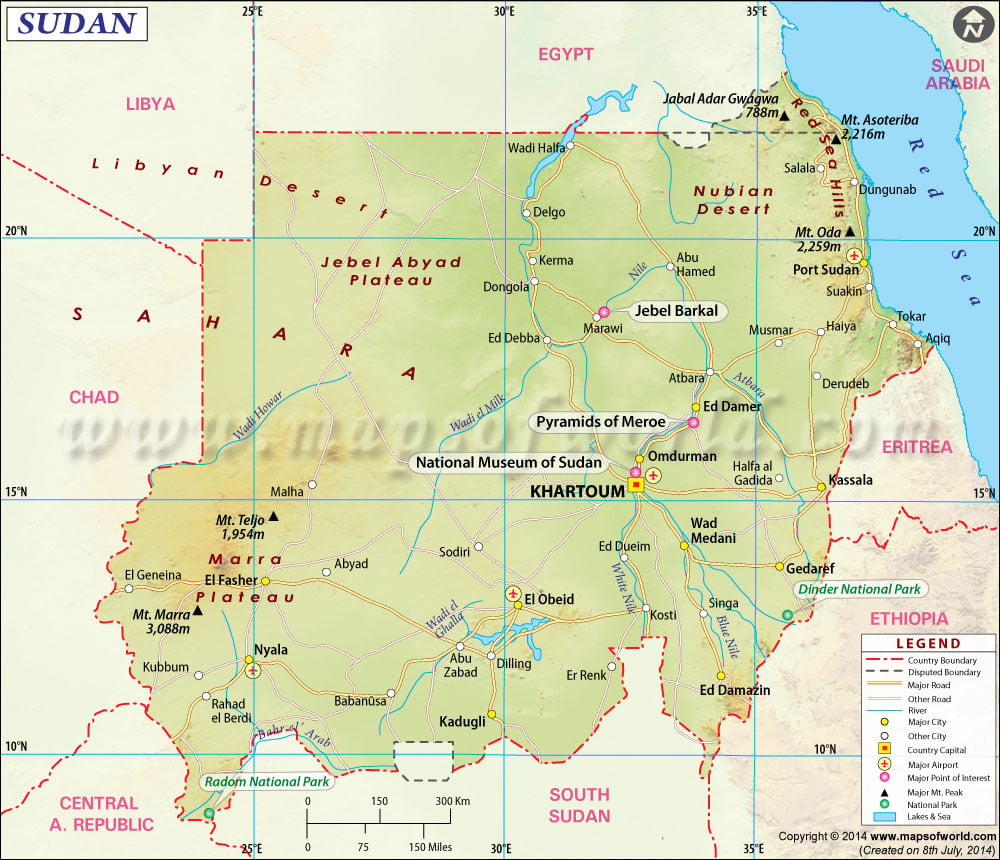
- Neighboring Countries - Chad, Libya, Egypt, Eritrea, Ethiopia, South Sudan
- Continent And Regions - Africa Map
- Other Sudan Maps - Where is Sudan, Sudan Blank Map, Sudan Road Map, Sudan Rail Map, Sudan River Map, Sudan Cities Map, Sudan Political Map, Sudan Physical Map, Sudan Flag
About Sudan
Explore this Sudan map to learn everything you want to know about this country. Learn about Sudan location on the world map, official symbol, flag, geography, climate, postal/area/zip codes, time zones, etc. Check out Sudan history, significant states, provinces/districts, & cities, most popular travel destinations and attractions, the capital city’s location, facts and trivia, and many more.
| Full name: | Republic of Sudan. |
| Capital City: | Khartoum |
| Language: | Arabic, Sundanese, Nubian, Ta Bedawie, dialects of Nilotic, Nilo-Hamitic and English. |
| Currency: | Sudanese Dinar. |
| Religion: | Sunni Muslim, animist and Christian. |
| National Anthem: | “Nahnu Djundulla Djundulwatan”. |
| Newspaper: | Sudanile, Sudan Gate, Alray Alaa’m, Al Osboa, Al Mshaheer, Akhirlahza and Akhbar-Alyoum. |
| Places to Visit: | Khartoum, Port Sudan, Meroe Sites, National Museum and Omdurman. |
| Transport: | Airways : Sudan Airways, EgyptAir, Kenya Airways, Ethiopian Airlines, Lufthansa, Gulf Air, Emirates are some of the air;ines that provide regular service; Roadways : though bus services are not available, the roads between Sudan and Egypt are open; Waterways : weekly ferries between Wadi Halfa port in Sudan’s and a port near the Aswan Dam in Egypt. Regular ferry services from Saudia Arabia between Suakin and Jeddah; Ports : Juba, Khartoum, Kusti, Malakal, Nimule, Port Sudan, Sawakin. |
| Shopping: | food, local crafts, spices, gold and silver jewelry, silver wares, basketwork, ebony carvings and assorted handicrafts. |
The country of Sudan, which is the largest country in Africa and has 26 states, broke away from British colonization by gaining independence in 1956. The word “Sudan” in the Arabic language translates as ‘Land of the Blacks’.
However, the country remains embroiled in a continual civil war between the Arab Muslims on one side and the Christians and Animists on the other.
The country is the seat of the ancient civilizations of Nubia and Meroë.
Location of Sudan
The country of Sudan is located in the northern region of the continent of Africa. In fact, it is the largest political land mass in the continent. Sudan is surrounded by several other countries on all sides.
Its immediate political neighbors are Egypt to the north; Eritrea to the east; Ethiopia to the southeast; Kenya, Uganda and Zaire to the south; the C.A.R or the Central African Republic to the southwest; Chad to the west and Libya to the northwest. The Red Sea is the only major water body that borders Sudan; it lies to the northeast of the country.
Physical Map of Sudan
Sudan has the largest land mass area in the continent of Africa. Generally, the landscape of the country is dominated by plains, either coastal or desert. The main river body tracing a path in the country is the River Nile.
The banks along the river are the most fertile regions in the country. Aside of these, there are mountains also to be found in the eastern and western regions of the country.
The highest point in the country rises to about 10,450 feet or 3,187 meters above the sea level, and is called Kinyeti. The lowest region in the country is of course the Red Sea.
Flag of Sudan
the flag of Sudan comprises of pro-African colors in a rectangular scheme. The colors that dominate the flag are red, black, white and green. The colors red, white and black (top to bottom) appear in equal horizontal stripes. The color green is contained in an isosceles triangle to the left of the flag whose base covers the entire length if the flag. The color red symbolizes in socialism; the religion of Islam is expressed through green; purity and optimism is displayed in white and black represents the people.
Climate of Sudan
The country of Sudan boasts of dual climatic conditions. The country falls in two distinct zones: the one in the north falls in the Sahara desert, while the southern region of the country, being close to the Equator, consists of a tropical habitat. So while the north is a hot dry desert, the south of Sudan is warm and humid. The country receives precipitation during the months between April and November.
Flora and Fauna of Sudan
The animal and plant life that abounds in Sudan is mainly of the desert and savannah variety. So, the flora that covers the country is the acacia types of shrubs and grasses. To the southwest of the country, where the area is tropical, broad-leaved woodlands are to be found. Along the banks of the river Nile, palm dates can be found. The names of the other kinds of vegetation that can be found all over Sudan are elephant grass, rubber, cotton, ebony, papyrus, baobab and castor-oil plants. There is an immense variety of animals in Sudan as well. Some of the most popular ones that populate the country are lions, leopards, cheetahs, elephants, hippopotamus, rhinoceros, buffalo, zebras, giraffe, antelope, various breeds of monkey and crocodiles. There are also several types of poisonous insects like mosquitoes, seroot flies and tsetse flies. Most of the animal fauna is concentrated to the south of the country that is closest to the Equator.
People of Sudan
Sudan is often referred to as “Little Africa” because of the number of African ethnicities and tribes that reside in the country. The country of Sudan comprises of a population of Africans, Arabs and Europeans. However, there is an immense diversity in ethnicity within the African tribes themselves. This occurred due to the prime location of the country which resulted in the free filtering in of people into the Sudanese territory.
Arts, Culture and Music of Sudan :
- Art : art in Sudan is mainly of the tribal kind. Making of masks, carving abstract patterns in wood, also making tribal headdresses out of wood, textile weaving, appliquéing patterns of historical events on cloth and drum making are some of the well known forms of the art in Sudan.
- Culture : the composite culture of Sudan coalesces some 600 distinct cultures, ethnicities and traditions in its folds. The country in itself has somewhere around 142 different languages and over 400 dialects. However, many of them have become obsolete due to the wars that took place between the 1980s and 1990s.
- Music : much of the musical tradition of Sudan has been subdued, probably even lost, due to the continual civil wars in the country. However, despite it all, some of it remains to be seen in the music of the Nuba tribe folk music. Traditional Sudanese music is percussion based. So, drums are an integral part of the music of Sudan. Over the years, European elements too have made contributions to the music in Sudan. As a result, today, instruments like Scottish bagpipes and guitars are used in the music of Sudan.
Economy of Sudan
the chief economic resources in the country of Sudan are its agricultural produces and crude oil. Most of the crops growing in Sudan have a commercial significance. The primary crops of the country are cotton, sesame, groundnuts, wheat, sorghum, gum Arabic, millet, tapioca, sweet potatoes, sugarcane, mangos, bananas and papaya. Most of them hold export value as they are either exported as raw materials or as processed goods. As a result many of the industries in the country have grown to support the agricultural sector. Some of them are cotton ginning, textiles, edible oils, sugar and soap distilling. The other industries that are also significant are oil, petroleum refining, cement, shoe making, pharmaceuticals, automobile assembly and parts and armaments. All these sectors together rake in revenues for the country of Sudan. Aside of them, the country has small reserves of natural resources like iron ore, tungsten, chromium ore, mica, zinc, copper, gold, silver and hydropower, from which it acquires substantial amounts of revenue.